55-year-old dual-income couple: “We’re retiring in five years, but apparently we’re 100 million won short for retirement” [Personal Finance Q&A]
- Input
- 2026-10-31 08:00:00
- Updated
- 2026-10-31 08:00:00

Q. A, 55, and their spouse, who is the same age, both work. Their older child has found a job and become independent, while their younger child is still living with them and is about to graduate from university. Although their children’s education is nearly complete, they are unsure when their younger child will find a job, and with the couple’s retirement approaching, they are increasingly concerned about their later years.
Until their 40s, they thought they would be able to get by in retirement on their pensions. But after entering their 50s, they began to worry about whether they could maintain their current standard of living after retiring. They expect to need about 5 million won a month for retirement living expenses, but also wonder about taxes on pension benefits and the effect of financial assets on health insurance premiums. They have been buying stocks with their surplus money, but with market volatility rising recently, they are unsure whether to continue investing.
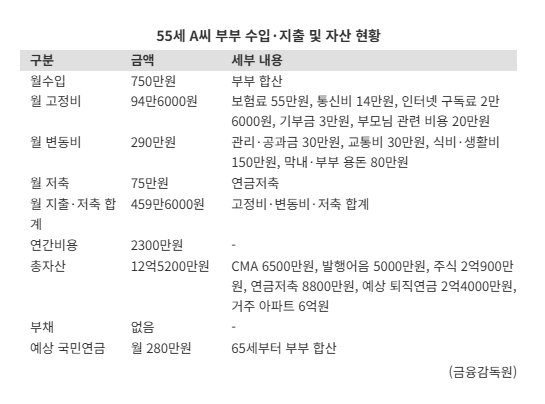
A and their spouse have a monthly income of 7.5 million won. Fixed expenses, including insurance premiums, telecommunications costs and expenses related to their parents, total 946,000 won, while variable expenses, including management fees, food and living expenses, and spending money, total 2.9 million won. They contribute 750,000 won a month to pension savings, and their irregular annual expenses amount to 23 million won.
Their assets include 65 million won in a Cash Management Account (CMA), 50 million won in issued notes, 209 million won in stocks, 88 million won in pension savings, an expected 240 million won in retirement pension benefits, and the apartment they live in, worth 600 million won at market value. Their total assets amount to 1.252 billion won, and they have no debt. Their combined National Pension benefits are expected to be 2.8 million won a month starting at age 65.
According to the Financial Supervisory Service (FSS), people in their 50s whose income has peaked, like A, should review both the funds they will need in the latter half of life and the types of assets they have accumulated. They need to divide their assets into cash, investments, pensions and personal-use assets, and allocate them according to when they will be needed and for what purpose.
Because A and their spouse have no debt and are nearing the end of their children’s education expenses, their regular living expenses may decrease after retirement. However, the liquid funds they need as lump sums may be greater than expected, including for the couple’s medical expenses, support for their parents, home repairs, vehicle and appliance replacements, their children’s weddings, and travel.
The FSS viewed the couple’s estimate of 5 million won a month as being based on their current level of consumption. According to its counseling materials, an appropriate level of living expenses for a couple in Seoul and the wider capital region is about 3.3 million won a month. Assuming their children are financially independent by the time the couple retires, their living expenses are estimated at 3.5 million won a month, with 350 million won in liquid funds needed for expenses including medical costs and their children’s wedding expenses.
Even with monthly National Pension benefits of 2.8 million won starting at age 65, they would be short 700,000 won a month for living expenses. Assuming they spend 3.5 million won a month until age 90, and taking into account their National Pension, retirement pension and pension savings, they would still have a shortfall of about 100 million won on a lump-sum basis. For the five years after retirement and before they start receiving their National Pension, they will need to cover monthly expenses of 3.5 million won from their financial assets.
Their current cash and investment assets, including their CMA, issued notes and stocks, total 324 million won. By saving the 20.84 million won they can set aside each year for five years, they can accumulate an additional 104.2 million won. The FSS recommended saving 20.84 million won a year over the next five years to make up the shortfall in retirement living expenses.
Their cash and investment assets can be used to build the 350 million won in liquid funds they will need after retirement. The analysis found that rather than pursuing excessively high returns, it would be appropriate to manage the assets with a target return 1.5–2% above inflation. Funds they will need in the short term should be kept liquid and stable, while funds that can be invested over the long term should be diversified across domestic and overseas stocks and bonds. They can also make use of the tax-exempt and separate-taxation benefits of an ISA.
Because their assets are currently divided between the couple and spread across different financial products, they are expected to be able to avoid additional burdens from comprehensive taxation on financial income or health insurance premiums for locally insured members. However, health insurance premiums may vary depending on the type of income and insurance eligibility, so they should check with the National Health Insurance Service (NHIS).
Up to 18 million won a year can be contributed to tax-qualified pension plans, including pension savings and IRPs. If they transfer their retirement pension to an IRP and then receive it as a pension, they can reduce retirement income tax by 30–50%, depending on the payout period. If they find themselves short of living expenses, they can also consider a housing pension using the apartment they live in.
An FSS official advised, “People in their 50s should plan for the latter half of life and review the pensions they will receive and the types of assets they have accumulated,” adding, “After determining when funds will be needed and in what form, they should allocate their assets with stability, returns and tax savings in mind.”
You can receive free, personalized financial counseling by entering “Fine,” the Financial Supervisory Service’s financial consumer portal, in an internet search engine, or by calling the FSS Call Center at 1332 (▶ press 7 for financial advisory services).
[email protected] Lee Jeong-hwa Reporter