Oxygen-deficient water masses completely disappear from coastlines nationwide after 157 days
- Input
- 2026-10-30 15:05:35
- Updated
- 2026-10-30 15:05:35
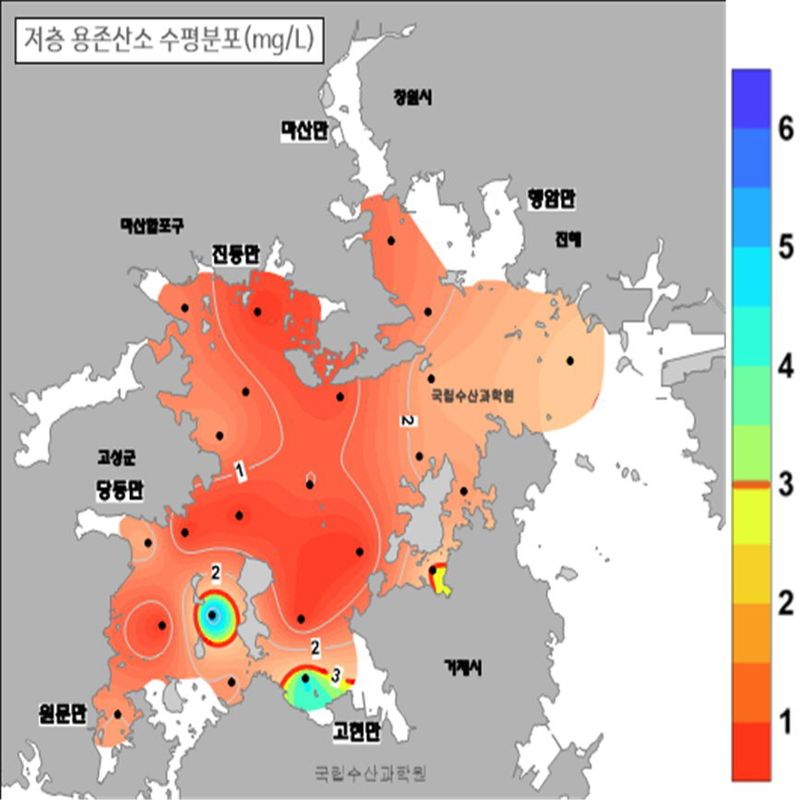
[Financial News] The National Institute of Fisheries Science (NIFS) announced on the 30th that the oxygen-deficient water mass that formed in late May had completely dissipated on the 29th, with Jinhae Bay in South Gyeongsang Province the last area affected.
An oxygen-deficient water mass is a body of water with a dissolved oxygen concentration of 3 mg/L or less. It forms mainly in enclosed bays where seawater circulation is poor. This natural phenomenon can cause significant damage to the fisheries industry, including the deaths of farmed aquatic organisms.
This year's oxygen-deficient water masses first appeared on May 26 in Jinhae Bay in South Gyeongsang Province and Gamak Bay in South Jeolla Province, then spread to the coasts of Tongyeong and Geoje in South Gyeongsang Province, Cheonsu Bay in South Chungcheong Province, and Jinju Bay in South Gyeongsang Province. By around the end of last month, they had dissipated from all waters except Jinhae Bay. Jinhae Bay was the last area where they disappeared.
This year, warmer-than-average spring temperatures led the oxygen-deficient water masses to form about two weeks earlier than last year, but their spread was less extensive. This was attributed to warm surface water extending down to the bottom starting in August and raising bottom temperatures to 26°C. Unlike in a typical year, stratification weakened, and the oxygen-deficient water masses did not spread further.
“Climate change has recently been changing the patterns in which oxygen-deficient water masses occur,” said NIFS Director Soonwook Kwon. “We will strengthen continuous monitoring of areas at risk and work to minimize damage to the fisheries industry by advancing forecasting technology,” he emphasized.[email protected] Byun Ok-hwan Reporter