Ruling Party to Decide Within 1–2 Weeks on Further Delay to Virtual Asset Taxation; Tax Subcommittee Talks in Focus
- Input
- 2026-10-30 14:59:04
- Updated
- 2026-10-30 14:59:04
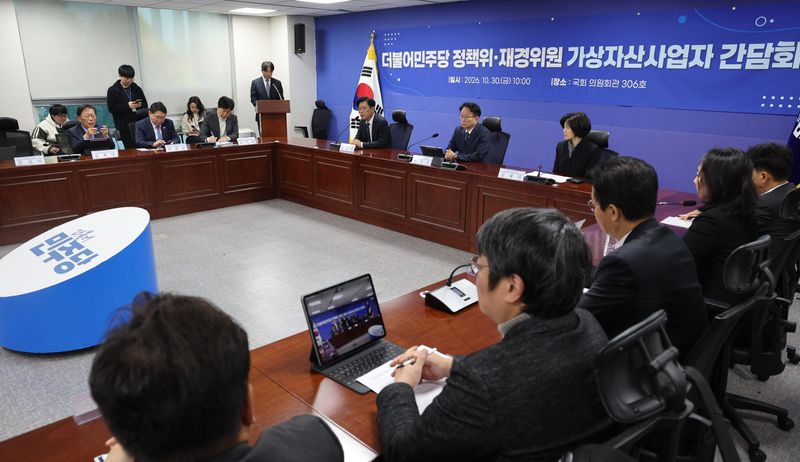
Oh Gi-hyoung, the Democratic Party’s secretary on the National Assembly of the Republic of Korea’s Finance, Economy and Planning Committee, told reporters on the 30th after a meeting with the virtual asset industry at the National Assembly of the Republic of Korea, “Ultimately, we need to decide within one to two weeks whether to defer it.”
Oh added, “The Tax Subcommittee will begin operating in November, so if we defer it, the bill will have to be handled by the end of November,” and “We need to check the issues before then and wrap everything up within one to two weeks.” The party intends to decide whether to tax virtual assets through the Tax Subcommittee’s deliberations, which will take place alongside the budget process.
The industry was reportedly said to have favored a tax deferral at the meeting that day, citing differences in market conditions between domestic and overseas virtual asset markets, among other factors.
Oh said, “The industry says there are many individual investors in Korea and almost no foreign investors,” and “In the United States, corporations manage the market and also deal in derivatives.”
He added, “We heard concerns about changes to the regulatory framework for virtual assets, an industry still in its early stages,” and said, “They asked us to defer taxation, and we’ll see whether their case is persuasive.”
In earlier remarks, Democratic Party of Korea Policy Committee Chair Kwon Chil-seung referred to the current clash over virtual asset taxation between the tax principle that “where there is income, there is tax” and the argument that “taxation should be deferred because of institutional shortcomings in the virtual asset market.”
Kwon said, “Leaving uncertainty in the market unaddressed any longer will impose a heavy cost on both the market and investors,” and “We will promptly finalize the party’s position.” He placed greater weight on the possibility that the market could be negatively affected if the only thing that continued was an unproductive debate over deferring virtual asset taxation.
In his opening remarks, Democratic Party lawmaker Cho Seung-rae, chair of the Finance, Economy and Planning Committee, said that the Ministry of Economy and Finance’s (MOEF) delay in issuing a notice on virtual asset taxation, which he had called for at the previous government-party meeting, would be realized. At a government-party meeting with MOEF on the 28th, Cho had pointed out that social discussions on whether to tax virtual assets had yet to conclude and urged the ministry to wait for the outcome of those discussions before issuing a notice, rather than issuing one outright.
The meeting was attended by Kwon, the party’s policy chief, and ruling-party members of the Finance, Economy and Planning Committee, including lawmakers Cho and Oh, the chair and secretary of the relevant standing committee. Industry representatives included Kim Jae-jin, standing vice chairman of the Digital Asset eXchange Alliance (DAXA); Kyungseok Oh, CEO of Dunamu; Kim Na-young, CEO of Streami; Kim Tae-yoon, vice president of Bithumb; Kang Min-gyu, director at Coinone; and Jin Myeong-gu, head of external policy at Digital X. Representatives of the five major virtual asset exchanges attended to relay the industry’s views to the party.
[email protected] Kim Hyeong-gu Reporter