Just as a rebound seemed in sight, another sharp plunge...KOSPI hit by fears over AI funding
- Input
- 2026-10-30 14:40:26
- Updated
- 2026-10-30 14:40:26
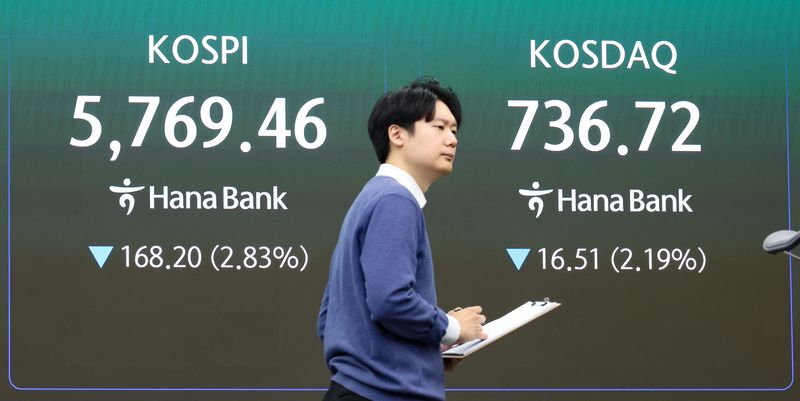
According to the Korea Exchange, as of 2:28 p.m. on the 30th, the KOSPI was trading at 5,694.43, down 243.23 points (4.10%) from the previous trading day. On the main-board market, foreign investors were net sellers of 1.3737 trillion won, while individuals and institutions were net buyers of 776.1 billion won and 367 billion won, respectively. The KOSDAQ was also down 30.08 points (3.99%) at 723.15.
SK hynix was trading at 1,418,000 won, down 7.08%, while Samsung Electronics was at 222,750 won, down 3.99%. A total of 717 stocks on the main board and 1,481 on the KOSDAQ fell, as losses spread across the market.
The immediate trigger was earnings reports from U.S. Big Tech companies. Alphabet Inc. fell short of expectations for search advertising revenue, its core source of earnings, and its free cash flow (FCF) posted a deficit of about $9.1 billion amid large-scale investment in AI infrastructure. Disappointment over slowing growth in Amazon.com, Inc.’s e-commerce business and its earnings outlook also came into focus. As AI investment spending surged, its FCF showed a deficit of about $33.5 billion.
Free cash flow is the amount left after subtracting spending on capital investment and other items from cash generated by operating activities. Even if AI and cloud businesses grow, the burden of raising external funds could increase if cash coming in from core businesses fails to keep pace with investment spending.
Joain, a researcher at Samsung Securities Co., Ltd., said investors had begun to focus less on the scale of AI investment itself and more on returns relative to investment and whether cash flow was improving.
This is fueling concern about future demand for domestic semiconductors. If worsening cash flow leads Big Tech companies to slow the pace of growth in AI capital spending, including on data centers, it could affect orders for memory chips and earnings forecasts. The concern is that worries over customers’ capacity to invest could be reflected in share prices first, even if domestic companies’ current earnings remain solid.
Weak supply and demand in the domestic market is also contributing to volatility. Investor deposits have fallen below 90 trillion won, and the KOSPI margin loan balance has dropped to 22.7 trillion won. Daily trading value on the KOSPI also dipped to around 12 trillion won at points this week. Analysts say price shocks from shifts in supply and demand could intensify because there is insufficient buying demand on standby to absorb selling.
SK hynix’s resumption of its 20 trillion won share buyback is seen as a factor that could help support supply and demand. However, how much of the market-wide selling it can absorb depends on the actual average daily purchase volume and the intensity of foreign investors’ selling. Whether concerns over Big Tech’s cash flow lead to an actual slowdown in investment and lower semiconductor earnings forecasts will also be a key factor shaping the market’s direction.
Kang Jin-hyuk, a researcher at Shinhan Investment & Securities, said, “When there is a vacuum in buying interest, prices can move sharply even with relatively small amounts of selling,” adding, “How much of the selling by foreign investors and others can be absorbed will be a key factor determining the stability of supply and demand in the domestic stock market going forward.”
[email protected] Bae Han-geul Reporter