Card spending also slows as Q3 growth in the value of approved card transactions falls from 7.6% to 3.4%
- Input
- 2026-10-30 14:45:58
- Updated
- 2026-10-30 14:45:58
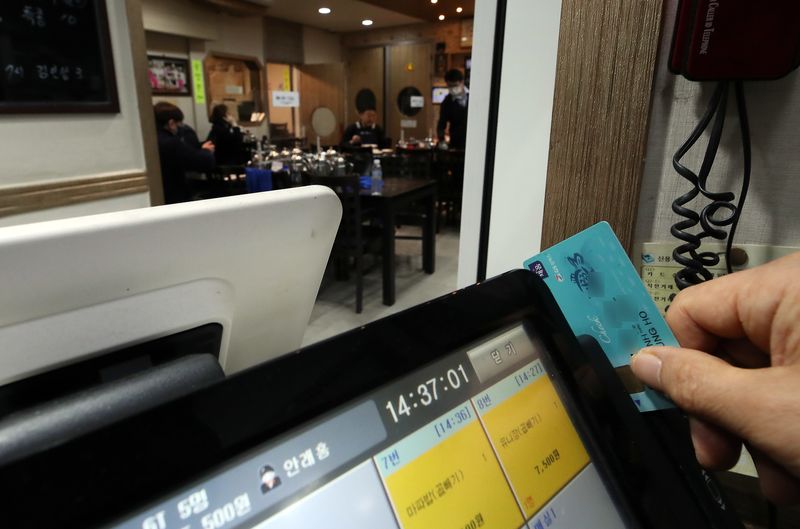
[Financial News] The value of card transactions approved in the third quarter of this year rose just 3.4% from the same period last year. That marked a sharp slowdown from the growth rate of in the 7% range recorded in the first half. Growth in the number of approvals also fell to the 1% range, suggesting the recovery in consumer spending has stalled.
The Credit Finance Research Institute reported on the 30th that the total value of card transactions approved in the third quarter of this year was 338.9 trillion won, up 3.4% year on year. The growth rate rose from 6.7% in the third quarter and 4.9% in the fourth quarter of last year to 7.2% in the first quarter and 7.6% in the second quarter of this year, before falling to 3.4% in the third quarter.
Growth in the number of card approvals also slowed. A total of 7.94 billion card transactions were approved in the third quarter, up 1.3% year on year. That was 4.7 percentage points lower than the 6.0% growth rate in the second quarter.
Growth slowed for both personal and corporate cards. The value of personal card transactions approved in the third quarter was 275.5 trillion won, up 3.7% year on year, while the number of approvals rose just 1.5% to 7.53 billion. The value of corporate card transactions approved increased 2.3% to 63.6 trillion won, but the number of approvals fell 0.9% to 410 million.
Weak consumer sentiment and the burden of high prices are thought to have constrained the growth in card spending. The Bank of Korea’s Consumer Sentiment Index fell from an average of 110.6 in the third quarter of last year to 106.8 in July, 104.5 in August and 106.6 in September this year. Consumer price inflation stood at 2.8% in July, 3.1% in August and 2.9% in September, remaining in the upper 2% to lower 3% range.
However, spending did not weaken across all sectors. Online shopping and department stores continued to grow, while large discount stores and the restaurant industry remained sluggish, showing divergent trends across spending channels and industries.
Online shopping transactions totaled 49.319 trillion won in July and August this year, up 7.3% year on year. Transactions in food and beverages rose 8.9%, while those for food services increased 8.2%. Department store sales also grew 8.0%. By contrast, sales at large discount stores fell 4.4%, leaving performance mixed even among offline retailers.
Tourism-related spending remained relatively resilient. Foreign tourist spending in the third quarter surged 48.8% year on year to 5.809 trillion won. Spending by domestic tourists also rose 6.6%. Helped by stronger tourism demand, including a 9.3% increase in international air passengers, the value of card transactions approved in the transportation industry rose 7.8%.
By contrast, the value of card transactions approved in the lodging and restaurant industries fell 0.6% year on year. The production index for the lodging industry rose 7.5%, but the index for restaurants and bars edged up just 0.1%. Some durable-goods spending was also weak, with domestic car sales down 17.9%.
The Credit Finance Research Institute said, “Positive factors such as growth in gross domestic income (GDI) and strong performance by domestic companies continued. However, a combination of factors—including the base effect of consumer coupons distributed in the same period last year, fewer business days due to an increase in public holidays, pressure from prices and interest rates, and weak sales of some durable goods such as automobiles—moderated the growth in card approval figures compared with the first half.”
[email protected] Hong Yeji Reporter