Jeju births down 62.5% in 30 years... Rebound also falls short of the national increase
- Input
- 2026-10-30 14:29:45
- Updated
- 2026-10-30 14:29:45
【Financial News, Jeju = Jeong Yong-bok】 The number of births in Jeju Province has fallen 62.5% in 30 years, and last year’s increase was also below the national average. Marriages rose for the second consecutive year, but the increase was smaller than nationwide, while the ages at marriage and childbirth have risen by 5–6 years compared with 30 years ago.
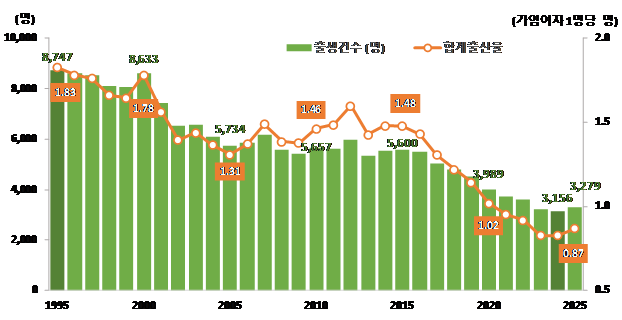
According to “Changes in Marriage and Births in Jeju over the Past 31 Years,” released on the 30th by the Jeju Office of the National Data Agency, the number of births in Jeju last year was 3,279, down 5,468 (62.5%) from 8,747 in 1995. As the number of births has declined nationwide, Jeju, too, continues to experience a long-term pattern of low birthrates.
Signs of a rebound have emerged recently. The number of births in Jeju fell from 3,222 in 2023 to 3,156 in 2024, then rose by 123 (3.9%) to 3,279 last year.
However, the trend differs from the nationwide recovery. Last year, the number of births nationwide was 254,341, up 6.7% from the previous year. Jeju’s growth rate was 2.8 percentage points below the national rate.
The total fertility rate, which represents the average number of children a woman is expected to have over her lifetime, has also fallen significantly. Jeju’s total fertility rate declined by 0.96 (52.4%), from 1.83 in 1995 to 0.87 last year. It rose by 0.04 from 0.83 the previous year, putting it above the national average of 0.80.
Differences also emerged among areas within Jeju. The number of births in Jeju City fell 39.4%, from 4,249 in 2010 to 2,573 last year. Over the same period, births in Seogwipo City fell 49.9%, from 1,408 to 706.
Seogwipo City’s decline was 4.0 percentage points greater than the nationwide decline of 45.9% over the same period. Jeju Province’s overall decline was 42.0%, lower than the national figure, but differences in population trends among areas were pronounced.
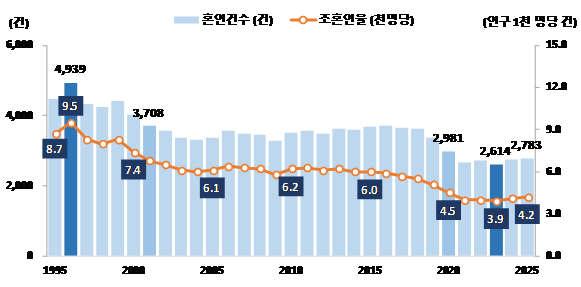
Marriages, too, have not escaped the long-term downward trend. The number of marriages in Jeju peaked at 4,939 in 1996 and then declined, reaching 2,614 in 2023. It rose for the second consecutive year afterward, to 2,744 in 2024 and 2,783 last year.
Last year’s growth rate was 1.4%, 6.7 percentage points below the national rate of 8.1%. Compared with 4,471 marriages in 1995, the current number is 37.8% lower.
The crude marriage rate, which measures the number of marriages per 1,000 people, also fell from 8.7 in 1995 to 4.2 last year. This was below the national average of 4.7.
The timing of marriage has shifted from people’s 20s to their 30s. The average age at first marriage for men in Jeju rose by 5.9 years, from 28.2 in 1995 to 34.0 last year. For women, it increased by 6.1 years, from 25.6 to 31.7.
The age at childbirth has also risen. Over the same period, the average age of mothers at childbirth increased by 5.3 years, from 28.3 to 33.6. The share of all births to mothers aged 35 or older rose by 29.9 percentage points, from 6.3% to 36.2%.
The age group with the highest fertility rate has also changed. Until 2005, it was concentrated among women in their late 20s, but from 2006 it shifted to women in their early 30s. Since 2019, fertility rates have been highest among women in their early 30s, followed by those in their late 30s and late 20s.
Changes were also seen in the composition of births. Last year, firstborns accounted for 54.6% of births, up 8.3 percentage points from 46.2% in 1995. By contrast, second births accounted for 35.3% and third or subsequent births for 10.1%, down 3.2 and 5.2 percentage points, respectively.
The higher share of firstborns was not due to an increase in the number of births. Over the same period, the number of first births fell 55.7%, from 4,040 to 1,788. However, second births fell 65.6% and third or subsequent births fell 75.2%, so their declines were relatively larger.
The time taken to have a child has also increased. The share of children born less than two years after the start of a marriage fell from 44.1% in 1995 to 36.7% last year. By contrast, the share of children born after five or more years of marriage rose from 20.4% to 28.5%.
This statistical analysis examined marriage and birth registration data for the 31 years from 1995 to 2025. Marriages were counted based on the husband’s address, and births based on the address of the child born.
Although marriages and births have recently been increasing, the changes in population structure that have taken shape over the past 30 years remain pronounced. In particular, with the ages at marriage and childbirth rising and second and subsequent births declining relatively more sharply, whether the recent rebound can lead to a long-term recovery remains a key challenge for Jeju’s population policy.
[email protected] Jeong Yong-bok Reporter