KOSPI pares losses after plunging more than 5% intraday; AI investment concerns persist [fn afternoon market]
- Input
- 2026-10-30 13:57:28
- Updated
- 2026-10-30 13:57:28
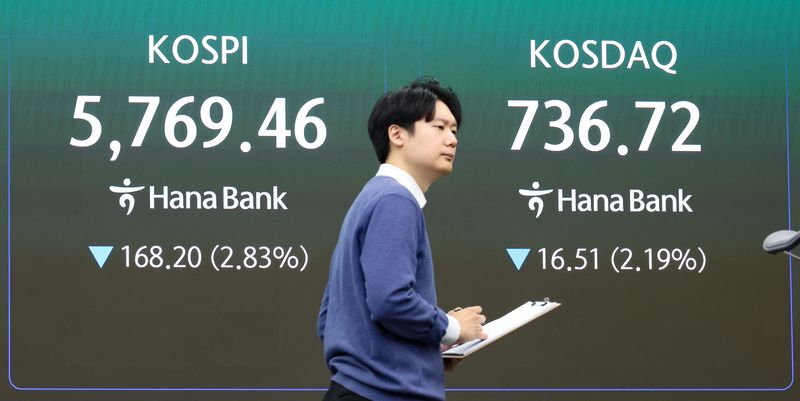
[Financial News] Concerns over the profitability of U.S. Big Tech companies’ artificial intelligence (AI) investments slammed domestic stocks, triggering extreme volatility, including a sell-sidecar early in the session. In the afternoon, however, bargain hunting by retail investors helped the market recoup some of its losses.
However, foreign selling continued, and large-cap semiconductor stocks remained weak, leaving investor sentiment across the market subdued.
According to the Korea Exchange (KRX), as of 1:48 p.m. on the 30th, the KOSPI Composite Index stood at 5,762.84, down 174.82 points (2.94%) from the previous trading day. At one point intraday, the index slid to the 5,599 level, with losses reaching 5.7%.
At 10:04 a.m., the KOSPI 200 futures index fell by 5% or more, triggering a sell-sidecar that temporarily halted program sell orders. It was the first KOSPI sell-sidecar activation in 11 trading days; the previous one was on October 15.
The KOSDAQ (Korea Securities Dealers Automated Quotations) also fell to 727.80 as of 1:48 p.m., down 25.43 points (3.38%) from the previous trading day. Foreign and institutional investors’ joint selling early in the session deepened the decline, but losses narrowed in the afternoon, particularly on the KOSPI.
The day’s sharp drop began with doubts about the sustainability of AI investment that emerged in U.S. markets overnight. Alphabet Inc. reported third-quarter revenue that fell short of market expectations, and its free cash flow (FCF) turned negative as it expanded investment in AI infrastructure, heightening investor concerns. Amazon also came under scrutiny over the burden of AI infrastructure investment and slowing growth in its existing e-commerce business.
The earnings reports fueled questions about whether Big Tech companies have enough cash-generating capacity to sustain massive capital investment in AI. Overnight, the U.S. Nasdaq index fell 1.38%, while the Philadelphia Semiconductor Index (SOX) dropped 1.42%. Investor sentiment toward technology stocks broadly weakened, with Alphabet Inc. shares plunging 12.64%.
Large-cap semiconductor stocks also led the decline in domestic markets. As of 1:48 p.m., Samsung Electronics traded at 226,500 won, down 2.37%, while SK hynix traded at 445,000 won, down 2.63%.
Samsung Electronics preferred shares fell 3.70%, and SK Square dropped 4.20%. Selling pressure continued across leading stocks by market capitalization, with Hanwha Aerospace also falling 10%.
Foreign investors were notably net sellers. As of 1:48 p.m., they had net sold 1.3719 trillion won on the KOSPI market. Retail investors were net buyers of 959 billion won, and institutions also recorded net purchases of 220.6 billion won. On the KOSDAQ, retail investors net bought 188.6 billion won, while foreign and institutional investors net sold 79.3 billion won and 106.1 billion won, respectively.
Joain, a researcher at Samsung Securities Co., Ltd., said the market decline was driven by the fact that “investors have begun focusing less on the scale of AI investment itself and more on returns relative to investment and whether cash flow is improving.” The explanation was that if cash generated by Big Tech’s existing businesses fails to keep pace with the growth in AI capital investment, the pace of investment could slow, weighing on the medium- to long-term demand outlook for domestic semiconductor companies.
An analysis also suggested the sharp correction had not undermined the market’s medium- to long-term investment appeal. “The recent sharp correction has eased valuation pressures in the domestic stock market to a considerable extent,” Jo said. “A strategy of gradually seeking investment opportunities in sectors and stocks with solid fundamentals appears appropriate.”
The market’s future direction is expected to depend on whether doubts about AI investment remain a temporary drag on investor sentiment or lead to actual changes in Big Tech’s investment plans and downward revisions to domestic semiconductor companies’ earnings outlooks. In the short term, volatility in domestic markets is likely to continue, depending on foreign investor flows and the performance of U.S. technology stocks.
[email protected] Kang Jung-mo Reporter