[Yoon Jae-joon's World View] U.S. Democrats lead in the polls ... Why can't they celebrate ahead of the midterms?
- Input
- 2026-11-02 05:00:00
- Updated
- 2026-11-02 05:00:00
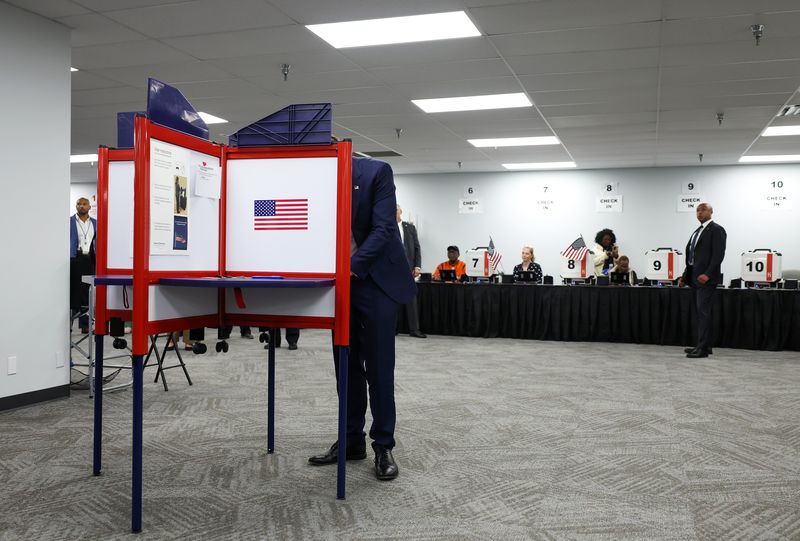
[Financial News] Ahead of the U.S. midterm elections, which will be held on the 3rd (local time), the prevailing view in Washington is that Democrats will win majority status in both the House and the Senate. President Donald Trump's approval rating is at the lowest level among presidents who have faced midterm elections during their terms, comparable to that of former President George W. Bush in 2006, when he was struggling with the Iraq War. Public backlash against the protracted war in Iran, along with anxiety over rising gas prices and inflation, has added to the picture. The historical midterm-election curse also bolsters Democrats' chances of winning.
Yet even with these favorable factors, Democrats are not exactly looking cheerful. Public opinion of the party and its brand image among Americans are also unfavorable. Within the party, quiet concerns are surfacing that excessive expectations could obscure political reality. Some warn that the anticipated Democratic surge—the “blue wave”—could turn out to be no more than a “ripple in a teacup” when the votes are counted.
Molly Murphy, who handled polling for former President Joe Biden's campaign, said, “I'm concerned that expectations have become overheated,” and observed, “People think a big wave will sweep everything away, but in modern elections, where redistricting and other factors have reduced the number of genuinely competitive races, it is difficult to win by the kind of landslide seen in the past.”■ Cracks in the anti-Trump alliance ... Deep-rooted identity confusionPolling averages show that public evaluations of the Republican and Democratic parties are roughly even, while Democrats continue to post a high net unfavorable rating. Political analysts say that if Republicans perform well in this election, the main reason will be public resentment toward Democrats, not that Republicans themselves did well.
During the 2018 midterm elections, Democratic Party members were strongly united under the banner of “holding Trump accountable.” This time, however, serious factional infighting is apparent beneath the surface of unity.
Ruy Teixeira, a senior fellow at the American Enterprise Institute (AEI), said, “The Democratic Party's identity is now very unclear, and internally it is divided into numerous factions.”
The conflict within the Democratic Party has now moved beyond a simple clash between moderates and progressives, escalating into a struggle for control between those seeking to preserve the existing establishment and those pushing for fundamental system reform. The progressive group Justice Democrats, a key force behind the emergence of “The Squad”—a hardline progressive faction in the House that includes Alexandria Ocasio-Cortez, known as AOC, and Ilhan Omar—advocates free health care and child care funded by cuts to the defense budget and the redistribution of wealth. The party establishment, by contrast, has ruled out a wholesale shift to a government-led health care system. Divisions are especially stark over Israel and Palestine. In Michigan's Democratic primary, in a battleground state with a large Arab-American population, a candidate who had criticized Israel's military operations won. The result provoked a backlash among Jewish voters within the party and escalated into a controversy over antisemitism.■ Democrats face low favorability and allegations of poll riggingDespite their lead in the polls, Democrats face clear structural limits on turning it into actual votes. To take control of the Senate, they must flip Republican seats, but the key battlegrounds are concentrated in “red states”—Republican strongholds that gave former President Trump large margins in the 2024 presidential election.
Doubts about polling accuracy are another source of concern for Democrats. Historically, polls have tended to underestimate Republicans' actual strength, particularly in more conservative states. If this trend continues, Democrats' strong showings in Alaska, Texas and Ohio could be an illusion. Another obstacle is voters' low opinion of the Democratic Party itself. According to a recent poll by The New York Times (NYT) and Siena College, only 28% of voters said they were satisfied with the Democratic Party, a figure below the approval ratings for the Republican Party and former President Trump's job performance.
The discovery that some polling firms had manipulated data showing Democrats in the lead dealt a blow to confidence in polling overall and added to the confusion over the actual state of the races. Just two weeks before the U.S. midterm elections, a poll claiming that the Mississippi Senate race in a Republican stronghold had become a toss-up was found to be fabricated, causing a major stir. The revelation sent shockwaves through Washington because major election-forecasting sites and news organizations had been duped by the fake results.
The polling firm at the center of the controversy, Wedgewood Polling, had repeatedly released fabricated data claiming that Democratic candidates were leading or closing the gap in key battlegrounds, including Republican strongholds such as Mississippi, as well as Texas, Michigan, Georgia, Maine, Ohio and Kansas. Wedgewood's manipulation came to light when analysts at the polling aggregator FiftyPlusOne tried to reproduce the Mississippi poll's results and found serious numerical discrepancies. Silver Bullet, led by prominent polling analyst Nate Silver, along with major news organizations and aggregators such as The New York Times (NYT), promptly removed Wedgewood's data from their forecasting models and aggregation. NYT said it was withdrawing all 15 Wedgewood poll results it had included since June, stating, “Although we conducted an initial vetting process, we were misled about how respondents were selected and how the weighting was calculated.”
Larry Sabato, director of the University of Virginia's Center for Politics, criticized the firm, saying, “At a time when the polling industry is already facing a serious crisis of confidence, this kind of irresponsible ‘experiment’ has further undermined trust in polling.”■ The Republican Party's formidable financial resourcesDemocratic strategist Howard Wolfson said, “If this wave amounts to just a small ripple, there would be two reasons: one would be major polling errors, and the other would be that Democrats lacked the money to make the races sufficiently competitive.”
The Republican Party, with its formidable financial resources, is outspending Democrats by a wide margin on advertising, while massive outside funding from Super PACs (special political action committees) is being concentrated in battlegrounds.
Republicans' financial advantage is indeed formidable. According to media tracking firm AdImpact, Republicans are outspending Democrats by about $650 million (approximately 867.8 billion won) on advertising in this election. In the seven Senate races classified as battlegrounds alone, Republicans are spending at least $320 million more than Democrats. Outside funding is also substantial: Elon Musk has contributed at least $276 million to encourage Republican voters to vote.
Experts are already warning that even if Democrats gain seats, they will be saddled with a time bomb of internal divisions as they work to pass legislation in Congress and prepare for the next presidential election. A victory gained through backlash against the Trump administration would be only a stopgap; unless Democrats prove their own identity and vision, they are likely to struggle to maintain the initiative in national politics.
[email protected] Yoon Jae-joon Reporter