ROK and U.S. defense chiefs reaffirm defense cooperation as KF-21 conducts first joint formation flight, demonstrating interoperability
- Input
- 2026-10-30 13:31:07
- Updated
- 2026-10-30 13:31:07
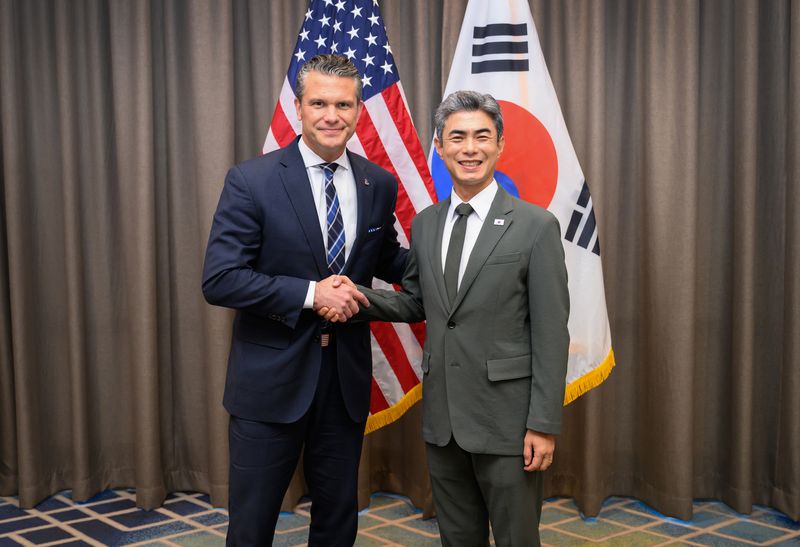
According to military authorities on the 30th, Defense Minister Kang Shin-cheol, who reported to the Ministry of National Defense headquarters that day after completing his schedule at the ASEAN Defence Ministers’ Meeting-Plus (ADMM-Plus) in Cebu, Philippines, drew a clear line in response to recent concerns raised at home and abroad.
Minister Kang emphasized the strength of the ROK-U.S. Alliance as he described his first face-to-face meeting with Pete Hegseth, the U.S. Secretary of Defense (Secretary of War), in the Philippines on the 28th. He added that the U.S. side also fully shared confidence in the alliance, saying it believes the strength of the ROK-U.S. Alliance cannot—and should not—be shaken.
The ROK-U.S. defense ministers’ meeting reportedly lasted 40 minutes, longer than originally scheduled, and was conducted with simultaneous interpretation. The two countries agreed to hold another defense ministers’ meeting in Washington, D.C., this December. The ROK-U.S. Security Consultative Meeting (SCM), usually held in early November, is reportedly expected to take place next year, depending on schedule coordination. Deputy Commander Kang dismissed the possibility of differences between the two countries, saying, “There were no differences.” On the proposal to complete verification of the Full Operational Capability (FOC) of the Future Combined Forces Command at the SCM early next year—the second stage of the assessment for the transfer of wartime operational control (OPCON)—he said, “The biggest achievement is that we agreed to align our views on the transfer of wartime OPCON.” He also said that the ongoing partial restrictions on information-sharing between South Korea and the U.S. regarding North Korea were “a very small part militarily, so we don’t have major concerns about them.”
The SCM was established in 1968, when the security crisis intensified amid a series of North Korean provocations, including the armed infiltrators’ incursion into the Blue House (the Jan. 21 Incident) and North Korea’s seizure of the U.S. Navy’s USS Pueblo. At the time, South Korea took a hard line toward North Korea, while the U.S. focused on securing the release of the hostages. As the need to reconcile the two countries’ differing views grew, the SCM emerged as the highest-level channel for regular meetings between the two defense ministers to coordinate military and security issues and prevent a rift in the ROK-U.S. Alliance. This is the third time in the SCM’s history that a meeting has been postponed into the following year, after 1980, in the aftermath of the new military regime, and 1998, during the U.S.-Iraq war. The 1980 meeting was effectively canceled, while the 1998 meeting was held two months later, in January 1999.
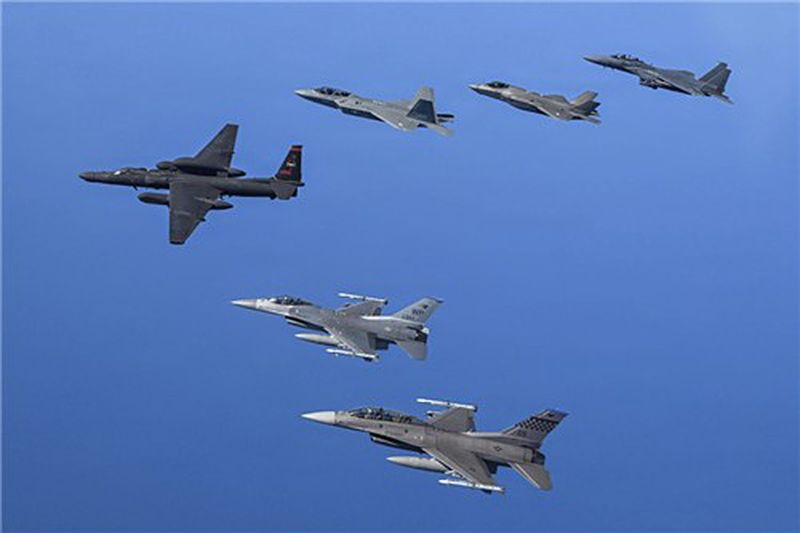
Meanwhile, in the skies, the KF-21, the culmination of advanced domestic defense technology, conducted its first formation flight with elite U.S. Air Force assets. On the 23rd, ahead of the start of Freedom Flag, a large-scale ROK-U.S. joint air exercise, KF-21 fighters assigned to the 156th Fighter Squadron under the 16th Fighter Wing successfully completed their first formation flight with U.S. Air Force aircraft over the West Sea.
The tactical flight involved South Korean Air Force aircraft, including the KF-21, F-35, F-15K and FA-50. The U.S. Air Force took part with a U-2 high-altitude strategic reconnaissance aircraft assigned to the 5th Reconnaissance Squadron, along with its main stealth fighters, the F-35 and F-16, showcasing a multilayered aerial formation. This was the first time the KF-21 had flown alongside the U.S. Air Force’s high-altitude reconnaissance and key strike assets.
An Air Force official explained, “Although the KF-21 is not an official participant in this Freedom Flag exercise, the formation flight was conducted to build experience in joint exercises and, ahead of its future operational deployment, to observe and verify the tactical integration of South Korean and U.S. weapons systems.”
The KF-21, whose development began in 2015 and was completed this June, is a key asset that will replace the South Korean military’s aging F-4 and F-5 fighters. The first production aircraft was delivered to Yecheon Air Base in September, and phased introduction into service is underway. Full operational deployment is expected in the middle to latter half of next year. The Air Force plans to introduce at least 100 KF-21s in phases by the early 2030s and operate them as its main fighter aircraft.
[email protected] Lee Jong-yoon Reporter