“Earnings are strong, they say—keep holding on longer?” Retail investors cry out as Samsung Electronics and SK hynix swing around 10% in a day [Why the stock market?]
- Input
- 2026-10-31 06:10:00
- Updated
- 2026-10-31 06:10:00
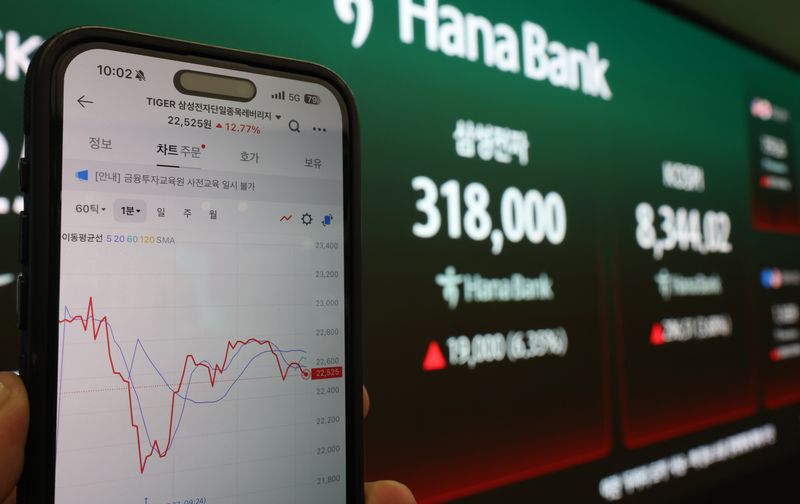
[Financial News] Despite record earnings, share prices are falling, then surging around 10% in a day before sliding again the next. The wild swings in Samsung Electronics and SK hynix shares are deepening investors’ concerns. Investors are caught between holding on in confidence in the companies’ earnings despite the volatility, and buying the dip while worrying about further declines.
Investor deposits and margin-trading balances, both sources of funds waiting to enter the stock market, are also shrinking. As individual investors’ buying power weakens, the market is looking beyond immediate earnings to when shareholder returns will be delivered and whether U.S. Big Tech companies can sustain their investment in artificial intelligence (AI).
Funds waiting to return to the market despite the rebound... Investor deposits and margin balances also decline
According to the Korea Exchange on the 31st, Samsung Electronics traded at 225,000 won, down 3.02% from the previous day, while SK hynix traded at 1,418,000 won, down 7.08%. Their declines from their closing prices at the end of September were 16.20% and 20.16%, respectively.What is adding to investors’ concerns is the sharp volatility during the downturn. Samsung Electronics fell 7.39% on the 13th and 9.48% on the 15th. SK hynix plunged 10.09% and 11.06% on those same days, respectively. By contrast, on the 28th, Samsung Electronics jumped 9.01% and SK hynix 10.89%. Even among the largest companies by market capitalization, share values rose or fell by around 10% in a single day.
The rebound did not last long. On the 29th, Samsung Electronics fell 4.13%, while SK hynix gained 2.62%; on the 30th, however, both stocks turned lower. Even investors who bought after seeing the rebound have had to contend with prices falling again almost immediately.
Funds waiting to enter the stock market also declined. According to the Korea Financial Investment Association, investor deposits stood at 88.2975 trillion won on the 28th, down 1.8055 trillion won from the previous day. They had fallen below 90 trillion won on the 26th and recovered on the 27th, but dropped back again just a day later.
Investor deposits fell below 100 trillion won on the 13th and had not recovered to that level by the 28th. Compared with 104.6644 trillion won at the end of September, they were down 16.3669 trillion won, or 15.64%. This means there were that much less funds on hand to put toward additional purchases when share prices fall.
The balance of loans taken out to buy stocks also declined. Margin-trading balances across the KOSPI and KOSDAQ markets totaled 29.329 trillion won on the 28th, staying below 30 trillion won for a second consecutive trading day after also falling below that level on the 27th. That was down 4.9597 trillion won, or 14.46%, from 34.2887 trillion won on the 12th.
An industry official said, “The decline in margin balances could reduce the pressure from forced selling in the future, but the fact that investor deposits are also falling suggests that individual investors’ capacity for additional purchases has weakened.” The official added, “Market conditions are still far from ample enough to absorb the sharp swings in large-cap semiconductor stocks.”
More than record earnings, timing of returns and capacity for AI investment... Long-term supply contracts offer support
The share-price volatility despite record earnings reflects a combination of expectations for shareholder returns and concerns over whether investment in artificial intelligence (AI) can be sustained. The market is looking beyond how much companies have earned to when they will return profits to shareholders and how long current demand will last.Shareholder-return policies were also what drove the divergence in Samsung Electronics and SK hynix shares on the 29th. Samsung Electronics was seen as falling short of market expectations with its plan to finalize the amount of remaining resources to be returned and specific implementation measures at the end of January next year. SK hynix, by contrast, rose after plans for additional share buybacks and substantial shareholder returns took concrete shape.
The deterioration in U.S. Big Tech companies’ cash flows added further pressure across semiconductor stocks. The concern is whether they can continue to cover the funds needed for massive investments even as AI-related revenue grows. Investors have become more cautious, seeking to assess not only semiconductor suppliers’ earnings but also their customers’ capacity to invest.
Yang Hyun-kyung, an analyst at iM Securities, said, “For U.S. Big Tech, deteriorating cash flows resulting from massive investments have become a burden despite growth in AI revenue.” She assessed, “A future rebound will depend on whether confidence in the profitability of AI investment holds, alongside the execution of shareholder returns.”
Brokerages, however, are focusing on long-term demand for the memory industry despite this near-term uncertainty. Analysts say that the expansion of long-term supply contracts with customers has made it easier to forecast future sales volumes and earnings.
Kim Young-gun, an analyst at Mirae Asset Securities, said, “More important than SK hynix’s expanded shareholder returns is that the company has offered confidence in the stability of medium- to long-term demand through 2029.” He explained, “It has signed long-term supply contracts, typically lasting five years, with 14 major customers, and if volumes currently under discussion are included, customer allocations for DRAM and high-bandwidth memory (HBM) through 2029 are effectively complete.”
The expansion of long-term supply contracts and the ability to respond flexibly with capital expenditure are also seen as factors that will support Samsung Electronics’ future earnings. Ryu Young-ho, an analyst at NH Investment & Securities, said the memory industry “is undergoing structural changes unlike those of the past,” and analyzed that “securing infrastructure first and then adjusting investment according to market conditions could limit the sharp downturn cycles seen in the past.”
[email protected] Choi Doo-seon Reporter