At the controls of an Apache, the Army sees its first female ‘Top Heligun’ and a two-time-winning veteran emerge: “Proving Army Aviation’s future security value”
- Input
- 2026-10-30 11:33:47
- Updated
- 2026-10-30 11:33:47
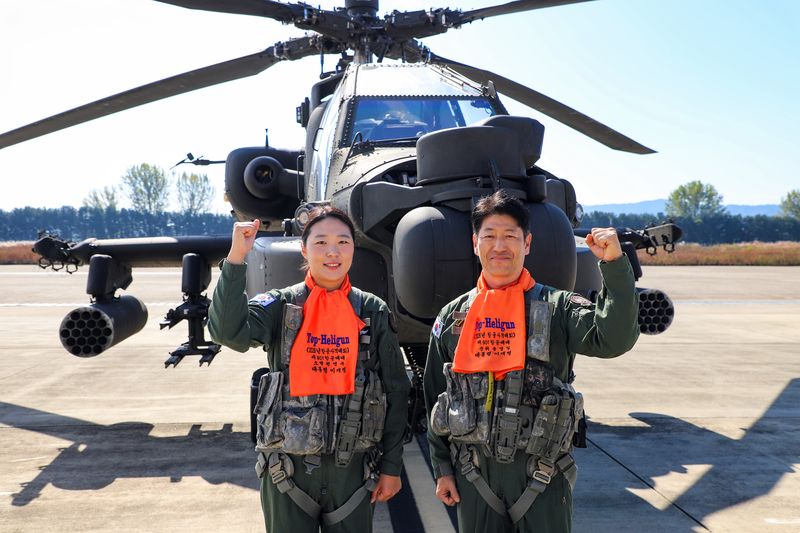
According to Army Aviation Command on the 30th, Major Pyeon Yeon-ju (Class 56, Bachelor’s Degree Course) and Warrant Officer Song Yeong-il (Rotary-Wing Class 136), Apache Guardian pilots with the 901st Aviation Battalion, achieved the highest scores at the awards ceremony for the 38th Army Aviation Shooting Competition, held at the Biseung Firing Range in Yangpyeong, Gyeonggi Province. They were selected as the 28th Top Heliguns and jointly received the prestigious Presidential Award. Since 2025, the Army has selected two pilots for each helicopter type as Top Heliguns based on their top shooting scores. The two awardees competed as pilots in command of different Apache helicopters and stood together at the top.
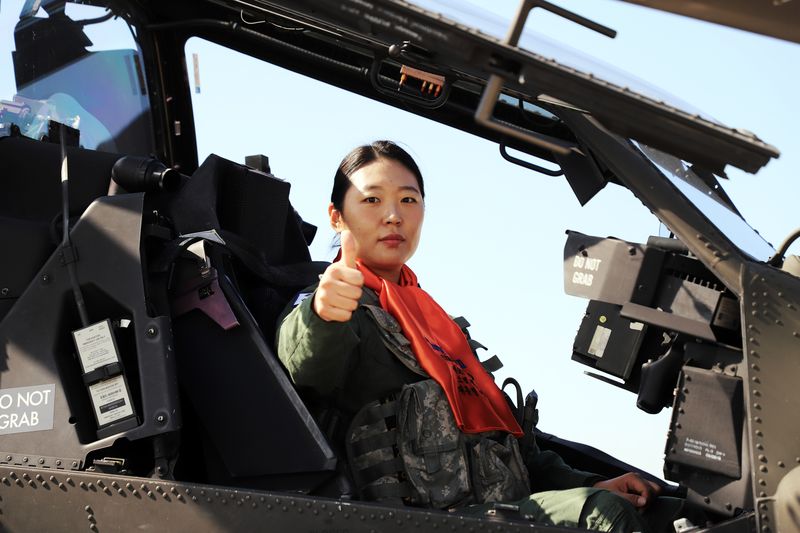
The biggest milestone of this competition was the selection of the first female Top Heligun. Major Pyeon Yeon-ju, the honoree, was commissioned in 2011 and began her service in 2013 at the controls of a Cobra (AH-1S) helicopter. After taking part in the task force to establish an Apache unit in 2015 and pursuing her ambition, she switched to the Apache in 2018, successfully completed her duties as a company commander, and now serves as an aviation operations officer with the 12th Division. Major Pyeon said, “The title of being the first woman was possible because the members of my unit, who quietly worked up a sweat out of sight, were with me.”
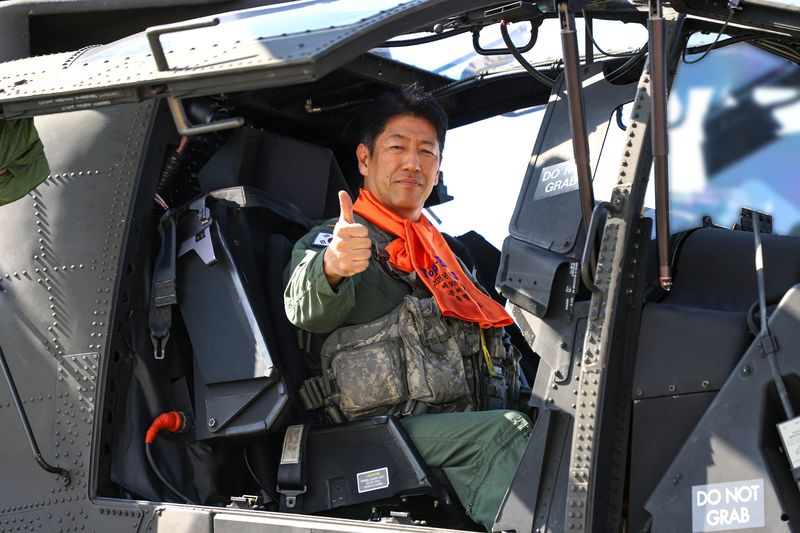
Warrant Officer Song Yeong-il, who shared the Presidential Award, is a veteran of Army Aviation. Since being commissioned in 2001, he has qualified to fly four types of helicopter: the Cobra, BO-105, 500MD and Apache. In 2015, at the 27th competition, he was selected as a Top Heligun flying the 500MD. This year, he claimed the Top Heligun title for the second time in his career, flying the Apache, setting a remarkable record of “two aircraft types, two wins.”
Some 200 elite pilots flying five types of helicopter—including the Apache Guardian, 500MD, KUH-1 Surion, Chinook (CH-47) and Sikorsky UH-60 Black Hawk—took part in the competition, which focused on assessing capabilities in ‘counter-drone operations’ and demanding ‘night firing,’ both of which have recently emerged as key factors on global battlefields. In the unit category, the 901st Aviation Battalion was named the top attack helicopter unit and received a Minister of National Defense citation, retaining its title as top unit for six consecutive years. The 60th Aviation Battalion took top honors in the maneuver helicopter category.
However powerful the Apache Guardian’s weapons systems may be, it cannot fully deliver its advanced capabilities without a skilled pilot at the controls. Flying an Apache is particularly unlike flying an ordinary helicopter. Pilots wear the advanced integrated helmet (IHADSS), which links the cannon to their line of sight. They need extraordinary concentration to fly at low altitude at night while reading thermal imaging instruments on a monocle display with the right eye and simultaneously looking ahead outside with the left.
According to an analysis by the Korea Institute for Defense Analyses (KIDA), training one ‘experienced pilot’ in South Korea at the level of an Apache pilot in command or mission commander takes an average of 8 years and 7 months (typically 8–10 years), with cumulative spending estimated at about 4.1 billion won per person. This reflects the combined costs of live-fire training with expensive Hellfire missiles, enormous hourly operating and maintenance expenses, simulator training and more. Given that, by overseas estimates, initial conversion training alone costs about 5.3 billion won to adapt an experienced foreign military pilot already qualified on another helicopter to the Apache and make them ready for combat deployment, it is clear how solid the foundation is for our military to develop its own veteran pilots.
A military official said, “Apache veteran pilots, developed through enormous taxpayer investment and years of patience, are irreplaceable national assets,” and stressed, “Improving their conditions and managing them systematically so they remain in the force and can focus solely on their missions is just as important as acquiring weapons.”
Brigadier General Park Min-sang, acting commander of Army Aviation Command, said, “All participants demonstrated teamwork and delivered excellent performances, regardless of unit or aircraft type,” and stressed that they would “continue honing their skills and fully demonstrate their capabilities as key figures in offensive maneuver warfare suited to the changing future battlefield environment.”
[email protected] Lee Jong-yoon Reporter