TMAP and LG Electronics team up to develop AI-powered road-recognition navigation technology
- Input
- 2026-10-30 09:35:06
- Updated
- 2026-10-30 09:35:06
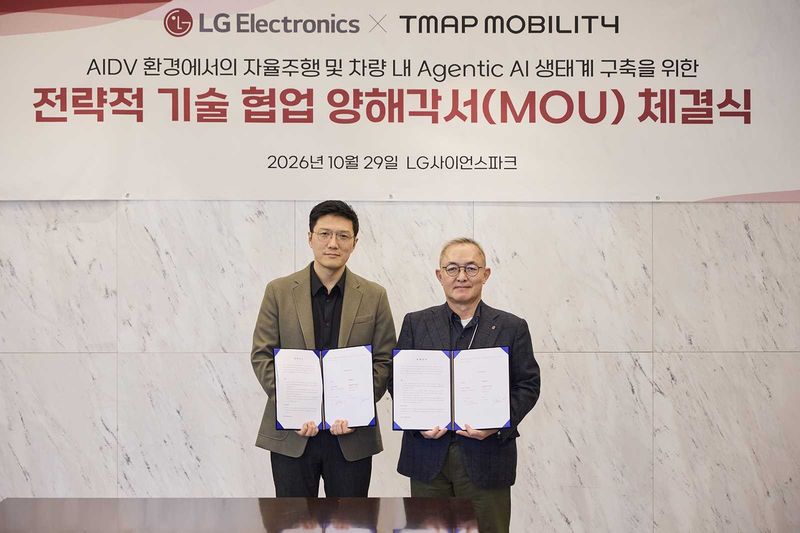
[Financial News] Tmap Mobility Co., Ltd. and LG Electronics are setting out to develop AI-Defined Vehicle (AIDV) technology that enables vehicles to understand drivers’ intentions and their surroundings and provide navigation automatically. They plan to combine in-vehicle artificial intelligence (AI) with high-precision maps and mobility data to deliver navigation suited to autonomous-driving environments and personalized services.
Using camera footage to provide directions in natural language
Tmap Mobility Co., Ltd. and LG Electronics said on the 30th that they had signed an MOU at LG Sciencepark in Magok, Seoul, to "build an ecosystem for autonomous driving and in-vehicle agentic AI in an AIDV environment." AIDV refers to vehicles that use AI to enhance driving, safety and infotainment functions and provide services tailored to drivers.The two companies will combine LG Electronics’ high-performance computing environment for vehicles and AI technologies that leverage vision-language models (VLMs), occupant monitoring systems and other technologies with Tmap Mobility Co., Ltd.’s high-precision maps, 3D navigation and point-of-interest (POI) data. They plan to use these resources to develop in-vehicle infotainment (IVI) and personalized services suited to autonomous-driving environments.
First, they will integrate Tmap Mobility Co., Ltd.’s maps and navigation into LG Electronics’ autonomous-driving simulation environment and high-performance-computing-based vehicle systems to validate the technology. In a digital twin environment modeled on real roads, they plan to assess the quality of IVI functions linked to autonomous-driving solutions and of driving guidance information.
They will also develop technology that combines forward-facing camera footage with map and POI information to provide route guidance in natural language. For example, it could give directions based on buildings or vehicles recognized by the camera, such as, “Turn right in front of the white building ahead, following the red car.”
Reflecting driver preferences and providing alerts for hazardous areas
They will also develop personalized features that reflect drivers’ driving habits and preferences. Alongside building a navigation system that uses a VLM to understand the road ahead and communicate naturally with drivers, they will enhance hazard-avoidance guidance by drawing on Tmap Mobility Co., Ltd.’s road and traffic data analysis capabilities. The system will detect icy road sections or repeated hard-braking patterns by the vehicle ahead, for example, and provide real-time alerts.The companies are also exploring new businesses beyond in-vehicle services, including content and location recommendations and insurance. By linking Tmap Mobility Co., Ltd.’s mobility and location data with data from LG Electronics’ in-vehicle content platform (ACP), they plan to recommend content and places suited to drivers’ situations and preferences, as well as pursue insurance services using video analysis technology and improvements to safe-driving score models.
The two companies plan to conduct joint tests in each field to verify whether the technologies and services they develop can be applied in actual vehicles, and to identify business opportunities with automakers in South Korea and abroad.
Jeon Chang-keun, chief operating officer (COO) of Tmap Mobility Co., Ltd., said, “In the AIDV era, maps and mobility data play a key role in helping vehicles understand drivers’ intentions and their surroundings. By combining the mobility data TMAP has accumulated with LG Electronics’ in-vehicle AI capabilities, we will strengthen our competitiveness in AIDV technology and set a new benchmark for future mobility experiences.”
[email protected] Yoon Hong-jip Reporter