LSCUS to build Korea’s largest rare-earth permanent magnet production hub in Gumi... 350 billion won investment
- Input
- 2026-10-30 09:22:18
- Updated
- 2026-10-30 09:22:18
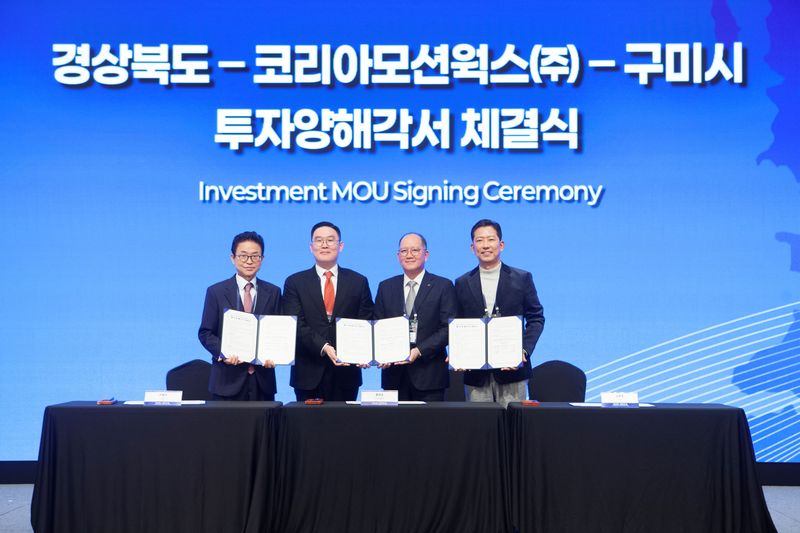
[Financial News] LSCUS plans to invest 350 billion won to build a rare-earth permanent magnet production hub in Gumi, North Gyeongsang Province. The plan is to establish a domestic production base for key materials used in robotics, electric vehicles and defense, and to create a supply chain that does not depend on China, from raw materials to finished products.
LSCUS said on the 30th that Korea Motion Works, its subsidiary for the rare-earth permanent magnet business, had signed an investment agreement (MOU) with North Gyeongsang Province and Gumi City on the 29th to build production facilities with an investment of approximately 350 billion won.
Korea Motion Works plans to begin construction in the first half of next year and start mass-producing neodymium (NdFeB) permanent magnets for robotics and electric vehicles in the second half of 2028. It will later expand its product lineup to include samarium-cobalt (SmCo) permanent magnets for defense. Annual production capacity is set to reach at least 1,000 metric tons, the largest level in South Korea, equivalent to 17% of domestic demand of approximately 6,000 metric tons. Rare-earth permanent magnets are key materials used in electric vehicle motors, robots and other applications.
The Gumi plant will serve as a key production hub in LSCUS’s non-China supply chain. LSCUS plans to link the supply of rare-earth materials from Australia’s Lynas with LS Eco Energy’s production of rare-earth metals in Vietnam and the manufacture of permanent magnets in the United States and South Korea. On this basis, it plans to target global defense, robotics and electric vehicle markets and enhance the stability of supplies of key materials for South Korea’s advanced industries.
LSCUS said it selected Gumi as the investment site in consideration of its industrial infrastructure and manufacturing capabilities, as well as North Gyeongsang Province and Gumi City’s efforts to attract investment and commitment to administrative support. With Gumi designated as a specialized complex for the national advanced strategic industry in robotics, the company also expects synergies between the permanent magnet production facility and the local robotics industry.
Hong Young-ho, CEO of Korea Motion Works, said, “The active efforts by North Gyeongsang Province and Gumi City to attract investment and their commitment to cooperation were a major help in making this investment decision,” adding, “We will develop Gumi into a rare-earth permanent magnet production hub that draws the world’s attention and grow together with the region.”
[email protected] Park Ji-yeon Reporter