Hyundai Motor Group demonstrates parking robot at Siheung apartment complex in Korea’s first pilot at a multi-family complex with at least 50 parking spaces
- Input
- 2026-10-30 09:04:38
- Updated
- 2026-10-30 09:04:38
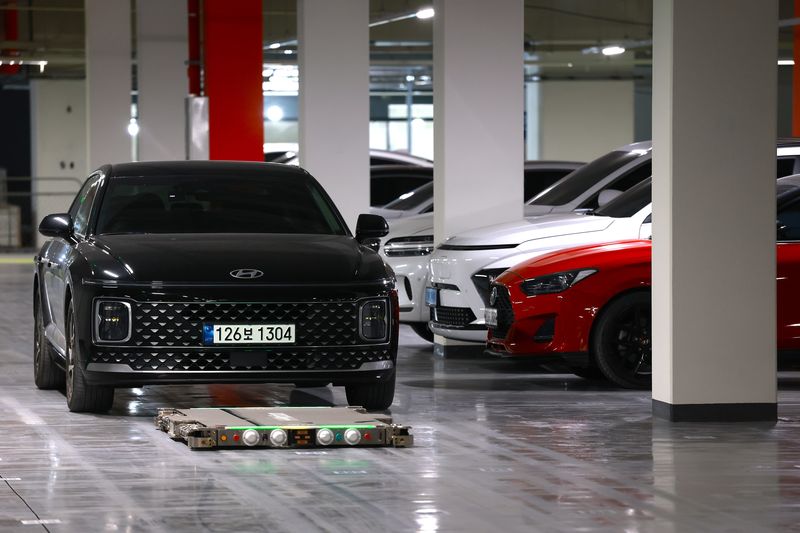
On the 30th, Hyundai Motor Group said it had held a demonstration of parking robots at Hillstate The Wave City in Siheung, Gyeonggi Province, on the 29th and shared the results of a pilot project being carried out by a consortium of Hyundai Motor Company, Hyundai WIA and Hyundai Engineering and Construction. Conducted under the Smart City Regulatory Sandbox, the project is the first in Korea to test the potential of parking robots by operating them in an actual multi-family residential complex with at least 50 parking spaces.
Officials from the Ministry of Land, Infrastructure and Transport, the Korea Agency for Infrastructure Technology Advancement, Gyeonggi Province, Suwon City, Siheung City, the Korea Land and Housing Corporation, the Korea Airports Corporation, the Korea Institute of Civil Engineering and Building Technology, and the Korea Transportation Safety Authority attended the event. They observed the parking robots operating in a multi-family residential complex and the pilot scenarios, and saw the potential to expand their use beyond such housing to transport hubs and public facilities.
Hyundai Motor Group demonstrated three scenarios reflecting situations that could arise in real-world parking environments.
The simultaneous-arrival-and-departure scenario involved arrival and departure requests being made at the same time. It showed the parking robots operating efficiently amid overlapping demand. The departure process was linked to the wall pad in each residential unit. When a resident made a request through the wall pad, a parking robot moved the vehicle to the departure area; the process took about three minutes.
In the scenario for clearing double-parked vehicles, the parking robot moved and repositioned vehicles. The company said this demonstrated the potential to reduce the space needed to move vehicles and make more efficient use of limited parking space.
The temporary vehicle retrieval scenario assumed that someone might request a vehicle but not use it, or might need it brought out briefly to retrieve something from inside. The demonstration showed the parking robot temporarily moving a vehicle and then returning it to its parking space.
For the pilot, Hyundai Motor Group built infrastructure to operate parking robots inside a multi-family residential complex and connected it to smart infrastructure, including the complex’s entrance barrier, wall pads in residential units and an AI-based vehicle inspection system. The company said it tested whether the entire process—from vehicle intake and storage to inspection and release—could be delivered as a single service.
Separately, Hyundai Motor Group upgraded its smart parking management system to version 2.0 to help parking robots navigate optimal routes and allocate vehicles. The system can currently control up to 200 parking robots simultaneously.
Drawing on experience gained through the pilot, Hyundai Motor Group will establish the technologies and operating standards needed for deployment at actual sites, and will also consider expanding use to transport hubs, commercial facilities and office buildings. It plans to explore with relevant agencies ways to improve regulations to support the stable operation and wider adoption of parking robots.
Jung Ho-geun, vice president of Hyundai Motor Company’s Future Strategy Division, said, “This pilot is meaningful because it not only confirms the potential of parking robot technology but also represents a step in applying robotics and mobility technologies in actual urban spaces.” He added, “We will turn these possibilities into reality so that parking spaces can develop into smart-city hubs connecting people, mobility, robots and urban infrastructure.”
[email protected] Kim Dong-chan Reporter