“A net worth of 1 billion won, yet a monthly deficit of 980,000 won” ... Retirement planning for the wife left behind [Money Planning Office]
- Input
- 2026-10-31 15:00:00
- Updated
- 2026-10-31 15:00:00

Moreover, if one person has handled all the money management, the surviving spouse may not even know where to draw living expenses from or how much to take out. Preparing for a spouse's retirement does not end with leaving behind assets. A structure must be put in place so the surviving spouse can secure living expenses independently and access the money when needed.
They Have a Home and Cash... So What Is the Husband Worried About?
“I worry about whether my wife will be able to live without worrying about money if I die first.”Kim Jeong-ho (pseudonym, 69) has been going to the hospital more often recently, and his concern for his wife, Park Yeong-hui (pseudonym, 67), who would be left alone, has grown. For more than 40 years of marriage, all money management—from opening bank deposits to investing and withdrawing pension benefits—has been Jeong-ho's responsibility. His wife has had almost no experience handling financial products, apart from managing their household-expenses account.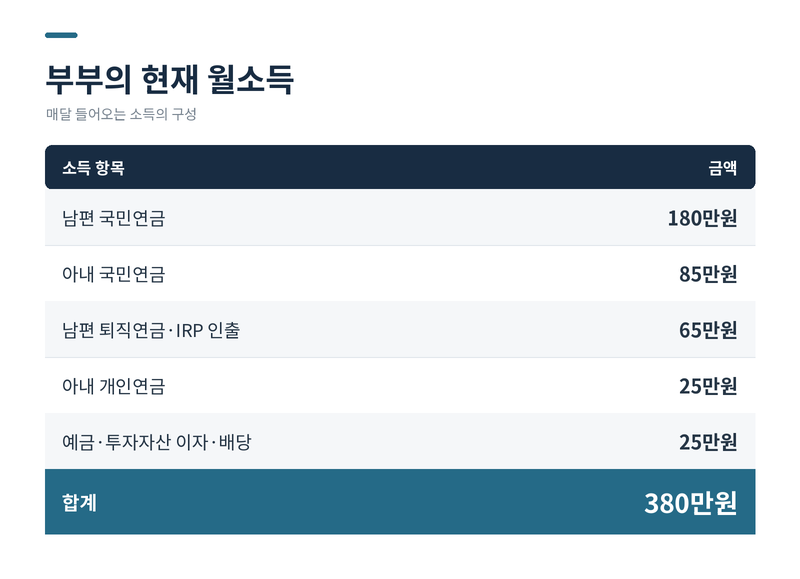
The problem will come after Jeong-ho dies first. Even if their assets remain unchanged, the income that came in every month will not necessarily remain the same.
Financial planner Cho Hyung-geun (AFPK) first calculated the wife's monthly income after her husband's death. Even if both spouses receive National Pension Service (NPS) pensions, they cannot receive the two pensions together when one spouse dies. This is because an adjustment for overlapping benefits applies when a person becomes entitled to both their own old-age pension and a survivor's pension.
For this consultation, Cho assumed that the survivor's pension after the husband's death would be 720,000 won a month. If the wife chooses her own NPS pension of 850,000 won, she would receive an additional 216,000 won—30% of the survivor's pension—for a total of 1,066,000 won a month. Adding her existing private pension of 250,000 won brings her regular income to about 1.32 million won.
Living expenses, however, do not fall by half just because someone lives alone. Maintenance fees, utility bills, and home upkeep costs continue. If the wife's target living expenses are set at 2.3 million won a month, she would be short by about 980,000 won each month. In effect, a household budget that used to have a monthly surplus of 600,000 won would turn into a deficit of 980,000 won. They need a way to fill that gap using financial assets, including the balance of the husband's retirement pension.
A “paycheck for life” with 100 million won
Cho divided the 280 million won remaining out of the couple's 300 million won in financial assets into resources for the wife's retirement, setting aside 20 million won for the husband's treatment and care.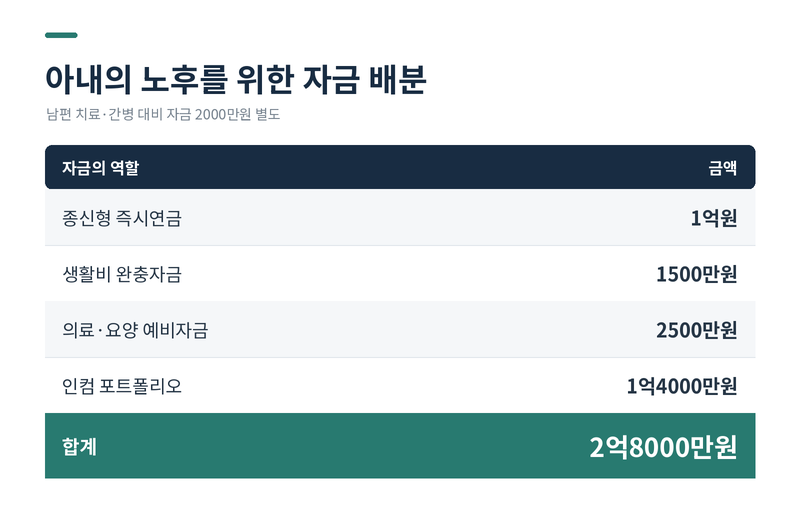
The immediate annuity would provide a steady contribution toward living expenses for as long as the wife lives. It could also reduce the burden of repeatedly having to decide which assets to sell to cover expenses. With this added, her regular income would rise to about 1.72 million won a month. The remaining shortfall against her target living expenses would be about 580,000 won.
Cho proposed filling this shortfall with an income portfolio worth 140 million won, generating annual cash flow of about 7 million won through interest and distributions.
The approach is to secure dividends mainly through high-quality bonds and bond exchange-traded funds (ETFs), while also including some covered-call ETFs. However, investment performance should not be judged just by the distributions deposited into the account. Even if distributions are received, falling asset prices could mean an overall investment loss. They should avoid a situation in which the wife's retirement nest egg shrinks as she tries to draw more money for living expenses.
Set aside a “buffer fund”
The remaining funds were also assigned specific roles. Of this, 15 million won is a buffer to cover living expenses if distributions from investments decline. Based on a monthly shortfall of about 580,000 won, it could last for around two years. It would also buy time so assets do not have to be sold in a hurry when markets are poor.A separate 25 million won was set aside for medical and long-term care expenses. Even with long-term care insurance, out-of-pocket payments and non-covered costs can arise. Rather than covering care costs for a lifetime, this is a safety net for the early stages of care.
The accounts should also be simplified so the wife can manage them. Their purposes can be divided among accounts for living expenses, investments, and medical and emergency funds. It would be good for her to get into the habit of checking balances and deposits herself, starting now. They should also decide in advance which funds to use first if distributions decline and whom to consult when reviewing the assets.
The home, which they hope to leave to their children, was kept as a last-resort resource. The plan is to cover living expenses with pensions and financial assets, then reconsider using the home if the wife lives longer than expected or care costs become too high to manage.
Cho noted that the surviving spouse's livelihood takes priority over inheritance. A plan to leave the home to the children can be honored only after the wife's living expenses are secured.
Cho stressed, “The essence of retirement planning is not ‘How much should we leave behind?’ It is to build a structure in which living expenses continue to come in even if one spouse dies first, necessary funds can be accessed if health deteriorates, and life can go on without complicated investment decisions.”
Earning, spending, and saving money are repeated throughout life, but financial planning is always pushed to the back burner. Money, however, has an age too, and it will not wait. If we do not make choices along the way, it is neglected; if we do not set a direction, it slips away. That is why we need to map the flow of money across our entire lives.[Money Planning Office]works with the Korea Financial Planner Association (IFPK), an AFPK certification body, to support life planning.
[email protected] Lee Hyun-jung, Kim Tae-il Reporter