“Even with a high salary, I wouldn’t take the job” ... Job seekers are interviewing companies, too
- Input
- 2026-10-30 09:33:17
- Updated
- 2026-10-30 09:33:17
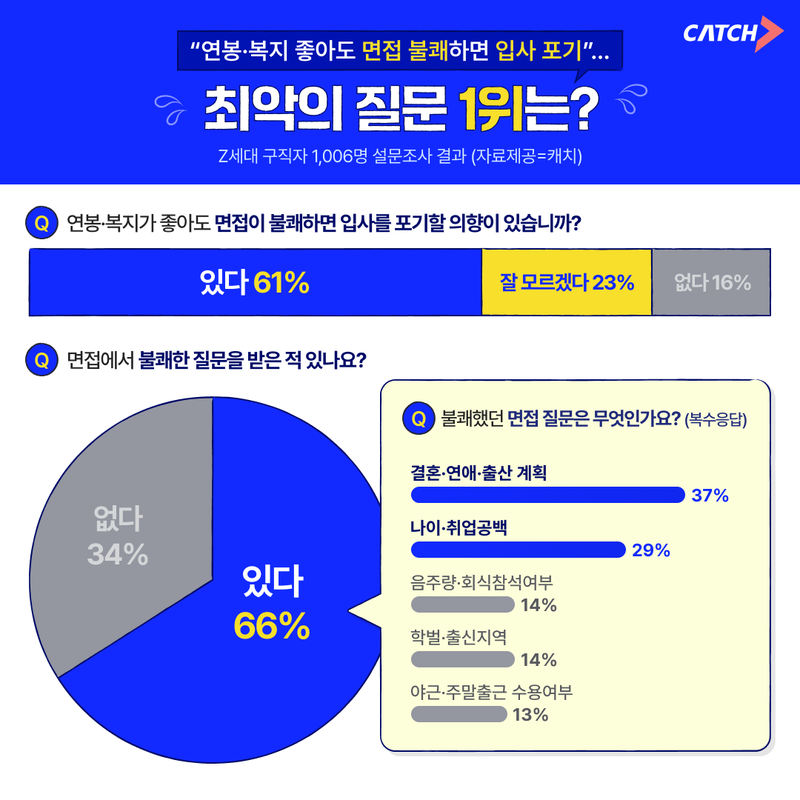
Six out of 10 job seekers said they could turn down a job at a company like that. Interviews, once a chance for companies to evaluate applicants, are now also becoming a chance for job seekers to evaluate companies. The analysis suggests that an interviewer’s words and attitude are becoming factors in securing talent, just as important as high salaries and good benefits.
A survey of 1,006 job seekers with interview experience, conducted by recruitment platform Jinhaksa Catch on the 30th, found that 61% of respondents would consider turning down a job if they had a bad interview experience, even if they liked the salary and benefits. Only 16% said they would not consider turning down the job. The remaining 23% said they were unsure.
Questions that left job seekers flustered in interviews were still common. A total of 66% of respondents said they had been asked an uncomfortable question during an interview.
The most common questions concerned personal matters with no direct bearing on job performance. Among respondents who had experienced uncomfortable questions, 37% cited questions about “marriage, dating, and plans to have children.” This was followed by age and gaps in employment (29%); alcohol consumption and participation in company dinners (14%); educational background and place of origin (14%); and willingness to work overtime or on weekends (13%). Questions about personality types such as the Myers-Briggs Type Indicator (MBTI), recently popular among young people, accounted for 10%.
Interviewers’ attitudes also had a direct impact on companies’ images. A total of 47% said their impression of a company improved after an interview, while 20% said it worsened. Another 33% said it did not change.
The factors that improved respondents’ impressions of companies were surprisingly simple. An overwhelming 78% of those whose impression improved cited “respect and attentive listening from the interviewer.” This was followed by candid explanations of the company and job (19%), sufficient information in advance (11%), and consideration during the wait and interview process (11%).
Conversely, the main factor that damaged companies’ images was interviewers’ rude behavior. As many as 60% of respondents whose impression worsened cited this. Other negative factors included inappropriate questions (32%), inadequate explanations of the company and job (15%), delays in communicating results or failure to do so (14%), and long waits or unilateral schedule changes (12%).
Interestingly, while companies ask job seekers personal questions, job seekers themselves often cannot ask the questions they most want answered.
The topic job seekers found most difficult to ask about in interviews was salary, performance bonuses, and raise rates (47%). Other information they felt uncomfortable asking about included overtime pay (22%), the workplace culture around taking annual leave (15%), employee turnover and why the previous person left (14%), and team atmosphere and management style (13%). Only 15% said there was no information they found difficult to ask about.
Kim Jeong-hyeon, a division head at Jinhaksa Catch, said, “An interview is a process in which companies evaluate applicants while applicants also decide which company to join. When companies and job seekers communicate with mutual respect and consideration, they can deepen their mutual understanding and create better hiring outcomes.”
[email protected] Jumi Lee Reporter