Ulsan Thermal Power Plant Collapse Caused by Excessive Column Cutting... Compounded by Errors in the Structural Review
- Input
- 2026-10-30 10:30:00
- Updated
- 2026-10-30 10:30:00
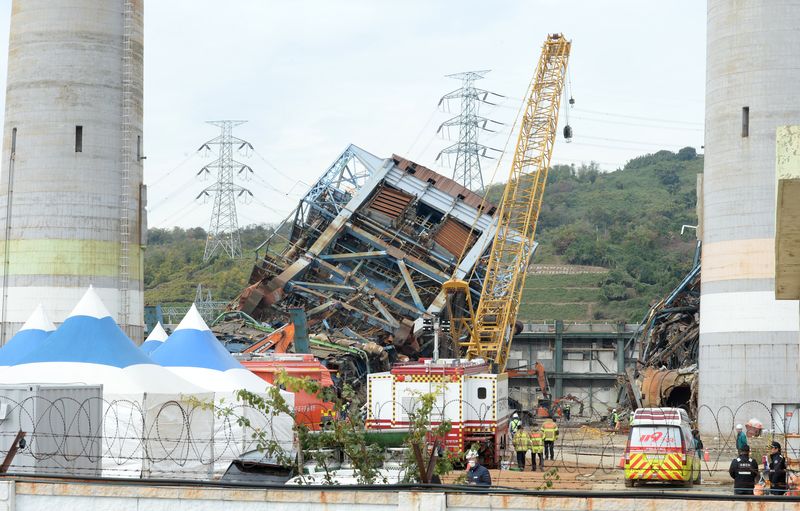
According to the findings of the Accident Investigation Committee released by the Ministry of Land, Infrastructure and Transport on the 30th, columns cut excessively during preliminary weakening work could not support the weight above them, triggering a chain reaction that brought down the entire structure. The key cause was identified as a miscalculation of how much could safely be cut, based on inaccurate site-condition data and an inadequate structural review.
The accident occurred at 2:07 p.m. on November 6 last year at the demolition site for Units 4–6 of Ulsan Thermal Power Plant in Nam-gu, Ulsan. The structure collapsed during preliminary weakening work on Boiler Tower No. 5, killing seven people and injuring two.
Preliminary weakening is the work of cutting away some parts, such as columns and beams, so that a structure falls in the intended direction during blasting. The committee concluded that local buckling occurred when the steel plates in the cut columns could not withstand the compressive force, causing them to bend and buckle.
The boiler tower was built with column steel plates that became thinner toward the top, but a thickness measured at one point on the ground floor was applied to all the upper columns. At the initial collapse point, 26.2–27.2 m above ground, the steel plates were actually 15 mm thick; the structural review used 24 mm, overestimating the columns’ capacity to bear the load.
The structure’s weight was also calculated as lower than it actually was. Measurements of the debris showed an actual weight of 3,525.8 t, but the structural review used 3,005.8 t. This meant the weight the columns had to support was understated by 520 t.
The possibility of local buckling in the remaining column cross-sections after cutting was also not assessed. The investigation found that no safety margin had been provided for accumulated deformation from long-term use or damage that could occur during cutting.
The committee conducted a detailed structural analysis using actual information confirmed through material testing, on-site measurements and a review of the as-built drawings. The analysis predicted local buckling failure in the columns at the height where the collapse actually began, and the deformation pattern in the analysis matched what occurred during the accident.
The investigation also found shortcomings in construction and project management. The prime contractor relied on a specialist company’s judgment for the preliminary weakening and blasting work and did not carefully verify whether the final construction detail drawings matched site conditions. The project owner, which directly supervised the work without a separate construction project manager, also failed to coordinate the work of the participating parties systematically.
To prevent similar accidents, the committee proposed strengthening on-site investigations; establishing technical standards for demolition work; strengthening design and construction management for high-risk demolition projects; and reinforcing project owners’ roles and responsibilities.
The Ministry of Land, Infrastructure and Transport will draw up measures to improve the regulatory framework for demolition work, taking into account these findings and the results of the collapse during demolition of the Seosomun Overpass, which is currently under investigation. It plans to notify the relevant agencies of the findings and cooperate to ensure follow-up measures, including administrative sanctions and investigations into violations of laws and regulations.
Accident Investigation Committee Chair Lee Gyeong-gu said, “I hope the findings of the accident investigation will help prevent similar accidents,” adding, “We plan to finalize and supplement the findings and submit the final report to the Ministry of Land, Infrastructure and Transport sometime in November.”
[email protected] Choi Ga-young Reporter