Spain revises train crash death toll from 74 to 69; identification efforts slow
- Input
- 2026-10-30 07:04:13
- Updated
- 2026-10-30 07:04:13
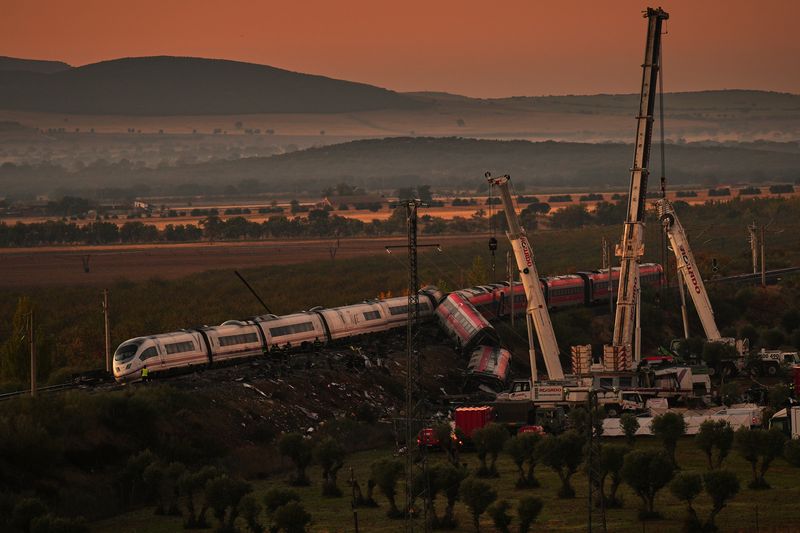
[Financial News] The death toll from a high-speed train collision in Urda, central Spain, on the 28th (local time) was revised from 74 to 69. The figure could change because of missing persons and unidentified bodies.
According to U.S. broadcaster ABC, Spain’s Interior Ministry said in a statement on the 29th that the previous day’s train accident had killed 74 people. However, on the same day, Spain’s Transport Ministry revised the death toll to 69. Spain’s Interior Ministry also said that 67 people were still missing and that the identities of 52 of the deceased had yet to be established.
At 8:54 a.m. on the 28th, two trains collided on the southbound track of a high-speed rail line near Urda in Toledo province, part of the autonomous community of Castilla-La Mancha, southwest of the Spanish capital, Madrid. One train, a high-speed service (AVE) operated by state-owned railway company Renfe, traveling at about 200 km/h, crashed into a train operated by private railway company Iryo that was stopped on the tracks. Both trains had departed Madrid and were heading to Seville in the southern region of Andalusia.
Esther Padilla, a spokesperson for the Castilla-La Mancha regional government, said that 397 people were aboard the Renfe train and 147 on the Iryo train, for a total of 544 people involved in the accident. At least 100 people were injured, and 57 remain hospitalized. Spain’s Foreign Ministry said that 42 foreign nationals from seven countries, including South Korea, were aboard the two trains; one died and at least seven were injured. According to the South Korean Embassy in Spain, 10 South Korean nationals were aboard, two of whom were injured and received hospital treatment.
Spain’s train drivers’ union went ahead with a previously announced strike on the 29th, demanding increased investment in rail safety. As a result, high-speed train services were disrupted. After two high-speed trains collided in the Córdoba area of Andalusia last January, causing large-scale loss of life, another major disaster occurred just nine months later, raising serious questions about rail safety in Spain.
In the capital, Madrid, 1,500 people gathered outside the Transport Ministry headquarters on the night of the 28th to demand the government’s resignation. Spain’s King Felipe VI visited a hospital in Toledo on the 29th, where he consoled the injured and called for a thorough investigation into the accident and measures to prevent a recurrence.
[email protected] Park Jong-won Reporter