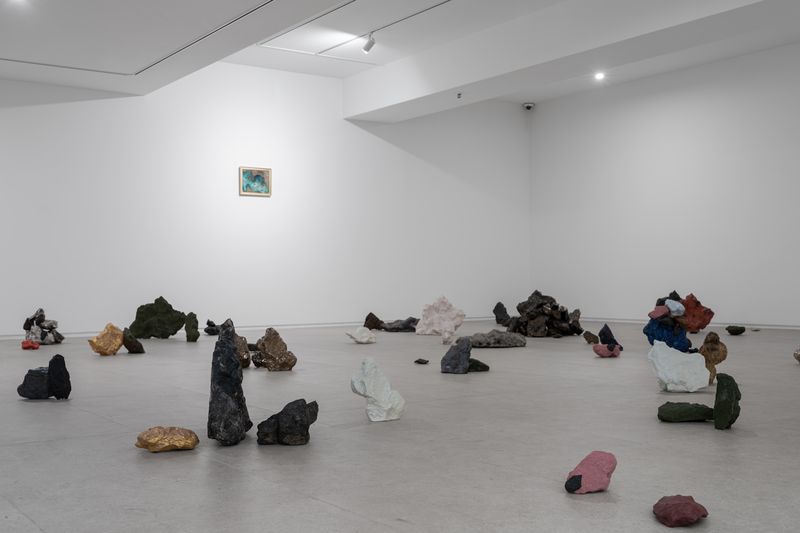
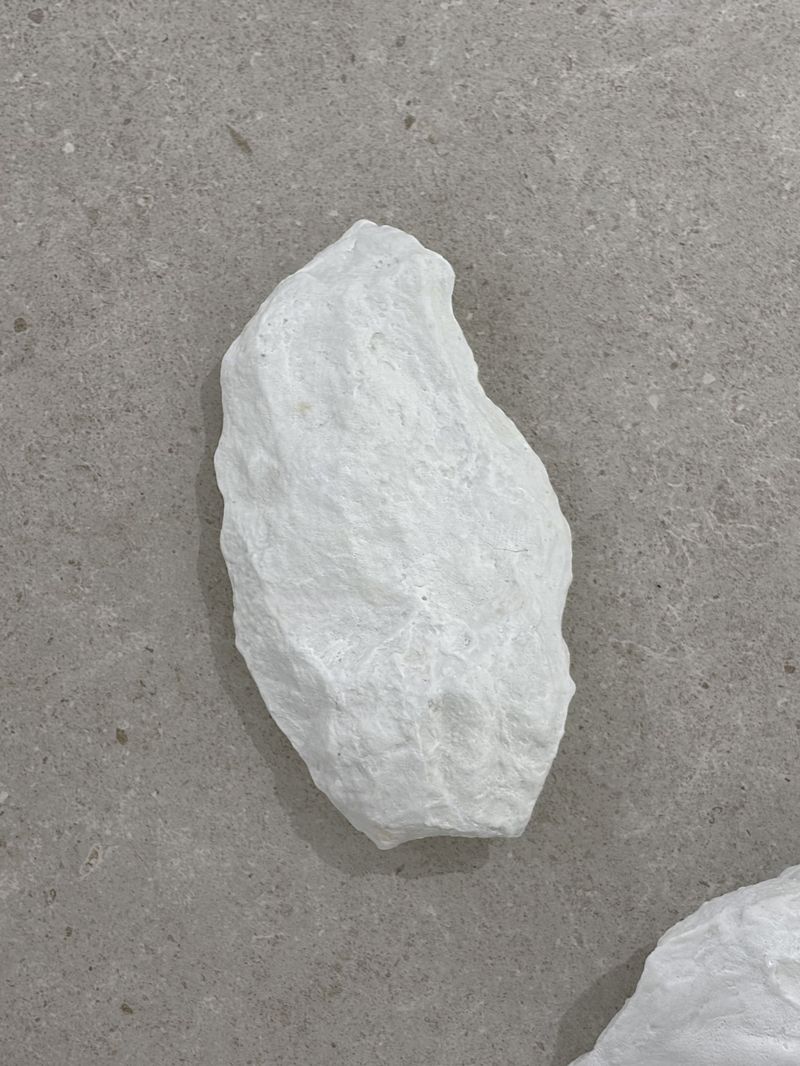
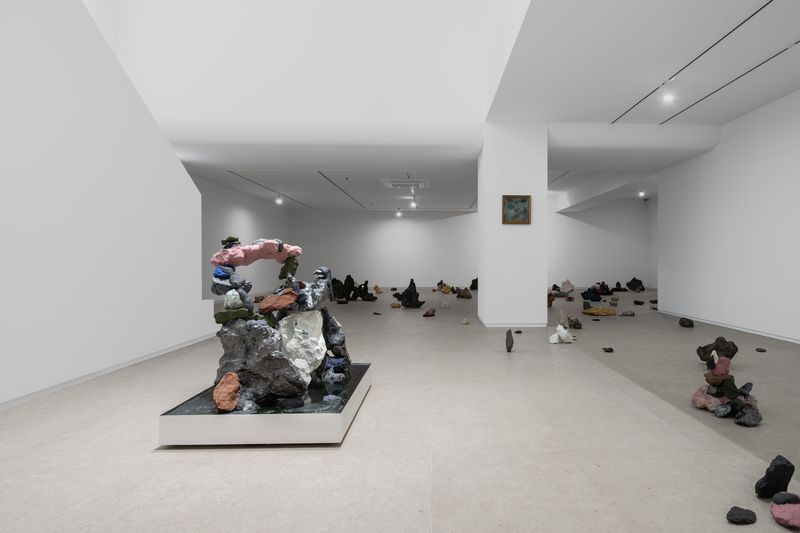
Ceramic works from Mikyung Shin’s solo exhibition. The rock-like sculptures reveal different colors and textures, and irregular contours. Courtesy of the Dalim Cultural Foundation Pink and black masses stand interlocked. Their rough surfaces and indented marks evoke minerals buried underground for a long time. But they are ceramics, made by shaping and firing clay. In front of Mikyung Shin’s “Megalith,” the time of the work’s creation and the time suggested by its appearance seem out of sync. How can a newly made ceramic sculpture look like an ancient stone?Mikyung Shin’s solo exhibition “Becoming Stone: From the Remains,” on view at AOD Museum in Mapo-gu, Seoul, explores this question through the transformation of materials. Organized by the Dalim Cultural Foundation, the exhibition opened on the 16th and features more than 200 works, including ceramics and new two-dimensional works made this year. It offers a look at the artist’s ongoing exploration of time and value as she expands her materials after recreating artifacts and classical sculptures in soap.
■ Expanding the exploration of materials from soap to ceramicsMikyung Shin, who is based in London and Seoul, has been translating historical artifacts and cultural symbols into soap since the late 1990s. Her sculptures resemble marble or decorative ceramics. Soap wears down and changes shape with use, unsettling the image of artifacts as solid and enduring.
The “Toilet Project,” begun in 2004, gives concrete form to this relationship. Soap sculptures were placed in restrooms for visitors to use. The everyday act of washing one’s hands changes the sculptures’ forms, and those traces in turn become part of the work.
Preparations to expand her materials also took a long time. The artist began studying ceramics during a sabbatical in 2014. Clay takes shape under the artist’s hands and is transformed by the heat of the kiln. It offered a new material through which she could explore the themes of creation and disappearance that she had examined through soap. “I didn’t want the work to come out clumsy, so from the very beginning I thought it would take about 10 years,” the artist said.
Mikyung Shin’s “Megalithes S-040.” The ceramic work’s rough surface and irregular contours evoke a rock. ■ Finding new forms in fragments from the kilnThe “Megalith” series took concrete shape from fragments Mikyung Shin discovered in 2019 at EKWC, a Dutch ceramic art center. They were remnants of a large ceramic work by another artist that had broken during firing in a kiln used earlier. In the ceramic that had lost its intended form, Shin saw shapes like rocks left behind by a geological event. The traces of failure became a clue for conceiving new sculptures.
She shaped and bent clay, ground its surface, and fired it to create ceramics resembling ancient mineral masses. She stacked them to develop rock-like structures. The exhibition also includes key works shown at the Princessehof National Museum of Ceramics in the Netherlands in 2021.
The same museum had exhibited her works reproducing Asian ceramics in soap in 2017. The artist, who had translated the forms of ceramics into soap, has now fired clay to create masses that look like stone. Her approach of setting material and appearance at odds continues, but her work has expanded from forms modeled on specific artifacts to shapes that are difficult to name.
In the exhibition text, Oh Ju-hyeon, the WWNN director who curated the show, wrote of soap and “Megalith”: “In one, time completes the work; in the other, the work precedes time.”
A view of Mikyung Shin’s solo exhibition “Becoming Stone: From the Remains,” on view at AOD Museum in Mapo-gu, Seoul. Rock-like ceramic sculptures are placed throughout the exhibition space. ■ Material and time built up on a flat surfaceThe “Unknown Painting” series, made this year, brings these interests onto the wall. Jesmonite, a sculptural material, and metal powder have been applied and layered onto surfaces hung like paintings. Rather than depicting specific objects, the works invite viewers to examine the forms and traces created as materials overlap. The “Painting Series,” which Shin has continued since 2014, consists of works made by pouring melted soap into molds, mixing it, and letting it harden. Their distinctive quality is that, despite their painterly appearance, they are material objects with thickness and scent. The new works extend that interest to the surfaces of other materials.
Where “Megalith” reveals the contours of masses and the structures formed as they interlock, the flat works invite viewers to read the traces of materials layered on their surfaces. “Becoming Stone,” the exhibition’s title, means “becoming stone.” As clay becomes ceramic and ceramic is read as ancient stone, the material, its name, and the meanings attached to objects all change together.
[email protected] Jang In-seo, Reporter
[email protected] Jang In-seo Reporter