Yun Ho-jung: “Choo Mi-ae’s claim about fire service personnel authority is untrue ... will consider using some of the tobacco tax revenue set to expire”
- Input
- 2026-10-29 18:28:35
- Updated
- 2026-10-29 18:28:35
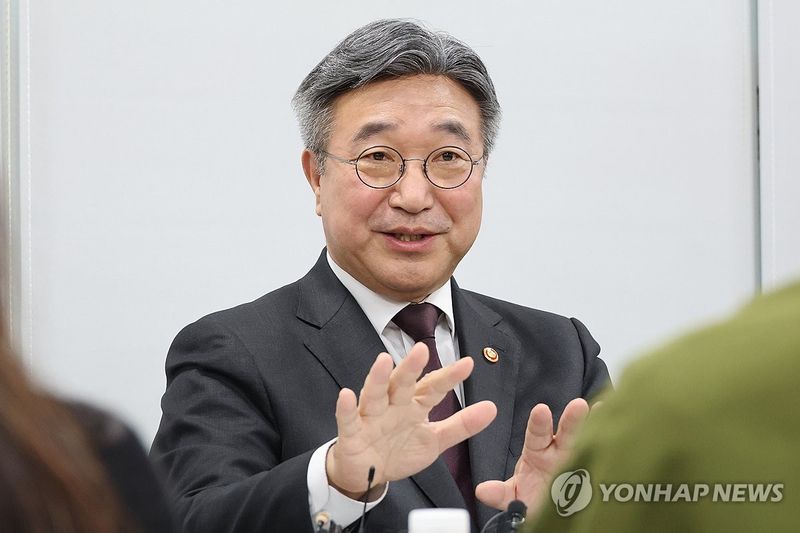
[Financial News] Yun Ho-jung, Minister of the Interior and Safety, rejected Gyeonggi Province Governor Choo Mi-ae’s claim that the state, which has authority over fire service personnel appointments, should also be responsible for personnel costs, saying it was “completely untrue.” He explained that even after fire service personnel were converted to national civil-service status, appointment authority remained delegated to provincial governors, except for certain senior positions. However, he agreed that fire service funding needed to be increased and proposed using the local account of the Future Response Fund to cover immediate shortfalls.
Yun made the remarks in response to Governor Choo’s claims about fire service funding when he met with reporters at Government Complex Sejong on the 29th. Choo had earlier argued that since the central government had taken over authority over key fire service appointments, the state should also be responsible for personnel costs.
Yun said, “That is not true,” adding, “Personnel authority has not changed at all from before the conversion to national civil-service status; it has remained as it was.”
He explained that when fire service personnel were converted to national civil-service status, appointment authority for personnel at Grade 5 or above was transferred to the president. However, under an enforcement decree, that authority was delegated back to provincial governors for all other fire service personnel at Grade 5 or above, except the commissioner of the National Fire Agency, heads of provincial fire headquarters, and fire academy chiefs.
He agreed that fire service funding needed to be increased. Yun said, “The structure for funding the fire service budget is quite fragile, so we need to come up with measures to address that.”
He said he would first seek ways to use the local account of the Future Response Fund to cover fire service funding shortfalls and provide support to local governments that do not receive general local allocation tax, such as Gyeonggi Province. In the medium to long term, he plans to develop measures to secure stable funding for the fire service as part of discussions on decentralizing local finances.
Yun expressed reluctance to use the local education tax revenue linked to the tobacco consumption tax, which is set to expire at the end of this year, to fund the fire service, as Governor Choo had requested, but left open the possibility of considering it.
The government has submitted a bill to the National Assembly to convert that revenue into a local housing welfare tax and use it to supply rental and social housing.
Yun said, “Since the bill has already been submitted by the government, revising it would be somewhat difficult,” but added, “If calls to use the funds for the fire service continue, we could consider dividing the revenue and using it for both purposes.” He continued, “Next year’s shortfall in the Fire Safety Grant Tax compared with this year is around 300 billion won, while the tobacco tax revenue set to expire is about 1.5 trillion won. Even if it were split 50-50, it could cover about 2.5 times the shortfall in the Fire Safety Grant Tax.”
Regarding the inspection of Lim Eun-jung, head of the Gwangju Regional Serious Crime Investigation Agency, who publicly criticized agency chief Kim Ji-hoon, Yun said, “I expect there will be a report once the inspection is concluded, but I haven’t received one yet.” He explained, “The inspection of Director Lim arose during the appointment process for Kim Ji-hoon as agency chief, so emotions could potentially become involved,” adding, “My understanding is that the agency chief is not briefed until the inspection is over, and that the deputy chief receives reports and directs the matter.”
On establishing a unit within the Ministry of the Interior and Safety to handle matters related to the Serious Crime Investigation Agency, he said, “There are various tasks related to the agency, so it seems we will need to create a unit, but we are discussing what kind of unit it should be.”
However, he made clear that it would not be an organization like the Ministry of Justice’s Criminal Affairs Bureau in the past. Yun explained, “The prosecution service did not have authority over personnel appointments or budget planning; the Ministry of Justice had both. The authority to direct investigations also rested with the justice minister.” He added, “As for the police, the Ministry of the Interior and Safety has only the authority to recommend personnel appointments.” He continued, “We currently have a policy liaison officer who serves as a liaison with the police, and I think the agency’s organization may be set up at roughly that level.”
On whether he would run in the 2028 general election, Yun signaled that he intended to do so, saying, “My main job is as a member of the National Assembly.” If Yun, a five-term lawmaker, wins the next general election, he will become a six-term lawmaker. Asked when he would resign as minister, he said, “I haven’t set a specific date,” adding, “Since this is a matter for the appointing authority, it’s difficult to say by when.”
[email protected] Lee Bomi Reporter