[Han Dong-ha’s Herbal Anecdotes] The Doctor Who Couldn’t Stop Making House Calls Even After Death
- Input
- 2026-10-31 06:00:00
- Updated
- 2026-10-31 06:00:00
In the late Ming Dynasty, a renowned physician named Bi Xinchen lived in Xincheng, Shandong.
Pil Sin-sin did not intend to become a physician from the beginning. In his youth, he enjoyed reading and set his mind on scholarship, but his family was too poor. He could not even afford to provide a small gift for his teacher. Eventually, he gave up his studies and entered the path of medicine.
He studied medicine under Liu Nanchuan, a renowned physician of the time. As his innate talent was combined with tireless effort, his skills became widely known before long. Eventually, he even received the official title of Limok at the Imperial Medical Office, the royal medical institution.
He was particularly well-versed in Shanghan (external pathogenic diseases) and Dujin (smallpox and rash-causing diseases). By checking a patient's pulse and assessing their condition, he could almost always accurately predict whether they would live or die. Furthermore, he prescribed medicine after thoroughly considering the patient's region of residence, the strength or weakness of their constitution, and even seasonal climate changes. Consequently, there were many cases where he cured illnesses with just one or two doses. A magistrate in Qingcheng had been unable to eat for several days due to severe abdominal swelling, but he was cured of his illness with a single spoonful of medicine given to him by Pil Sin-sin.
However, Pil Sin-sin was respected by the people not solely because of his exceptional medical skills. At dawn, carts and horses carrying patients lined up in front of his house. There were high-ranking officials as well as poor commoners living hand-to-mouth. Yet, Pil Sin-sin treated everyone in the order they arrived. He did not prioritize those of high rank, nor did he delay treatment for the poor. Sometimes, he would hang medicine at the door for those in need to take, and he did not even charge for it.
Those who highly valued his medical skills and character treated Pilsinshin with great hospitality. Even Taebok Wang Hyeong, who was known for his strict nature, personally prepared food to serve him when he visited.
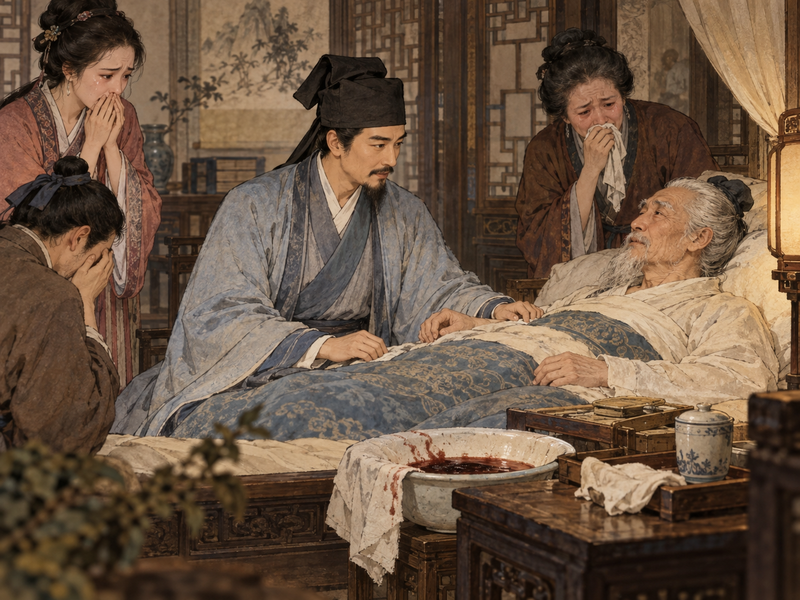
One day, when Pilsinshin returned from a distant house call, the entire household was a sea of tears. His elderly father had suddenly fallen critically ill. The family gathered around his bedside, weeping. Seeing him as if he could breathe his last at any moment, everyone was preparing for the end.
Pil Sin-sin hurriedly sat beside his father and took his pulse. However, to his surprise, he spoke calmly. "Do not worry. Father will survive." The family members looked at each other. It was simply unbelievable that he was telling them not to worry when it seemed as though he were about to pass away at any moment.
Pilsinshin immediately prepared and served the medicine. Then, something astonishing happened to the father after he took a dose. He suddenly vomited up several measures of blood. The family screamed in shock. They thought that far from curing the illness, it was actually hastening his death. However, the father, having lost so much blood, actually regained his senses and was cured as if by magic.
Then, what did Pilsinshin notice in his father's pulse that made him say he could save him with such confidence?
In the classic text of Korean medicine, the *Shanghanlun*, there is a passage stating that even if heat accumulates in the lower abdomen and a person acts as if they are going mad, they will recover if blood comes out naturally. This describes a condition called *Chukhyeol* (blood accumulation syndrome), where heat and blood become entangled and clumped together, and medicines that expel blood stasis are sometimes used for such conditions.
The representative medicinal herb is rhubarb. Rhubarb has a bitter taste and a cold nature, and its strong effect in expelling stagnant blood and heat has earned it the nickname "General." The phrase "pushing out the old to bring in the new" also describes the efficacy of rhubarb.
Of course, there is no record of what medicine Pil Sin-sin actually used. However, given his expertise in treating typhoid fever, if he diagnosed his father's illness as blood stagnation, it is highly likely that he used a prescription containing rhubarb. To the family, the spilled blood may have appeared as a sign of death, but to Pil Sin-sin, it was a sign that the illness was being cured.
Pil Sin-sin lost his life in 1642 during a national crisis when the Qing army captured the fortress of his hometown. He was forty-eight years old.
Even after Pilsinshin passed away, strange things happened whenever his son, wife, or daughter fell ill. It is said that whenever his children suffered from dysentery, malaria, boils, or smallpox, Pilsinshin would appear in their dreams and hand them medicine. "If you take this medicine, you will recover in a few days."
Amazingly, the family recovered from their illness on the day he told them. While alive, Pilsinshin cared for patients regardless of wealth or social status, and even after death, he worried about his family's illness and prepared medicine for them.
Pilsinshin did not stop making house calls even after death.
Today's Herbal Medicine Anecdotes Source
/ Han Dong-ha, Director of Han Dong-ha Korean Medicine Clinic
[email protected] Jeong Myeong-jin, Medical Specialist Reporter