Ruling Party Slows Push for Mega-Regional Special Zones, First Seeks to Appease Labor and Honam
- Input
- 2026-10-29 17:36:39
- Updated
- 2026-10-29 17:36:39
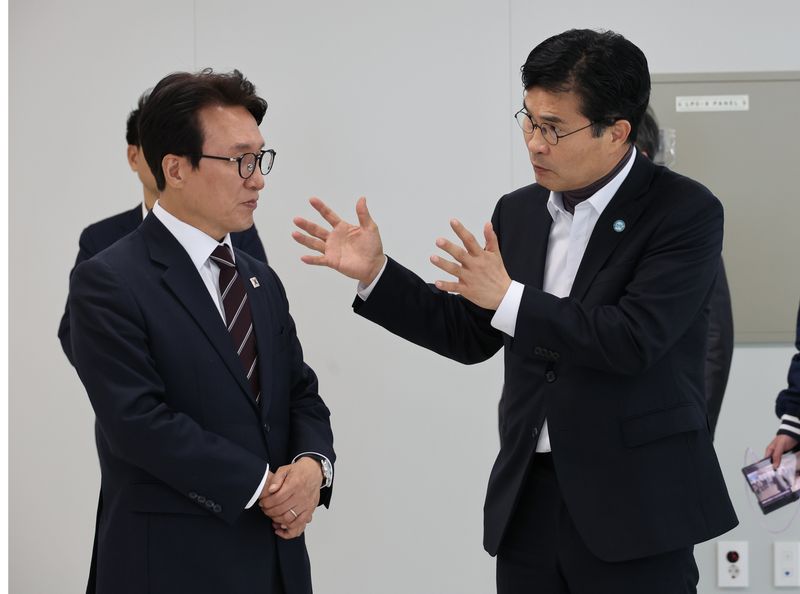
On the morning of the 29th, Democratic Party of Korea leader Kim Min-seok visited Kim Jun-young, chairman of the Metal Workers’ Federation under the Federation of Korean Trade Unions (FKTU), who was staging a hunger strike outside the National Assembly to protest LS Cable & System’s unfair labor practices. Kim promised to call for a special labor inspection by the Ministry of Employment and Labor and an investigation. Kim Jeong-ho, chair of the National Assembly’s Climate, Energy, Environment and Labor Committee, also raised the possibility of pursuing a separate hearing on workplaces where unfair labor practices and wage arrears recur. That afternoon, Kim traveled to Saemangeum in Jeonbuk and held a meeting of the Mega Growth Special Committee, stressing his commitment to supporting Hyundai Motor Group’s investment project worth 8.9 trillion won. He also outlined plans to provide budget support for regional talent-development initiatives, including establishing a Hyundai Motor contract-based department at Jeonbuk National University (JBNU).
The ruling party leadership’s successive efforts to court labor groups and Honam stem from backlash among its support base that has emerged during the push for growth policies. In fact, the Mega-Regional Special Zones Act, which includes an exemption from the 52-hour workweek, was left off the agenda at a party-government meeting of the National Assembly’s Climate, Energy, Environment and Labor Committee that day. This is seen as a decision to put contentious legislation lower on the priority list after efforts to ease labor regulations to attract corporate investment met with opposition from labor groups. Differences have also surfaced within the party, with separate bills introduced over whether to include labor-related exemptions.
In Honam, large-scale investment plans instead fueled claims that some regions were being left behind. Samsung Electronics proposed an investment plan of around 400 trillion won for two semiconductor plants in Gwangju, and a total of 425 trillion won for the Honam region, including an artificial intelligence (AI) data center in Haenam. By contrast, Hyundai Motor Group’s planned investment in Saemangeum, Jeonbuk, is worth 8.9 trillion won. After complaints arose even within the Democratic Party of Korea that investment in Jeonbuk was smaller than in Gwangju and South Jeolla Province, the party leadership is understood to have moved to defuse the discontent by emphasizing efforts to attract additional investment and provide budget support.
[email protected] Jiwon Song Reporter