Hyundai Motor's operating profit rises 5.5% despite 11% plunge in sales; annual target cut (Roundup)
- Input
- 2026-10-29 16:13:53
- Updated
- 2026-10-29 16:13:53

[Financial News] Hyundai Motor Company's global sales plunged 11.3%, but operating profit rose 5.5%. The company protected profitability in the third quarter through increased hybrid electric vehicle (HEV) sales and favorable exchange rates, but decided to lower its annual sales target by about 160,000 vehicles and cut investment by 1.8 trillion won. With strikes and parts supply disruptions compounded by weak sales in the Middle East, expanded sales of new models and a return to normal production in the fourth quarter are expected to be pivotal to an earnings recovery.
■ Sales down 11%, but operating profit up 5.5%
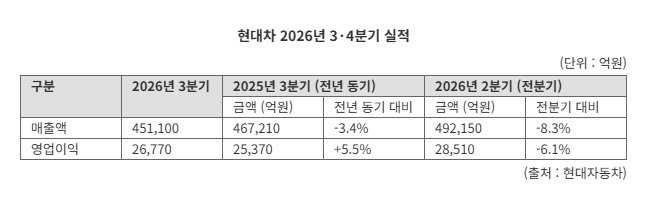
Hyundai Motor held an earnings conference call on the 29th and said it posted revenue of 45.1102 trillion won and operating profit of 2.6772 trillion won on a consolidated basis in the third quarter. Revenue fell 3.4% year on year, while operating profit rose by 139.9 billion won (5.5%). The operating margin was 5.9%, up 0.5 percentage points from the same period last year. Net income, meanwhile, fell 24.2% to 1.9317 trillion won.Global wholesale sales in the third quarter totaled 920,710 vehicles, down 11.3% from the same period last year. Domestic sales plunged 27.2% to just 131,468 vehicles, affected by strikes and fewer operating days due in part to the Chuseok holiday. Overseas sales also fell 8.0% to 789,242 vehicles amid weaker global demand and export disruptions at domestic plants.
The increase in operating profit despite the sharp drop in sales was largely due to increased sales of higher-value hybrid vehicles and favorable exchange rates. The average won-dollar exchange rate in the third quarter was 1,423 won per dollar, up 2.8% year on year. Companywide emergency measures, including cost cutting and cost optimization, also helped cushion earnings.
Rising raw material prices pushed the cost-of-sales ratio up 1.5 percentage points from the same period last year to 83.8%. However, selling, general and administrative expenses as a share of revenue fell 2.0 percentage points to 10.3%.
Hybrid vehicles were a particular mainstay of earnings. Global hybrid vehicle sales in the third quarter totaled 167,414, up 3.8% year on year. Their share of total sales also rose 2.7 percentage points to 18.2%. By contrast, sales of battery electric vehicles (EVs) fell 9.2% to 69,117. Total sales of electrified vehicles declined 2.7% to 245,540.
A Hyundai Motor representative said, "Sales volume declined in the third quarter due to fewer operating days and production disruptions at domestic plants, but we protected profitability through exchange-rate effects, cost optimization efforts and increased HEV sales."
■ Annual sales target lowered to 4 million; rebound expected with new models in Q4
Hyundai Motor lowered its annual global wholesale sales target for this year by 158,300 vehicles, from 4,158,300 to 4 million. It also cut its consolidated operating margin target from 6.3–7.3% to 5.5–6.5%, lowering both the upper and lower bounds by 0.8 percentage points. However, it kept its annual revenue growth target unchanged at 1.0–2.0%.On the conference call, Hyundai Motor cited strikes at domestic plants, parts supply disruptions and declining sales in the Middle East as reasons for lowering its annual target. It said that supply disruptions caused by a fire at a parts supplier in the second quarter, along with strikes that continued through the third quarter, reduced production, while geopolitical uncertainty in the Middle East weighed on sales. The fixed-cost burden from lower production and rising raw material prices also put pressure on profitability.
The company also cut its investment plan for the automotive business by 1.8 trillion won, from 17.8 trillion won to 16 trillion won. It plans to improve the efficiency of its capital allocation by adjusting investment priorities and timing.
Hyundai Motor will seek to recover sales in the fourth quarter by normalizing production and capitalizing on new models. With production at domestic plants back to normal since September, it plans to expand sales of the all-new Avante, the All-New Hyundai Tucson and the Genesis GV90, and increase the share of high-margin models with the launch of the Genesis GV80 Hybrid.
Lee Seung-jo, head of Hyundai Motor's finance division and an executive vice president, said on the conference call, "We expect cost pressures to continue into the fourth quarter. Geopolitical issues remain, and the global business environment is challenging. That said, production at domestic plants has returned to normal since September, and we expect a new-model effect as launches and sales gather pace in the fourth quarter."
He added, "We also expect an improved product mix from expanded sales of new models such as the Avante, Tucson and GV90, as well as the launch of the GV80 Hybrid. We plan to make companywide efforts to improve profitability through initiatives such as cost reductions and lower incentives," he stressed.
The burden of U.S. tariffs, rising raw material prices and slowing global automotive demand are among the factors that could affect an earnings recovery. Hyundai Motor plans to minimize the impact of lower sales volumes through solid sales in North America and a higher share of hybrid vehicles.
Meanwhile, Hyundai Motor decided to maintain its existing shareholder-return policy despite lowering its earnings outlook. It set the third-quarter dividend at 2,500 won per share, unchanged from a year earlier. On the conference call, the company also reaffirmed its commitment to maintaining a minimum annual dividend of 10,000 won under its existing Shareholder Value Enhancement Program.
[email protected] Kim Dong-ho Reporter