Signs of a Resumption in North Korea-U.S. Talks: China as a Bridge, While Fears of South Korea Being 'Sidelined' Become Reality
- Input
- 2026-10-29 16:36:09
- Updated
- 2026-10-29 16:36:09
At a National Assembly Intelligence Committee audit on the 29th, the NIS reported that although North Korea and the United States disagree on the conditions for talks, they are leaving open the possibility of a shift in the situation around the APEC summit. Yun Kun Young of the Democratic Party of Korea, the ruling party's secretary on the Intelligence Committee, cited the fact that a large number of officials from North Korea's diplomatic corps, including Foreign Minister Choe Son-hui, accompanied Kim on his recent visit to Dandong, China, and said, “I believe the North would have conveyed its intentions regarding North Korea-U.S. talks to China's leadership.” However, there was also an assessment that China is unlikely to actively mediate. Yoo Young-ha of the People Power Party, the opposition party's secretary on the committee, said, “We understand that China may be able to convey Kim Jong Un's position to the United States somewhat gently, but has no intention of actively mediating itself.”
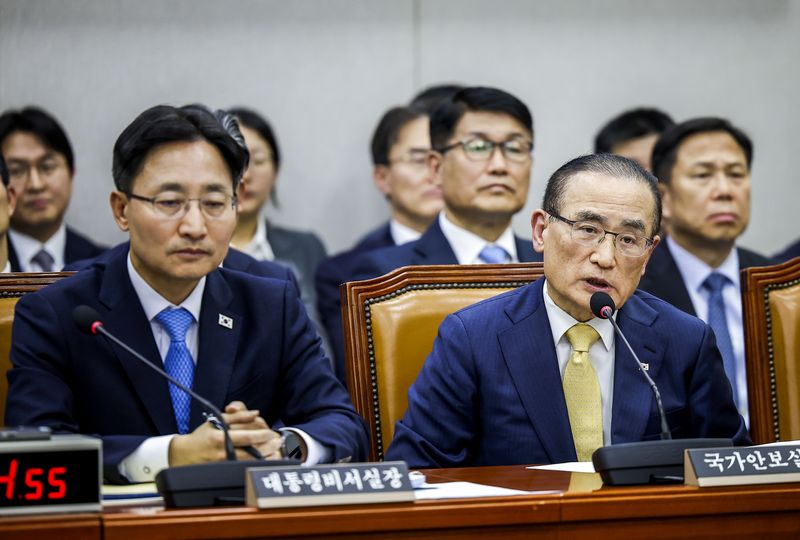
With North Korea not responding to inter-Korean dialogue, concerns have emerged that South Korea's role could be limited if North Korea and the United States engage in direct negotiations or China steps in to relay messages. The possibility of a separate channel of communication opening between North Korea and the United States makes close advance coordination with Washington all the more important for Seoul. However, controversy over South Korea-U.S. coordination was also raised repeatedly during the audit. At a National Assembly Steering Committee audit of the Presidential Secretariat and the National Security Office that day, Kim Ki-woong of the People Power Party pressed National Security Office Director Wi Sung-lac on the denial of U.S. visas to South Korean lawmakers, limits on information sharing and issues related to South Korea-U.S. combined military exercises, saying, “Overall, is there no problem with the South Korea-U.S. alliance? It seems to be creaking.” The NIS also confirmed that the United States had restricted the provision of some information. Yoo said, “After related remarks by Unification Minister Chung Dong-young, the United States restricted the provision of certain information,” while relaying the NIS's explanation that “this can be supplemented with domestic reconnaissance assets.” Yun also cited the NIS's report that intelligence cooperation between South Korea and the United States was proceeding smoothly in other areas.
It also emerged that the United States had given no advance notice in the course of military cooperation. Wi acknowledged that “there was no advance notice” regarding the partial suspension of South Korea-U.S. combined military exercises. He added, “We discussed afterward how to devise measures to ensure the South Korea-U.S. combined deterrence would not be undermined,” saying they had responded through follow-up coordination to ensure the combined deterrence was not compromised.
The issue of inconsistent messaging on North Korea from the government's diplomatic and security team was also raised. Kim Jun-hyung of the Rebuilding Korea Party cited North Korea's denuclearization, South Korea-U.S. combined military exercises and the response to the Korean Demilitarized Zone (DMZ) landmine incident, and pointed to a difference in tone between President Lee Jae-myung's conciliatory stance toward North Korea and the National Security Office's position. Wi rebutted, “The president speaks in terms of direction, while I speak about reality,” adding, “I may seem to differ from the direction because I speak about reality, but there is no difference.”
[email protected] Jiwon Song Reporter