“Red ginseng extends healthspan” ... 14th International Ginseng Symposium concludes in Jeju
- Input
- 2026-10-29 16:05:53
- Updated
- 2026-10-29 16:05:53
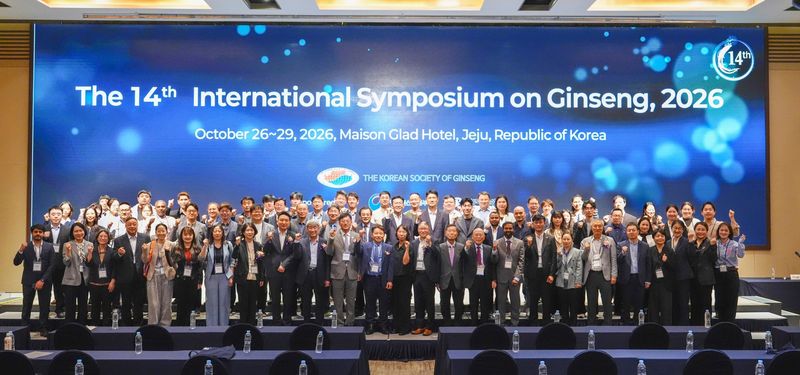
[Financial News] As interest shifts from “how long we live” to “how healthily we live,” scientific evidence that red ginseng helps extend healthspan has been repeatedly presented on the international academic stage.
The Korean Society of Ginseng held the 14th International Ginseng Symposium at Maison Glad Jeju over four days, from the 26th through the 29th. The event, sponsored by the Ministry of Agriculture, Food and Rural Affairs and the Korean Ginseng Association, drew about 800 academic and industry experts from 14 countries, including South Korea, the United States, Germany, Sweden, China and Japan.
First held in 1974, the International Ginseng Symposium is an international academic conference in the field of ginseng that takes place every four years and has a history spanning more than 50 years.
This year’s symposium shared findings from a range of clinical and basic research on “healthspan” and “anti-aging,” key topics in an aging society. Studies were presented in succession showing that red ginseng acts on key factors determining healthspan, including by mitigating oxidative stress that accelerates aging, improving sleep quality, and alleviating dementia, metabolic syndrome and sarcopenia.
In his keynote address, Johan Auwerx, a leading scholar in metabolism and aging and a professor at the School of Life Sciences at the Swiss Federal Institute of Technology Lausanne (EPFL), presented findings from research showing that red ginseng extract improved indicators related to metabolic syndrome and liver damage.
Hong-Sheng Tan, a professor at the School of Medicine at Shanghai Jiao Tong University in China, drew attention with findings showing that red ginseng consumption significantly lowered levels of malondialdehyde (MDA), a marker of oxidative stress, and substantially improved deep-sleep duration and quality-of-life indicators.
Findings from Korean researchers were also presented. A team led by Professors Min-ho Moon and Yun-kwon Nam of Konyang University’s College of Medicine presented research on treating Alzheimer’s disease and improving cognitive function using polysaccharides, one of red ginseng’s main active components. Professor Sang-min Park of Chungnam National University’s College of Pharmacy presented findings on mitigating age-related muscle loss, improving motor function, and the mechanism linking the brain and liver. These studies, spanning brain health and musculoskeletal disorders, were praised for taking the academic and practical value of red ginseng to a new level.
Other sessions covered a wide range of research, from basic science to industrial applications, including skin and sensory function, colitis suppression, immune regulation and antiviral activity. A “Global Ginseng Industry” session also shared the state of and outlook for the industry in major ginseng-producing countries such as South Korea, China and Vietnam, laying the groundwork for international cooperation.
Kim Jong-hoon, president of the Korean Society of Ginseng, said, “This symposium was a meaningful occasion where researchers from around the world came together to identify and share the scientific mechanisms through which red ginseng and ginseng contribute to extending the healthspan of modern people.” He added, “Building on the research findings discussed, we will strengthen the global competitiveness of red ginseng and ginseng and ensure that preparations for the 15th symposium, to be held four years from now, proceed smoothly.”
[email protected] Jung Myung-jin, Medical Correspondent Reporter