Gang-Ruled City: Port-au-Prince, Haiti [Park Jong-won's Then and Here]
- Input
- 2026-10-31 06:00:00
- Updated
- 2026-10-31 06:00:00
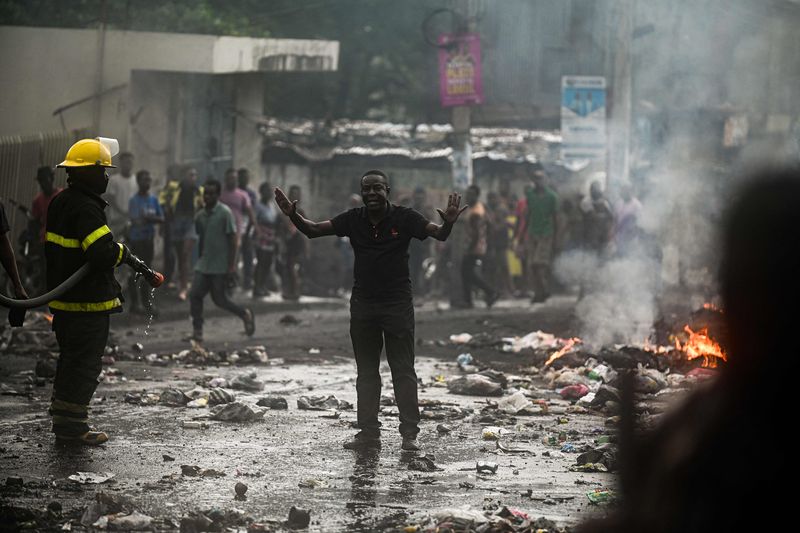
[Financial News] Haiti’s Provisional Electoral Council (CEP) announced on the 28th (local time) that it was postponing the presidential election, scheduled for December 13 this year, until July 18 next year. Haiti had planned to hold elections on August 30 but postponed them to December, then delayed them again. The last election held in Haiti was in November 2016, 10 years ago.
The reason Haitians cannot vote is that the country is effectively in a state of anarchy. Efforts to overcome this by establishing a government have left people unable to vote because there is no government. The gangs controlling the cities do not want a new government to be formed, as they seek to protect the spoils from infrastructure they already control, including roads and ports, and to continue crimes such as kidnapping and their collusion with political figures. With help from the international community, Haiti’s electoral authorities tried to prepare for a vote under these circumstances. But gang-imposed roadblocks and attacks in areas they control have made not only voting but even campaigning impossible.
In addition, it is difficult to determine voter rolls by region because about 1.5 million residents have been displaced. Haiti’s electoral roll had about 6.5 million registered voters at the time of the last presidential election in 2016. But for this year’s election, only about 900,000 voters had completed registration between July and October. The electoral authorities decided to postpone the election, reasoning that if it went ahead under these conditions, most citizens would lose their right to vote.
The worst unrest is in the capital, Port-au-Prince. Located on the western coast, it is a port city whose urban core covers about 36 km2, roughly the size of Seoul’s Gangnam District. The greater metropolitan area, including surrounding satellite cities, covers about 150–160 km2, or about one-quarter of Seoul’s total area. About 3.2 million people live in the region. Haiti has an area of 27,750 km2, comparable to the entire Gyeongsang region including its metropolitan cities, and a population of 12.04 million. About 26.6% of the country’s population is concentrated in the greater metropolitan area.
Gangs currently occupy about 80% of the metropolitan area. The UK-based BBC reported in December 2022 that Haiti had about 200 armed groups, more than half of them in the metropolitan area.
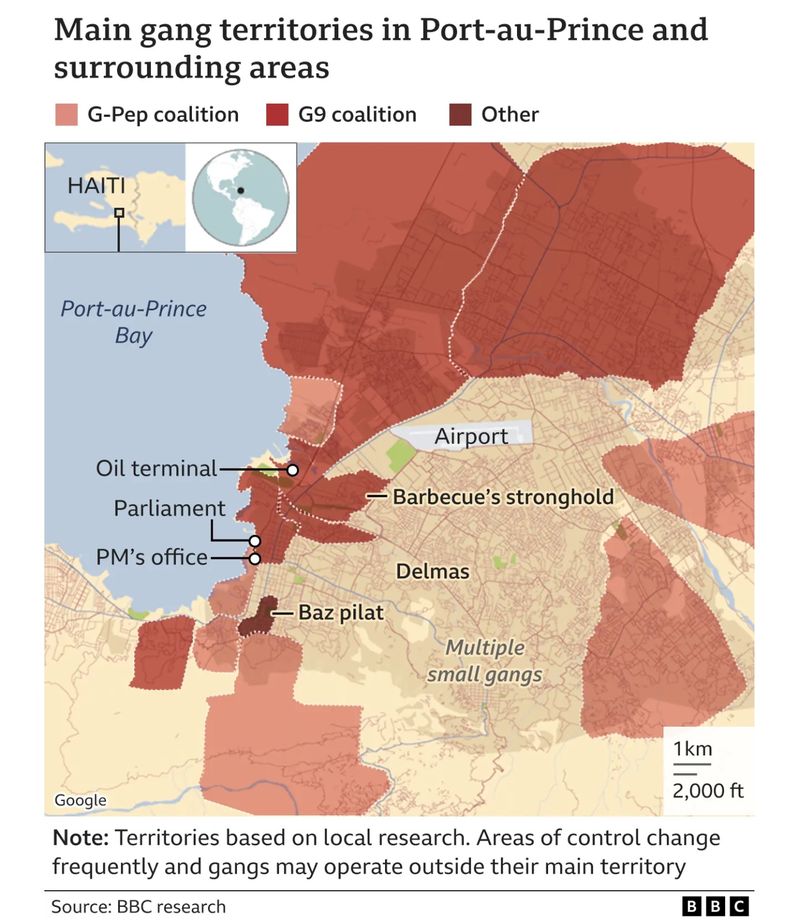
The most powerful gang in Port-au-Prince is G9, an alliance founded in June 2020 by former police officer Jimmy Chérizier, who brought together nine major gangs. Chérizier expanded his influence through an alliance with the ruling party of former president Jovenel Moïse, who was assassinated in 2021. The gang mainly collected passage fees at fuel terminals and on nearby roads.
Just one month after G9 was formed, gangs opposed to it came together in Port-au-Prince to establish G-Pep. Led by Gabriel Jean-Pierre, G-Pep grew with support from the opposition and fought a bloody conflict with G9 in the capital for years.
The two factions have cooperated since 2023 under an alliance called Viv Ansanm (“coexistence”). Former Haitian Prime Minister Ariel Henry, who served as acting president after Moïse’s death, acknowledged the paralysis of state authority and called on the UN to send troops. Feeling threatened, the gangs joined forces. They then presented themselves as popular revolutionary groups. In February 2024, Viv Ansanm attacked police stations, prisons and the international airport, forcing Henry to step down and enabling the alliance to take control of the metropolitan area as it does today.
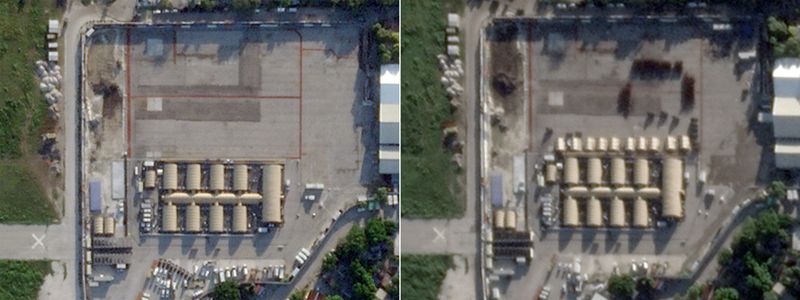
Viv Ansanm and the UN’s Multinational Gang Suppression Force (GSF) have recently clashed in the metropolitan area. The deployment, which began in June 2024, was planned to involve about 5,500 personnel, but the actual force numbered around 1,500.
This balance is set to change with the arrival of a large contingent of Salvadoran troops. El Salvador’s President Nayib Bukele, who has waged war on gangs throughout his term since taking office in 2019, decided on a large-scale deployment after four Salvadoran technicians working with units of Haiti’s GSF went missing following a gang attack on the 18th. Foreign media reported that, as of the 29th, at least 2,000 Salvadoran regular troops had landed in Haiti.
[email protected] Park Jong-won Reporter