U.S. Doctor Flies in from Hawaii, Avoids Paralysis Crisis in Seoul
- Input
- 2026-10-29 15:52:41
- Updated
- 2026-10-29 15:52:41
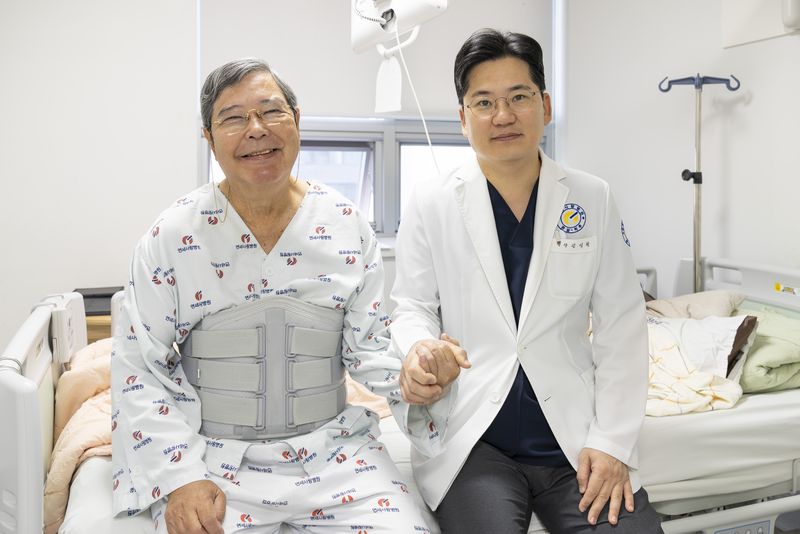
[Financial News] “In the United States, surgery costs $60,000 to $70,000, but in Korea it costs between half and one-third as much.”
A 71-year-old American who practices internal medicine in Hawaii faced the threat of paralysis from the waist down while traveling in South Korea, but recovered after emergency spinal surgery at a specialist hospital there.
Yonsei Sarang Hospital, a joint-specialty hospital designated by the Ministry of Health and Welfare, said that a team led by Kim Seong-cheol, head of its Spine Center, successfully performed lengthy spinal surgery on Young Hiram, an American internist, on the 2nd.
Young is an internist who has actively provided care at public health centers and volunteered medical services for vulnerable communities in Hawaii. Young had come to South Korea to travel and attend an acquaintance’s wedding. After arriving on a long-haul flight of more than eight hours, Young developed paralysis and abnormal sensations in both legs. With help from an acquaintance, Young quickly found a hospital and received one-stop care, including an examination by a spine specialist, an MRI scan and interpretation, and an explanation of the treatment plan, all in one place.
At the time of admission, Young had sharply worsening back pain, radiating pain extending into both legs, progressively declining sensation in both feet, reduced sensation in the perineal area, and difficulty walking. Detailed tests showed very severe spinal stenosis from lumbar vertebrae 3 to 5. The diagnosis was not simple stenosis but stenosis accompanied by cauda equina syndrome, making emergency surgery urgent.
Cauda equina syndrome is a condition caused by damage to the lumbosacral nerve roots inside the spinal canal. Severe compression of the nerve bundle can cause permanent damage to bowel and bladder control, sexual function, and the function of both legs. Time is critical to treatment: unless paralysis symptoms are relieved as quickly as possible, they can lead to permanent disability.
Young had been receiving treatment locally for back pain, but the rapid worsening of symptoms left little time to return home for treatment. As a physician, Young understood the urgency better than anyone and recognized the risk that delaying treatment could lead to paralysis from the waist down. Having long regarded the standard of medical care in Korea as high, Young also trusted the medical team’s assessment that prompt surgery was necessary and the country’s specialized spinal-care system, and decided to undergo surgery in Korea.
To achieve extensive nerve decompression, Dr. Kim performed a laminectomy from lumbar vertebrae 3 to 5 and a foraminotomy, a procedure that widens the passage through which nerves travel. The operation was completed with posterior screw fixation and spinal fusion, a procedure that uses screws to fix the vertebrae together after nerve decompression and permanently stabilize an unstable joint.
After surgery, Young’s difficulty walking improved, and recovery was free of complications such as bowel or bladder problems or sensory impairment. Young was discharged on the 12th, thanking the medical team with a cheerful expression.
Young said, “My health suddenly deteriorated unexpectedly while I was visiting Korea, but I had surgery quickly and recovered.” Young added, “My back has straightened and I feel like I’ve grown a little taller, so I feel lucky and happy.” Young expressed satisfaction, saying, “The medical team’s kindness, the care system, and the surgical result were all ‘very good.’”
Neurosurgeon Kim Seong-cheol said, “Sudden paralysis in the legs and loss of sensation are signs that nerve damage is progressing, so prompt evaluation and surgical treatment are important. Despite the patient’s advanced age, the patient endured a complex, lengthy operation in which every moment mattered, and we were able to complete it safely.” Kim added, “We will continue to provide high-quality medical services to patients at home and abroad, drawing on our specialized spinal-care and surgical system.”
The hospital said the case was a rare instance of an elderly foreign patient visiting Korea who developed sudden symptoms of paralysis from the waist down and recovered after prompt testing and surgery at a specialist medical institution in Korea, adding that it demonstrated the competitiveness of Korean healthcare.
[email protected] Myung-jin Jung, Medical Correspondent Reporter