'Excess Demand and High Inflation': Will the BOK Reach for the ‘Hoe’ in November?
- Input
- 2026-10-29 15:45:05
- Updated
- 2026-10-29 15:45:05
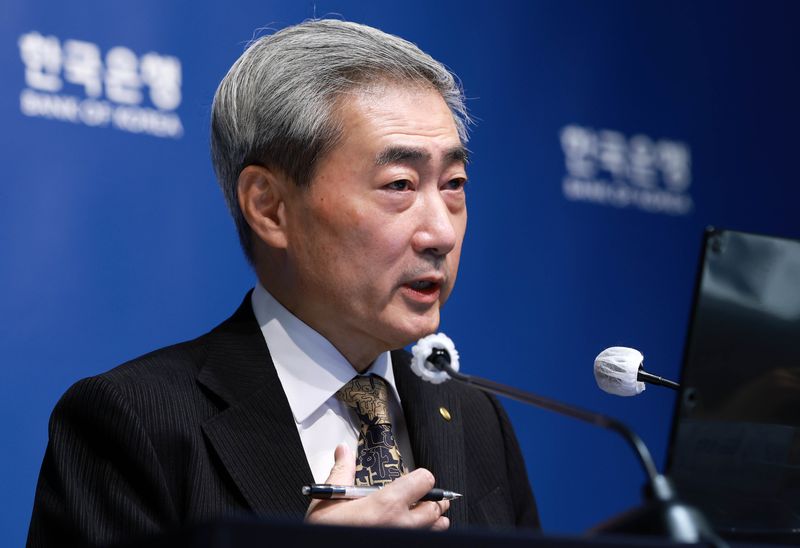
[Financial News] A November rate hike by the Bank of Korea (BOK) remains a strong possibility. Following the U.S. Federal Reserve’s decision to hold its policy rate steady, the BOK has bought time by preventing the Korea-U.S. interest rate gap (1.00 percentage point at the upper end) from widening further, which can be seen as giving it more room to maneuver.
On the 29th, the BOK held a meeting to review market conditions following the U.S. Federal Reserve’s decision to hold rates steady. It said, “Given the high uncertainty, including over U.S. policy changes, we will closely monitor conditions in domestic financial and foreign-exchange markets with particular vigilance.”
Markets expect two rate hikes of 0.25 percentage points each: one in November this year and another in the first quarter of next year. The expectation is that further tightening will follow depending on inflation and economic conditions, with the BOK ultimately maintaining a high-rate stance in the 3.50%–4.00% range.
The BOK believes that by raising its base rate in consecutive months, July and August, it has significantly reduced economic costs related to stabilizing inflation and the exchange rate. It has even called this the “fruits of hoe work,” as BOK Governor Hyun Song Shin put it (meaning that acting before economic risks grow helps avoid paying far greater costs later). This is also the context for the BOK’s confident “breather” this month, when it held rates steady.
The BOK is likely to raise its base rate at its November Monetary Policy Board meeting. Such a move could have two effects: narrowing the rate gap with the United States and responding preemptively to strong domestic growth and high inflation.
The main reason the BOK may need to reach for the “hoe” again is “overheated demand.”
Buoyed by strong semiconductor exports and increased facility investment, nominal GDP growth in Korea this year is expected to reach the 20% range, far exceeding the initial forecast of 12.3% year on year. Real GDP in the recently reported third quarter also posted a surprise quarter-on-quarter increase of 1.0%, more than three times the BOK’s forecast of 0.3%. As a result, economic growth this year is expected to come in between the mid-to-high 3% range and as high as the low 4% range. Governor Shin reiterated that “inflation driven by demand-side factors will emerge” and that “we will maintain a tightening stance until inflation converges to the stable level of 2%.”
In addition, at least 70 trillion won in dividends and performance bonuses from major companies, including semiconductor firms, will flow into the market from the end of this year through early next year. More than 10% of that money is expected to go toward consumption, putting considerable upward pressure on prices. As of September, consumer price inflation was 2.9%, below 3% according to the official figures, but the inflation people feel in everyday life is well above 4%. Core inflation, excluding food and energy, also rose 2.8%, already surpassing the BOK’s forecast.
Meanwhile, the BOK is closely monitoring financial imbalances, including rising housing prices and lending in the Seoul metropolitan area and mounting interest burdens.
With average mortgage rates entering the 5% range in September, private consumption contracted by 0.2% in the third quarter, its first negative growth in three years and nine months, as households’ spending power weakened. K-shaped polarization is deepening, with the shock of high interest rates falling disproportionately on vulnerable groups such as highly leveraged households and marginal firms.
Now that the economy has entered a phase of “high inflation and excess demand,” pressure to raise the base rate further is mounting. Attention is focused on which course the BOK will choose in November: a preemptive response (a rate hike) or policy balance (adjusting the pace).
[email protected] Jung Sang-gyun Reporter