Overseas stock buying by Korean retail investors fleeing the domestic market hits a year-to-date high ... ₩4.7 trillion bet on SOXL alone
- Input
- 2026-10-29 15:43:06
- Updated
- 2026-10-29 15:43:06
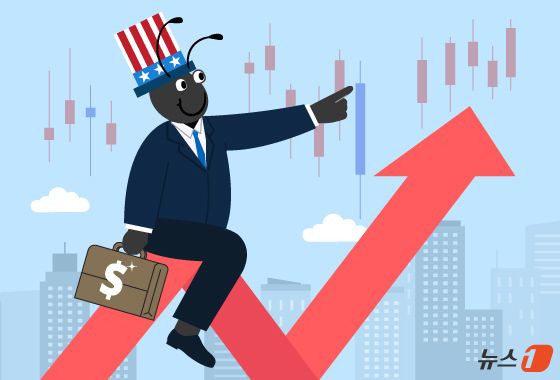
According to SEIBro, the Korea Securities Depository’s data service, domestic investors’ net purchases of U.S. stocks settled from the 1st through the 28th of this month totaled $5.32414 billion (about 7.1152 trillion won), as of the 29th. That was about 5.3 times the $1.00128 billion recorded last month. Net purchases of U.S. stocks fell from $4.64241 billion in July to $1.96234 billion in August and $1.00128 billion in September, before rising again this month. This is the largest net-purchase total so far this year, surpassing the $5.00299 billion recorded in January.
Among the top net purchases, investment targeting a rebound in semiconductor and technology stocks stood out. The largest amount of funds went to the Direxion Daily Semiconductor Bull 3X ETF (SOXL), with net purchases reaching $3.58925 billion. The fund tracks three times the daily return of an underlying index made up of U.S. semiconductor stocks favored by Korean retail investors investing overseas. Its net purchases were about 8.7 times the $414.12 million for SpaceX, which ranked second.
Leveraged products betting on gains in the Nasdaq-100 also ranked among the top purchases. ProShares Ultra QQQ ETF (QLD), which tracks twice the daily return, ranked fifth with $217.28 million, while ProShares UltraPro QQQ ETF (TQQQ), which tracks three times the daily return, ranked sixth with $205.47 million. Net purchases of SOXL and the two ETFs totaled $4.01208 billion. IonQ, a quantum computing company, also ranked fourth with $238.12 million.
Brokerage analysts say AI companies’ success in monetizing their businesses needs to underpin a recovery in semiconductor stocks. Rapid cash burn and financing pressures at big tech companies are weighing on the share prices of companies benefiting from AI investment. The view is that if AI companies prove they can monetize their businesses and big tech shares recover first, semiconductor and hardware stocks could rebound afterward.
Kim Seong-hwan, a researcher at Shinhan Investment & Securities, said, “If signs of successful monetization and a rising share-price trend are confirmed first, the rebound in sectors tied to AI capital expenditures—which were weak in the second half of 2026 but remain constrained by supply shortages—could be strong, though it would come later.” He added, “In sequence, big tech and AI companies come first.”
Recently, there have also been signs that market concerns about AI companies’ financing are easing. Credit default swap (CDS) premiums for Oracle and CoreWeave have fallen, and Oracle’s forecast that it will return to positive free cash flow in the second half of fiscal 2028 is seen as easing concerns about returns on AI investment. The renewed increase in semiconductor earnings estimates following SK hynix’s earnings announcement is also cited as a factor supporting hopes for a rebound.
Hwang Su-wook, a researcher at Meritz Securities, said, “Alongside recent news about big tech companies’ financing, we believe concerns over AI financing, which have weighed on global market sentiment since mid-October, are passing their low point.”
[email protected] Bae Han-geul Reporter