Office rents rise while retail rents fall ... Ttukseom and Myeong-dong buoyed by tourist demand
- Input
- 2026-10-29 15:12:53
- Updated
- 2026-10-29 15:12:53
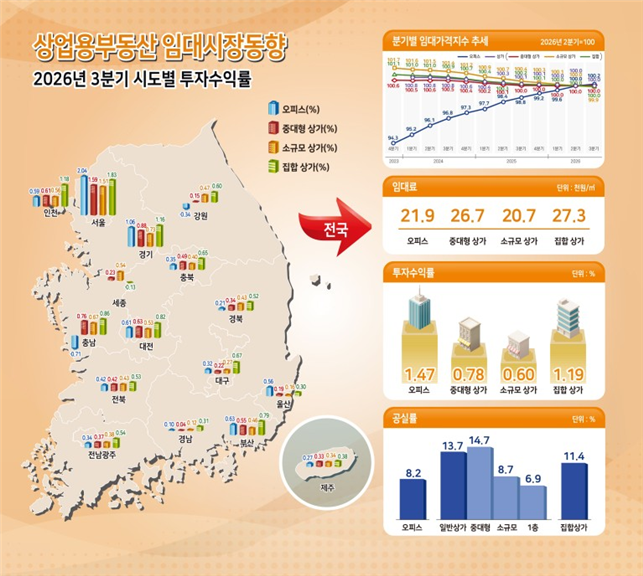
Stable tenant demand in Seoul drove the nationwide rise in office rents. Seoul’s rental price index increased 0.30%, marking its 19th consecutive quarterly rise since the first quarter of 2022. By contrast, all cities and provinces outside Seoul declined, with Gyeonggi and Incheon each down 0.01%.
In Seoul, demand for large offices in Yeouido and Gangnam, along with demand for office space from industries related to foreign visitors, contributed to the rise. The index for major business districts—Downtown Seoul, Gangnam and Yeouido—rose 0.47%. Yeouido led with 0.58%, followed by Gangnam at 0.44% and Downtown Seoul at 0.34%.
Retail property markets remained weak nationwide amid subdued consumption, falling sales and prolonged vacancies. Rents rose 0.43% in Seoul and 0.13% in Busan, but fell 0.07% in Gyeonggi and 0.17% in Incheon.
Rises were particularly pronounced in Seoul’s popular shopping districts. Rents climbed 9.92% in Ttukseom, where demand from foreign tourists is concentrated, and 4.53% in Myeong-dong. By type, all categories of Seoul retail properties rose: mid- and large-sized properties by 0.49%, small-sized properties by 0.47%, and multi-tenant retail properties by 0.25%.
The nationwide vacancy rate for general retail properties stood at 13.7%, up 0.3 percentage points from the previous quarter. The rates were 14.7% for mid- and large-sized properties and 8.7% for small-sized properties, while the vacancy rate on the first floor of general retail properties was 6.9%. The vacancy rate for multi-tenant retail properties rose 0.9 percentage points to 11.4%.
The vacancy rate for general retail properties in Seoul was 9.6%, below the national average. The rates were 11.3% in Gyeonggi and 14.0% in Incheon. Office vacancy rates were 8.2% nationwide, 5.4% in Seoul, 8.8% in Gyeonggi and 12.5% in Incheon.
Retail investment yields fell across all property types. Nationwide, yields for mid- and large-sized retail properties fell 0.33 percentage points from the previous quarter to 0.78%; those for small-sized properties fell 0.26 percentage points to 0.60%, and those for multi-tenant retail properties fell 0.11 percentage points to 1.19%. The Korea Real Estate Board said the decline was affected by falling asset values amid reduced investment demand and increased operating expenses due to property tax assessments, among other factors.
Office investment yields were 1.47% nationwide and 2.04% in Seoul. The investment yield is a measure that combines rental income and changes in asset value over a three-month period.
Starting with this survey, the office sample was completely redesigned and the number of commercial districts was expanded from 368 to 385. The Korea Real Estate Board said that, for offices, rental rates, investment yields and vacancy rates cannot be directly compared with the previous quarter, unlike the rental price index, and should therefore be interpreted with caution.
[email protected] Choi Ga-young Reporter