Firefighting water and access road problems flagged 12 years ago ... hampering response to Guryong Village fire once again
- Input
- 2026-10-29 15:18:43
- Updated
- 2026-10-29 15:18:43
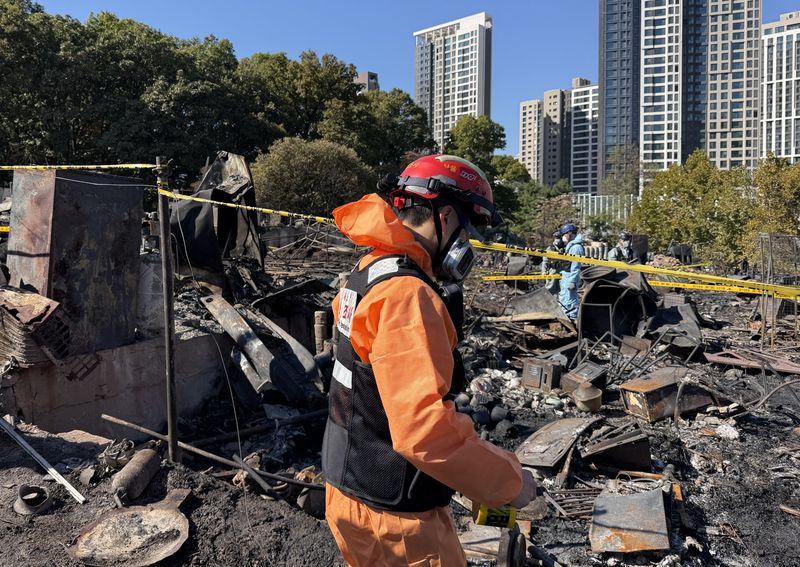
[Financial News] Fire authorities struggled to secure firefighting water during the major fire that broke out on the 27th in Guryong Village, Gangnam-gu, Seoul. It has emerged that the same problem was raised at the Seoul Metropolitan Council 12 years ago. Although the Seoul Metropolitan Government and fire authorities have moved to reinforce facilities, including by installing hydrants and fire-hose cabinets, structural limitations such as narrow alleys and restrictions on connecting to water mains mean that difficulties securing firefighting water recur with each fire.
A review of Financial News reporting on the 29th found that shortages of firefighting water and difficulties getting fire engines into Guryong Village were also raised at a meeting of the Seoul Metropolitan Council’s Urban Safety and Construction Committee in November 2014.
At the time, Seoul Metropolitan Council member Lee Seok-ju called for more firefighting facilities, asking, “Couldn’t we install just about two outdoor hydrants in the middle of Guryong Village?” Kwon Sun-gyeong, then head of the Seoul Metropolitan Fire and Disaster Headquarters, replied, “Hydrants are installed along the main road on both sides of the village entrance.” This showed that concerns had already been raised about the lack of hydrants inside the village, which meant long fire hoses had to be connected to hydrants outside it.
The difficulty of getting fire engines in because of the narrow roads was also discussed. Kwon said at the time that they were pursuing improvements, adding, “The access road is narrow, so once a vehicle goes in, there’s nowhere for it to turn around and come back out.”
The following year, the Seoul Metropolitan Government and fire authorities began reinforcing firefighting facilities. According to the minutes of a Seoul Metropolitan Council meeting in March 2015, Kwon said, “Since January, we have been working to bring the water-main pipes along the main road into the village; we installed one hydrant and six fire-hose cabinets.”
Alongside the facility upgrades, Guryong Village has been designated and managed as an enhanced fire-prevention district since 2002. According to the Seoul Metropolitan Government, as of January this year, the village had 10 emergency firefighting installations and two simple connected water-supply systems, among other facilities. At least 500 million won has also been spent on site management, applying fire-retardant coating and building fire lanes.
Despite continued facility upgrades, fire authorities are still struggling to secure firefighting water. They explain that there are too few hydrants connected to the water mains inside the village, forcing them to rely on hydrants along the main road. In addition, water pressure may drop when several fire engines draw water at the same time, limiting their ability to fight large fires.
A fire official said, “There are no hydrants connected to the water mains inside the village, so we carry out firefighting operations using hydrants along the main road,” adding, “When multiple hoses are connected to a single pipe, the water pressure weakens.” The official continued, “It is also practically difficult to install additional hydrants inside the village,” and added, “We struggle to secure water every time a fire breaks out, including the fire earlier this year.”
Some analysts say that despite continued investment in expanding firefighting facilities and preventing fires, there are limits to fundamentally addressing the village’s structural hazards, including narrow roads and flammable building materials. Lee Yong-jae, a professor in the Department of Fire Safety and Disaster Prevention at Kyungmin University, said, “In areas like Guryong Village, built with fire-prone materials such as sandwich panels and boards, there are limits to fundamental fire response even if more hydrants or emergency firefighting installations are added.” He stressed, “A fundamental solution will be difficult unless the village’s structural problems, including its narrow roads and flammable building materials, are addressed.”
[email protected] Lee Dong-hyuk Reporter