‘Maritime Capital Busan Sales Team’ launched... “Moving beyond the Seoul metropolitan area’s single-pole system to a multipolar one”
- Input
- 2026-10-29 16:56:54
- Updated
- 2026-10-29 16:56:54
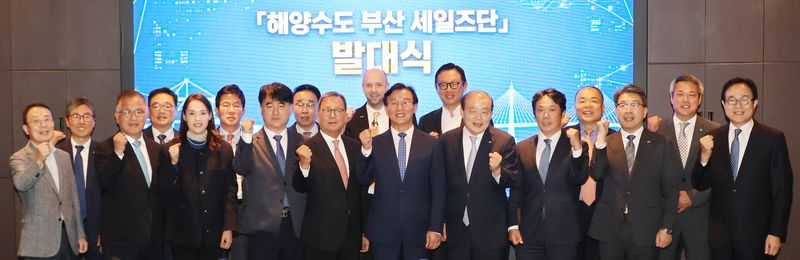
[Financial News] Busan City has launched the ‘Maritime Capital Busan Sales Team,’ a public-private investment attraction body involving experts from business, finance and industry, to realize its vision of ‘Maritime Capital Busan.’ The plan is to draw on private-sector expertise and domestic and international networks to identify promising companies and turn them into tangible investment outcomes.
Busan City held the launch ceremony for the ‘Maritime Capital Busan Sales Team’ on the 29th at Conrad Seoul in Yeouido, Seoul. The team is a non-standing public-private consultative body involving experts in business, finance and industry. Busan Mayor Chun Jae-soo will lead it, while Oh Seok-geun, the city’s Deputy Mayor for Economic Affairs, will oversee its operations and coordinate investment projects.
Business leaders taking part include Lee Bang-soo, advisor to LG Energy Solution; Park Woo-dong, CEO and vice chairman of Poongsan; Oh Chi-hoon, chairman of Daehan Steel; and Ji-Ho Hyun, executive vice chairman of Hwaseung Group. From the financial sector, Lee Young-chang, outside director of Woori Investment Securities, and Bin Dae-in, chairman of BNK Financial Group, are participating. Financial News chairman Jeon Jae-ho and former Kyonggi University professor Eom Gil-cheong will advise the team on investment attraction strategies.
The team will use domestic and international networks to identify promising companies and investment projects. For projects where investment reviews have advanced to a concrete stage, Busan City will work with relevant organizations on financing, site selection and permits to support their implementation. It will address obstacles through small-scale meetings for each project and plans to hold quarterly strategy meetings starting this November.
Mayor Chun presented overcoming the Seoul metropolitan area’s single-pole system and fostering new growth hubs as key tasks for South Korea’s sustainable growth. He said that the concentration of businesses, capital and population in the Seoul metropolitan area had deprived other regions of growth drivers, while the metropolitan area itself faced various inefficiencies.
At the launch ceremony, Mayor Chun stressed, “Overcoming the Seoul metropolitan area’s single-pole system in the true sense does not mean simply redistributing the area’s resources to other regions; it means creating a powerful new growth engine outside the metropolitan area,” and added, “South Korea must move from a single-pole system to a bipolar system, and then to a multipolar system with three or four poles, among others.”
He also identified Busan as a key hub for a new national growth strategy. He described opening up the Northern Sea Route (NSR) as an opportunity to reshape the global shipping and logistics order, and explained that developing Busan as a maritime capital would be a national growth strategy to overcome South Korea’s structural crisis, beyond simply advancing regional development.
As key policies to achieve this, he proposed a ‘four-part Maritime Capital Busan package’: relocating the Ministry of Oceans and Fisheries and its affiliated public institutions to Busan; establishing a specialized maritime court; concentrating the headquarters of global shipping companies there; and establishing a Southeast Investment Corporation. He also outlined a vision to expand the investment base not only for shipping and logistics but also for manufacturing and advanced industries by pursuing the establishment of a Southeast Investment Corporation with a scale of 50 trillion won.
Mayor Chun also emphasized the economic benefits of establishing a specialized maritime court. He pointed out that substantial legal service costs were flowing out of the country as domestic maritime disputes were handled overseas, in places such as London and Singapore. “A specialized maritime court is not just a place where trials are held. It is a place where related industries—including marine insurance, appraisal, interpretation and translation, and consulting—can grow together,” he said. “We must build this kind of knowledge-services ecosystem in Busan.”
The first investment attraction strategy meeting, held after the launch ceremony, discussed policy support and ways to attract companies to help Busan rise as a maritime capital.
Yang Jaesaeng, president of the Busan Chamber of Commerce and Industry, said the city should actively pursue major companies, building on the Port of Busan’s geographic advantages and logistics competitiveness. Yang said that opening up the Northern Sea Route could reduce shipping times and costs and strengthen export competitiveness, and proposed, “Facilities are important, but it would help Busan’s development even more if major companies came to Busan of their own accord.”
Park Seong-ho, head of the Busan-Jinhae Free Economic Zone Authority, proposed a joint investment attraction strategy that combines the strengths of Busan and Gyeongsangnam-do. “When promoting the region overseas, having Busan and Gyeongsangnam-do together gives us very strong selling points,” Park said. “We should link the two regions’ logistics, industrial and residential conditions, and provide information in multiple languages so companies can easily access investment information.”
At a separate investment attraction briefing for companies in the Seoul metropolitan area held that day, Busan City signed memorandums of understanding on investment totaling 163 billion won with three companies: Coupang Logistics Services, LS Power Solution and ReadyPost. The city expects the investments to create 776 new jobs.
[email protected] Seong Chorong Reporter