National Fire Agency: Lithium battery thermal runaway suspected in fire at Coupang logistics center in Incheon
- Input
- 2026-10-29 14:52:55
- Updated
- 2026-10-29 14:52:55
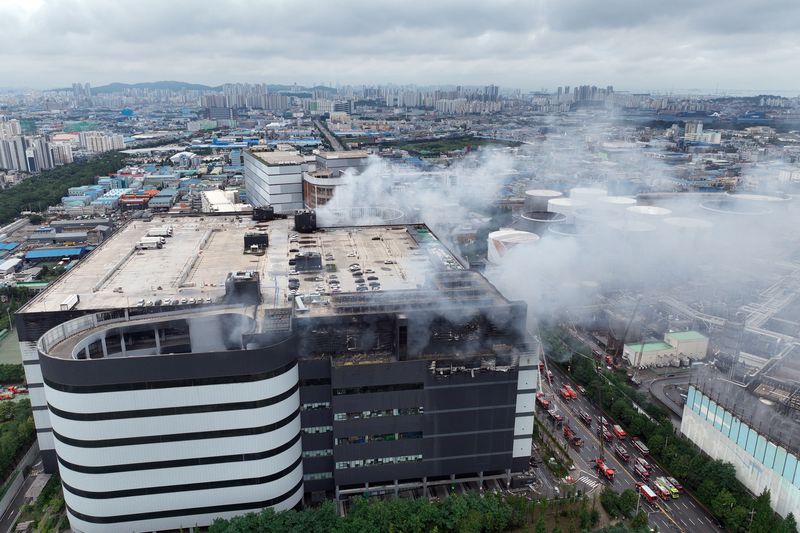
[Financial News] The fire at the Coupang logistics center in Incheon that broke out last July is believed to have started with thermal runaway in lithium-ion batteries embedded in household goods stored there. The National Fire Agency released these findings 102 days after the fire and said it would pursue measures to limit the charge levels of batteries stored in logistics warehouses to a set threshold or below.
On the 28th, the National Fire Agency announced the findings of an investigation by the Central Joint Fire Investigation Team, which included around 30 experts from eight organizations, including the National Fire Agency, the Incheon Fire Headquarters and the National Fire Research Institute.
Based on statements from people involved, CCTV footage and an on-site examination, the joint investigation team identified the initial point of ignition as a goods-storage rack on the sixth floor of Building B. Household goods containing lithium-ion batteries were stored on the rack. An assessment by the National Forensic Service also found that the fire may have started after the batteries’ internal insulation was damaged. However, the products were so badly damaged by the fire that investigators could not identify the specific product that first ignited.
The fire spread to the products’ outer casings, packaging and nearby cardboard boxes, then moved to the upper floors and along the building’s exterior walls. It reached restaurants on the seventh floor and the rooftop level of the eighth floor, and also spread along Building B’s exterior toward Building A. Fire authorities set up a defensive line along the access ramp, preventing the flames from spreading to Building A and to floors five and below.
The fire, which broke out on July 18, was fully extinguished at 8:35 p.m. on the 22nd. Extinguishing operations alone took 109 hours and about 30 minutes, with 917 personnel, including firefighters and police officers, and 255 pieces of equipment deployed. Two firefighters sustained minor injuries, including smoke inhalation and exhaustion. Property damage was estimated at 37.4 billion won in real estate and 76.6 billion won in movable property, for a total of 114 billion won.
The Incheon Metropolitan Police Agency’s Metropolitan Criminal Investigation Unit also said that it had closed its investigation into the fire that day, having found no indications of criminal wrongdoing. Police investigated an unidentified person booked on suspicion of accidentally causing the fire, but found no evidence of improper management of fire-safety facilities or violations of safety rules and decided not to refer the case to prosecutors due to lack of charges. The investigation also found that fire-safety facilities, including sprinklers and fire shutters, had operated normally.
The National Fire Agency said it would strengthen safety standards for battery storage in logistics warehouses in response to the fire. Given that fire risk can vary depending on battery charge levels, it plans to consult with relevant ministries on measures to limit the charge levels of lithium-ion batteries and products containing batteries to a set threshold or below.
The fire response procedures for large logistics warehouses will also be updated. The agency plans to establish new “Fire Response Procedures for Logistics Warehouses with Windowless Floors and Complex Structures (SOP 244),” which will call for the rapid assessment of the possibility of containing a fire in its early stages and for setting up defensive lines and zones to prevent the flames from spreading.
The logistics center where the fire broke out had received a building permit in May 2020 and was not subject to the strengthened fire-safety standards for large logistics warehouses that took effect this year. The National Fire Agency plans to develop additional prevention and response measures that can be applied on site.
National Fire Agency Commissioner Choi Yong-cheol said, “Logistics warehouses contain a lot of combustible materials, such as cardboard boxes and packaging, so even a small spark can lead to a major fire. Businesses that store battery-related products should take particular care to manage storage areas and detect fires early, and should, where possible, store batteries at a lower charge level.”
[email protected] Lee Bomi Reporter