China takes its offensive beyond EVs to hybrids: “For Korean automakers, the crisis is now, not in 2030”
- Input
- 2026-10-29 16:16:52
- Updated
- 2026-10-29 16:16:52

■ “China prices PHEVs below hybrids... changing market benchmarks”
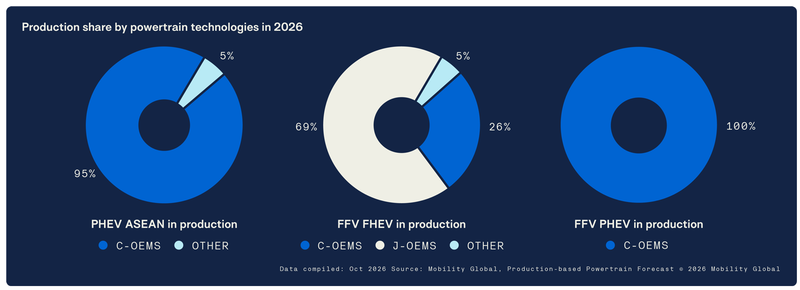
At the briefing, Lee Sang-min, a senior researcher in Mobility Global’s powertrain division, said, “When people say Chinese automakers are a threat, everyone talks only about low-cost electric vehicles,” adding, “But the market that really matters to automakers is one built around internal combustion engines.” He explained that Chinese automakers’ hybrids and PHEVs pose a greater threat than their electric vehicles.
Established automakers have entered emerging markets in stages, starting with internal combustion engine vehicles, followed by hybrids and then PHEVs. The higher the fuel efficiency, the higher the price. Chinese automakers, by contrast, are offering PHEVs for less than established automakers’ full hybrids (FHEVs), changing consumers’ expectations themselves, he explained.
According to Mobility Global’s forecast for this year, Chinese automakers account for 95% of PHEV production in ASEAN. Japanese automakers produce 69% of flex-fuel vehicle (FFV) hybrids, which run on a blend of ethanol and gasoline, while Chinese automakers produce 26%. Only Chinese automakers currently produce models that combine FFV and PHEV technologies.
The gap in development speed was also identified as a threat. The researcher said, “Global automakers’ new-vehicle development cycles are 36–48 months, while China is targeting 18–24 months,” adding, “For every new vehicle developed once by a global automaker, China is going through almost two cycles.” He continued, “This isn’t a forecast for 2030 or 2035—the vehicles are already entering production and the competition is underway,” and emphasized, “Things are fine for now, but the biggest threat is how we’ll compete with vehicles one or two generations from now.”
Regulatory trends are also turning in China’s favor. The United States is pushing to delay its Tier 4 emissions standards, while the standards under Euro 7 in Europe and KLEV4 in South Korea have also been relaxed. China, by contrast, is preparing to implement China 7 in 2028.
The researcher said, “Internally, we expect China 7 to be about as stringent as the draft version of Euro 7,” adding, “Chinese automakers are developing cleaner hybrids and pushing them into emerging markets at low prices.”
■ China’s weak domestic demand fuels “push exports”... “Potential for a balloon effect”
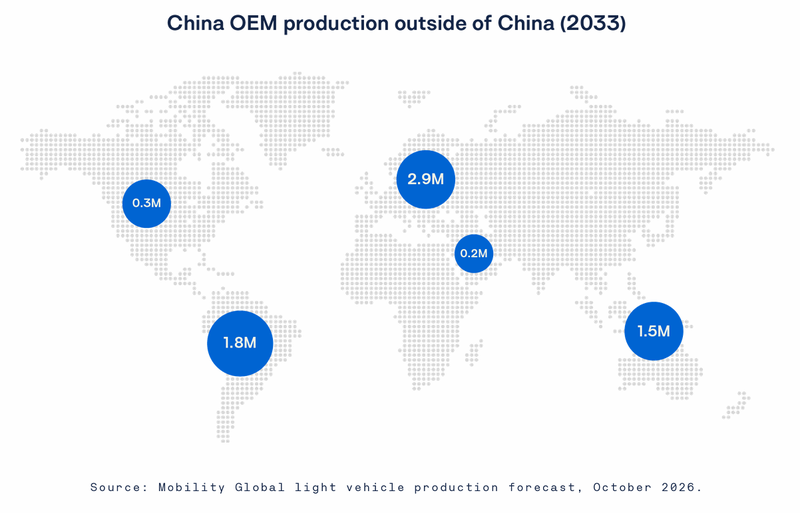
Chinese automakers are expanding local production as well as exports. Mark Fulthorpe, head of global production forecasting at Mobility Global, forecast that Chinese automakers’ overseas production in 2033 would reach 2.9 million vehicles in Europe, 1.8 million in South America, and 1.5 million in Asia.
He said, “Established automakers are focused on the relatively protected U.S. market, so competition will intensify,” adding, “South Korean companies will have to consider how to maintain their plant utilization rates.” Mobility Global forecasts that North America will account for 63% of exports from South Korean plants this year.
The domestic market is no safe haven either. According to the Korea Automobile & Mobility Association (KAMA), Chinese-made vehicles—including Teslas made in China—accounted for 41.2% of South Korea’s imported-car market in the first half of this year, overtaking Germany’s 30.1% for the first time.
Asked whether intensifying protectionism could create a balloon effect, with Chinese cars flowing into markets with low barriers such as South Korea, Vice President Lehne replied, “That’s possible.” He cited Europe, Türkiye, Brazil, Mexico, Thailand, and India, explaining, “Many countries raise trade barriers as soon as Chinese vehicles begin entering their markets.” On South Korea, he said, “It’s a special case where strong domestic automakers have protected the market, so a separate scenario analysis is needed,” adding, “We haven’t yet developed a specific scenario in which Chinese cars flow into the country in large numbers.”
In this connection, Mobility Global outlined a scenario for the United States. Vice President Lehne forecast, “If the U.S. market, which is currently closed to Chinese automakers, opens up to them, Chinese brands will capture the entry-level price points in every segment, reaching 1.4 million vehicles by 2030.”
[email protected] Kim Dong-chan Reporter