Toss Securities: “AI Has Transformed the Memory Market ... Semiconductor Cycles Set to Become Less Volatile”
- Input
- 2026-10-29 14:25:28
- Updated
- 2026-10-29 14:25:28
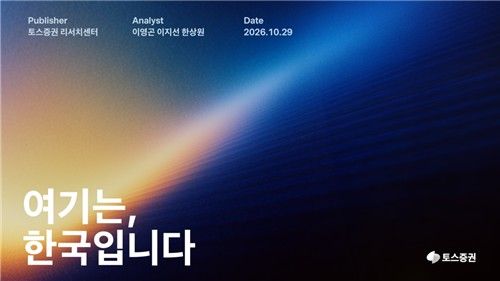
[Financial News] Toss Securities’ Research Center said on the 29th that it had published a report titled “This Is Korea,” analyzing changes in South Korea’s memory semiconductor industry amid the growth of the artificial intelligence (AI) industry.
The report covers the business strategies presented by Samsung Electronics and SK hynix at Korea Premium Week 2026, as well as the history of South Korea’s semiconductor industry explored during a visit to the Samsung Innovation Museum (SIM).
The Research Center analyzed that the growth of the AI industry has made memory a key factor determining system performance. It forecast that memory’s share of the overall semiconductor market would rise from about 30% in past boom periods to more than 50% this year.
It said that as the use of AI inference and agents increases, memory demand is expanding beyond high-bandwidth memory (HBM) to conventional DRAM and NAND. However, it said supply shortages could persist due to reduced investment during the previous downturn and the time needed to bring new factories online.
The report also compared the two companies’ next-generation HBM strategies. It said Samsung Electronics was touting a “one-stop solution” that leverages its business structure spanning memory, foundry and packaging, while SK hynix was promoting an integrated, ecosystem-centered strategy based on collaboration with customers, foundry companies and others from the early stages of design.
The report forecast that this memory cycle would have narrower swings than those of the past. It cited a shift in the center of demand from consumer devices to Big Tech’s AI investments, and the fact that expanding HBM supply requires not only production facilities but also stacking equipment, packaging and customer qualification. It also pointed to the rise in long-term supply agreements (LTAs) with stronger binding terms, such as advance payments, penalties and minimum-price clauses.
The report also outlined the characteristics of different types of domestic semiconductor exchange-traded funds (ETFs), classifying them as funds focused on Samsung Electronics and SK hynix, market-cap leaders, the value chain and active strategies, or materials, components and equipment.
Center Director Lee Young-gon said, “Booms and downturns in the memory industry will continue to recur, but this cycle is different from those of the past in that memory has become fully connected to the massive investment trend that is AI.” He added, “The market’s focus is expected to expand beyond the scale of profits during boom periods to include how steadily profitability can be maintained even during future downturns.”
[email protected] Joo Won-gyu Reporter