‘55.8 Billion Won Coin Scam’ Ringleader Gets 18 Years and 6 Months on Appeal; Victims to Seek Redress Through Civil Suits After Confiscation Reversed
- Input
- 2026-10-29 15:56:44
- Updated
- 2026-10-29 15:56:44
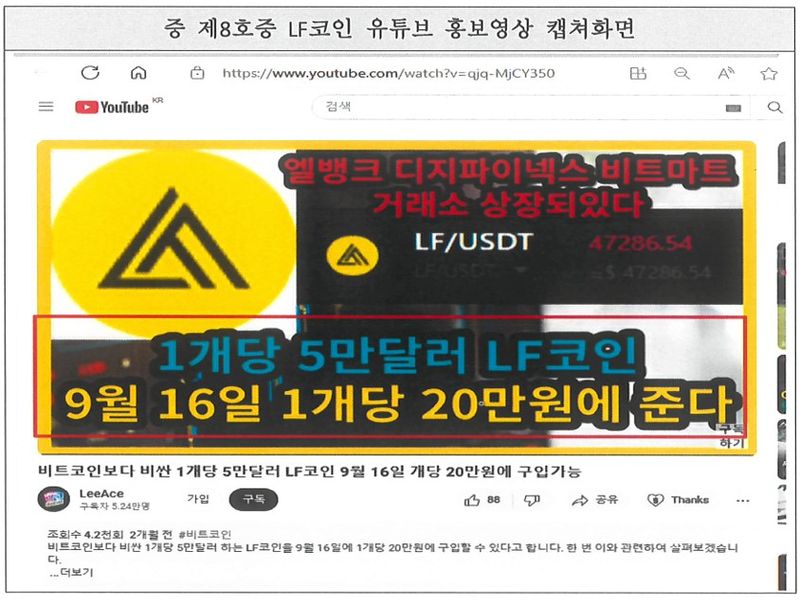
[Financial News] The ringleader of the ‘LF Coin’ scheme, who was sentenced to 20 years in prison at trial after being accused of defrauding investors of tens of billions of won through cryptocurrency (coin) investments and illegal quasi-deposit-taking, had the sentence reduced to 18 years and six months on appeal. For legal reasons, the appellate court overturned the first-instance order for confiscation and dismissed all compensation applications, leaving victims to seek direct recovery through individual civil lawsuits rather than state confiscation and restitution.
On the 29th, the Seoul High Court’s 2nd-3rd Criminal Division, presided over by Judge Cho Eun-a, overturned the lower court’s ruling and sentenced the ringleader to 18 months and 17 years in prison, for a total of 18 years and six months. The sentence was handed down at the appeals hearing for the LF Coin Foundation, which had been indicted on charges including fraud under the Act on the Aggravated Punishment, etc. of Specific Economic Crimes and violations of the Act on the Regulation of Similar Receiving.
The two-and-a-half-year prison term for co-defendant Ha, who was indicted alongside the others, was upheld, but the first-instance confiscation order was overturned. Another Lee’s sentence was reduced to two months in light of a separate finalized judgment and other factors. The original sentences were upheld for the other co-defendants: Lee (two years in prison), Kim (six months), and Kang (two years and six months).
The court said, “They have not sought forgiveness from the victims, nor have they shown any notable efforts to provide redress by the time of this trial,” adding, “There appears to have been no change in circumstances since the lower court’s ruling.” It added, “We took into account the fact that the confiscation portion had been removed and that some settlements had been reached.”
They were indicted on charges including deceiving people with promises to guarantee their principal and pay high dividends if they invested in coins and other assets, defrauding about 370 investors of approximately 11 billion won, and illegally raising more than 50 billion won in investment funds through quasi-deposit-taking schemes. Elderly and low-income victims were among those repeatedly ensnared by promises such as “principal guaranteed, daily profits,” and elderly victims also attended court that day to hear the verdict.
However, the victims’ compensation applications were dismissed at the hearing that day. The court called on them to seek redress through civil lawsuits.
The court explained, “In some cases, victims appear to have already received some money in the form of profits or allowances, and it is practically difficult for a criminal court to examine each case individually and determine the amounts,” adding, “It is more appropriate to pursue civil proceedings, where a thorough examination of the evidence can establish each party’s share of liability and allow each person to secure enforcement rights directly in their own name.”
It also emphasized, “Even if confiscation is not ordered in a criminal trial, account records and other evidence can establish the amount of the loss and the facts alleged in the indictment, making it possible to exercise a civil claim for the return of property,” adding, “Securing enforcement rights directly through individual civil lawsuits may provide victims with a more effective remedy.”
[email protected] Chang-hun Lee Reporter