Bringing AI and Robots to Factories ... 5 Trillion Won to Be Invested in SME Manufacturing Innovation
- Input
- 2026-10-29 14:52:02
- Updated
- 2026-10-29 14:52:02
The Ministry of SMEs and Startups (MSS) announced the “Strategy to Expand Physical AI in Small and Medium-Sized Manufacturing” at the 16th National Policy Coordination Meeting, chaired by the prime minister, held on the 29th at Chong Kun Dang in Cheonan, South Chungcheong Province.
The strategy’s core is to shift manufacturing innovation policy, which has focused on rolling out smart factories, to an autonomous manufacturing system combining data, AI and robots. The government plans to pursue the so-called “3X strategy,” linking digital transformation (DX), AI transformation (AX) and robotics transformation (RX) at small and medium-sized manufacturers.
Small and medium-sized manufacturers have laid the digital foundations for their production sites by building smart factories, among other measures. However, limited investment capacity and a shortage of skilled workers have constrained their ability to introduce AI and robots across production processes. There have been calls to strengthen policy coordination linking technology development with testing and deployment, so that foundational AI technologies and industry-specific models developed at the national level can reach the actual manufacturing sites of SMEs.
To this end, the government plans to invest at least 5 trillion won in smart manufacturing innovation by 2030, supporting the digital transformation of 30,000 small and medium-sized manufacturers and AI adoption at 6,000 of them. It aims to raise the digital transformation rate among these manufacturers from its current level of around 30% to 50%, and the AI adoption rate from 1% to 10%.
First, the MSS will provide phased support for digital transformation and AI adoption based on each SME’s level of technological capability. It will help companies at the basic stage obtain data by building smart factories, and expand the adoption of process-specific AI and autonomous factories at companies with the necessary capabilities. It also plans to promote manufacturing innovation, focusing on promising regional companies and new growth sectors such as new security, pharmaceuticals and biotech, climate tech and K-consumer goods.
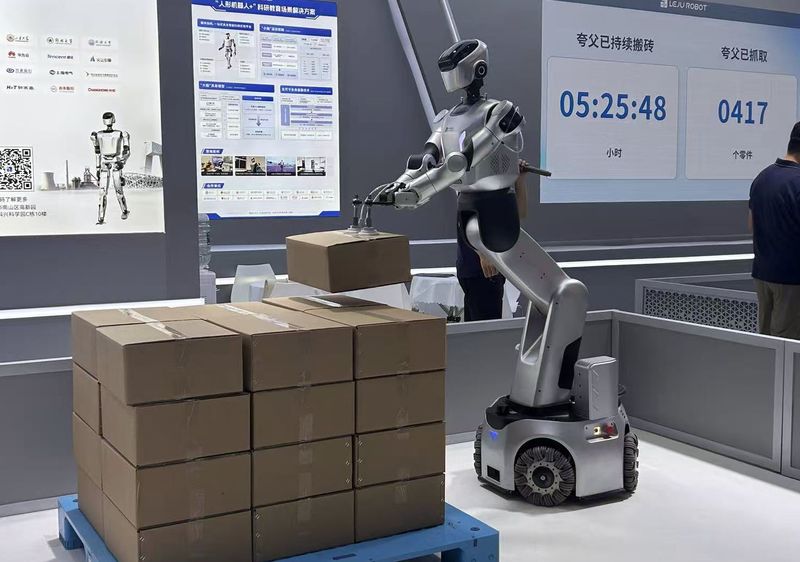
In particular, the government plans to expand demonstrations of physical AI, in which AI and robots operate together at actual manufacturing sites. It will deploy various industrial robots—including articulated, collaborative and mobile logistics robots—to around 1,000 small and medium-sized manufacturers.
The government will also foster SMEs that supply smart manufacturing technologies. It plans to provide linked support for technology development, demonstrations and overseas expansion, and to designate outstanding companies as specialized smart manufacturing firms, fostering 500 of them by 2030.
The government will also improve the related infrastructure so that data collected at manufacturing sites can be used to develop AI technologies and improve production processes. It plans to upgrade the existing AI Manufacturing Platform (KAMP) into “Manufacturing AI 24” and establish a system that links every step, from data collection to standardization and assetization, AI model development and on-site application.
The government will also increase the value of using manufacturing data held by companies. It plans to assess the data’s economic value and recognize it in government support programs in the same way as an in-kind contribution, easing companies’ financial burden. In such cases, ownership of the data will remain unchanged to protect manufacturers’ trade secrets.
The government will also expand infrastructure and specialist training to support the use of AI by regional manufacturers. It plans to link regional hubs, including Manufacturing AI Data Centers, with demonstration facilities and train AI specialists, focusing on the four institutes of science and technology.
Lee So-young, minister of the MSS, emphasized, “Small and medium-sized manufacturing sites will become stages for innovation where physical AI is demonstrated and deployed. We will actively support SMEs by linking and integrating their transitions to data, AI and robotics, enabling them to innovate their production methods, strengthen their technological capabilities and grow into central players in national strategic projects.”
[email protected] Lee Jumi Reporter