Parties Unite to Protect Platform Workers; Push to Enact ‘Basic Act for Working People’ Gains Momentum
- Input
- 2026-10-29 15:07:56
- Updated
- 2026-10-29 15:07:56
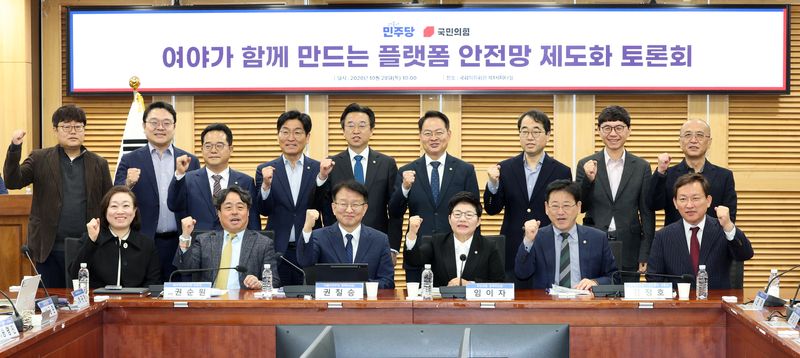
[Financial News] The policy committees of the ruling and opposition parties have agreed to work together on legislation to protect platform workers. The Democratic Party of Korea and the People Power Party have each previously introduced the Basic Act for Working People and the Act on Support and Protection for Workers in Vulnerable Situations, respectively, to address blind spots in labor protections, and they reached consensus on pursuing the legislation within the year.
The policy committees of the Democratic Party of Korea and the People Power Party held a forum on institutionalizing a platform safety net jointly created by the ruling and opposition parties at the National Assembly Members’ Office Building on the 29th. The event followed up on an agreement made by the policy committee chairs of both parties on the 15th of last month to expedite action on their shared pledges.
The forum was held to discuss legislation to fill gaps, eliminate blind spots and reflect changes in reality, as new forms of work—including platform work, special-type employment and freelancing—continue to grow. Kwon Chil-seung, the Democratic Party’s policy committee chair, said, “Protecting the rights of working people and ensuring appropriate compensation and a safety net are matters directly tied to everyone’s lives.” He pointed out, “If we fail to reflect the reality that new forms of work continue to grow, the burden will ultimately be shifted to working people, especially workers in blind spots.”
The People Power Party also plans to cooperate on livelihood legislation. Im Lee-ja, the party’s policy committee chair, said, “Even if political strife intensifies, we must not allow issues affecting people’s livelihoods or policies for the public good to grind to a halt,” and proposed, “On livelihood issues at least, let the ruling and opposition parties unite and build a strong support system for platform workers.”
The government and ruling party are pursuing the Basic Act for Working People. A total of eight related bills have been introduced by the ruling camp, but they remain pending, with substantive review yet to begin at the Climate, Energy, Environment and Labor Committee, the committee with jurisdiction over them. The bills aim to guarantee comprehensive and universal rights as a “working person,” regardless of contract type. Because current labor laws have limitations in protecting the rights of new types of workers, such as platform workers, the goal is to enact a new basic law and fill the gaps.
The People Power Party has also previously introduced a bill to protect workers in vulnerable situations, led by Chair Im. The bill was drawn up through consultations between the party and the government when the People Power Party was the ruling party during the Yoon Suk Yeol administration. Its key provisions include establishing standard contracts, creating a system to prevent nonpayment of wages and setting up a dispute mediation committee. Im explained, “Although there are differences in our approach and the details, our ultimate goal is the same: to protect working people left in blind spots.”
Some disagreement is expected, however, over the presumption-of-worker-status system. The Ministry of Employment and Labor had initially maintained that an amendment to the Labor Standards Act establishing this system should be legislated as a package with the Basic Act for Working People. The system refers to an amendment that would presume that “a labor service provider who directly provides services and receives compensation” is an employee. People Power Party leader Jang Dong-hyeok has previously criticized the system as “a bill that puts a noose around businesses’ necks,” and is therefore expected to voice opposition. On this issue, Democratic Party lawmaker Lee Yong-woo argued, “Unless we work together to overcome the situation in which people who are workers are not recognized as workers and are denied protection of their rights, the basic law could be half a law—or even less,” adding, “It must be passed as a package.”
[email protected] Lee Hae-ram Reporter