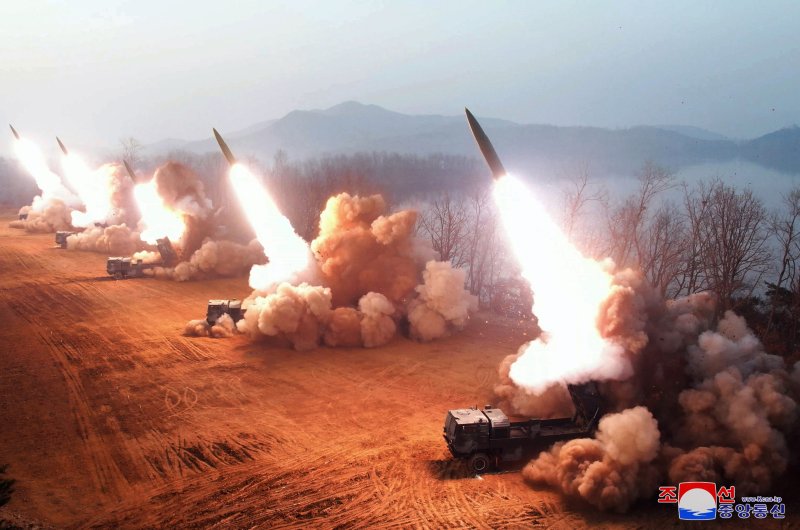
Korean Central Television (KCTV) reported that North Korean leader Kim Jong Un guided on site a fire-strike drill by the Hwasong Artillery Unit, which is responsible for key operational missions on the western front, on March 9, 2023. Kim watched the launch of the “new-type tactical guided weapon,” a short-range ballistic missile (SRBM), accompanied by his second daughter, “Ju Ae,” and called for building up overwhelming response capabilities. Screenshot from KCTV [Financial News] North Korea carried out a high-intensity armed provocation on the 29th, suddenly launching a salvo of around 10 short-range ballistic missiles toward the East Sea. It was North Korea’s 18th ballistic missile provocation this year and marked the resumption of such launches after 17 days. North Korea had previously fired several ballistic missiles from the Pyongyang area on the 12th. Those missiles flew at least 900 km over the East Sea. South Korean military authorities immediately stepped up surveillance and vigilance and activated a real-time intelligence-sharing system through trilateral cooperation among South Korea, the United States and Japan. The surprise provocation is seen both as a military response to the recently adopted, emphatic resolution rejecting recognition of North Korea as a nuclear-armed state at United Nations Headquarters in New York, and as a show of force in reaction to the coordination on pressure against North Korea that Defense Minister Kang Shin-cheol secured through a series of meetings with key ASEAN allies at a multilateral diplomacy forum in the Philippines.
■ JCS detects around 10 short-range ballistic missiles and other projectiles from Wonsan... Flew about 250 kmAccording to the Joint Chiefs of Staff (JCS), the South Korean military detected around 10 short-range ballistic missiles (SRBMs) and other projectiles launched toward the East Sea from the Wonsan area of North Korea at around 12:30 p.m. on the 29th. North Korean forces are believed to have conducted missile test-launch drills using various means besides 600-mm multiple rocket launchers (SRBMs). The detected North Korean missiles flew about 250 km, and South Korea and the United States are conducting a detailed analysis of their exact specifications. The JCS also said that South Korea and the United States closely monitored the missiles from the preparation stage and detected and tracked them immediately after launch. The South Korean military emphasized that, under its robust combined defense posture with the United States, it is closely watching North Korea’s various activities and maintaining the capability and readiness to respond overwhelmingly to any provocation. Military authorities are strengthening all-around surveillance and vigilance in preparation for the possibility of further missile launches by North Korea. North Korea’s simultaneous launch of around 10 missiles is interpreted as an attempt to maximize military tensions in the region by showcasing its ability to saturate a specific area with an attack.
■ Military backlash against the UN First Committee’s adoption of a resolution rejecting recognition of North Korea as a nuclear-armed stateNorth Korea’s latest provocation is also believed to have been prompted in part by a recent, serious diplomatic decision by the international community. On the 27th, local time, the First Committee of the United Nations General Assembly, which handles disarmament and international security, adopted a resolution at United Nations Headquarters in New York. It said North Korea could never be recognized as a nuclear-weapon state and strongly called for complete, verifiable and irreversible dismantlement (CVID). The resolution passed with an overwhelming 150 votes in favor.
Despite the North Korean delegation’s strong objections at the meeting, international pressure measures became tangible in the form of a resolution. The North Korean leadership effectively responded with the physical act of “launching a salvo of missiles over the East Sea,” signaling its resolve to break out of diplomatic isolation and not yield on its policy of maintaining nuclear forces. Analysts say North Korea’s characteristic brinkmanship mechanism has been activated, with the country confronting an international legal resolution through military defiance.
■ A move to block Minister Kang Shin-cheol’s ASEAN front of “defense sales and coordination against North Korea”The provocation is also analyzed as being related to the Philippines, where the 13th ASEAN Defence Ministers’ Meeting-Plus (ADMM-Plus) is being held, and to the recent activities of Defense Minister Kang Shin-cheol. On the 28th, Kang held a series of bilateral meetings in the Philippines with defense chiefs from key allies in the Indo-Pacific region, including the United States, Japan, Malaysia, India and the Philippines.
During the series of meetings, Kang shared details of the landmine explosion in the Demilitarized Zone (DMZ) involving North Korea in September and stressed the need for firm international coordination to respond to deepening North Korea-Russia military cooperation. He secured active support from ministers of ASEAN countries.
North Korea is likely to view as a security threat the trend of key ASEAN countries strengthening technological and security cooperation based on South Korea’s K-weapons systems and closing ranks with the South Korea-led front for pressure against North Korea. North Korea is therefore believed to have sent an indirect warning to allied countries in the region—“Do not align with the South Korea-led security cooperation framework”—by launching a salvo of ballistic missiles from the Wonsan front, in waters adjacent to the ASEAN diplomatic forum.
A military official emphasized, “North Korea’s latest provocation is a paradoxical expression of anxiety over diplomatic isolation,” adding, “Our military is maintaining a firm state of readiness, based on trilateral cooperation among South Korea, the United States and Japan, to respond immediately and overwhelmingly to any asymmetric provocation North Korea may attempt.”
Meanwhile, the latest provocation was carried out while North Korea had not responded to the Ministry of National Defense’s proposal on the 23rd for inter-Korean military talks to resolve differences in how the two Koreas understand the Military Demarcation Line (MDL) and discuss restoring military communication lines. It is also seen as an attempt to use a show of force to signal that it will not accept the South’s offer of dialogue and to increase pressure on South Korea.
The Korean Central News Agency reported that North Korean leader Kim Jong Un guided on site a fire-strike drill by the Hwasong Artillery Unit, which is responsible for key operational missions on the western front, on March 9, 2023. Kim’s second daughter, “Ju Ae,” also accompanied him to the drill site. At the site, Kim stressed that “we must thoroughly deter the risk of military conflict on the Korean Peninsula by maintaining and continuously building up a powerful capability to respond overwhelmingly and overpower at any time.” Screenshot from KCTV [email protected] Lee Jong-yoon Reporter