Labor groups demand stronger state responsibility for care, urge National Assembly to increase budget for improving working conditions
- Input
- 2026-10-29 14:58:24
- Updated
- 2026-10-29 14:58:24
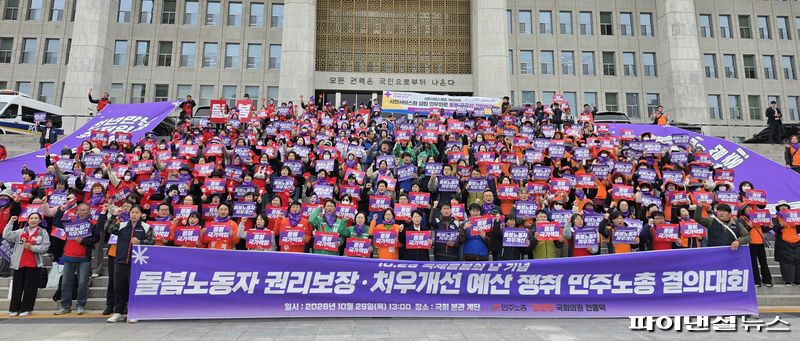
At around 1 p.m. on the 29th, the Korean Confederation of Trade Unions (KCTU) held a “Rally to Secure a Budget for Guaranteeing Care Workers’ Rights and Improving Their Working Conditions” on the steps in front of the National Assembly Main Building in Yeouido, Seoul. KCTU called for an increase in next year’s budget for improving care workers’ working conditions, expansion of public care facilities, and mandatory establishment and direct operation of a Social Service Agency by each local government.
At least 200 people attended the rally, including Progressive Party lawmaker Jeon Jong-deok, officials from KCTU-affiliated organizations such as the Public Solidarity Union, the Korean Public Service and Transport Workers’ Union (KPTU), the National Care Service Workers’ Union, the Dagachi Union and the Korean Health and Medical Workers’ Union (KHMU), as well as care workers. Participants held placards reading “State responsibility for care” and other messages, and chanted, “Minimum wage forever—improve care workers’ working conditions!”
According to KCTU, most of the approximately 1.3 million care workers are employed in hourly-wage jobs paying around the minimum wage, and are either denied recognition for their experience or tied to part-time or fixed-term contracts.
In his opening remarks, KCTU Vice Chair Jeon Ho-il said, “Since May, we have held labor-government consultations with the government to improve care workers’ working conditions, and agreed to raise base pay and allowances such as transportation expenses.” He added, “But none of the measures to improve working conditions agreed on by labor and the government have been included in the government’s budget proposal, which is up 12.8% from the previous year to 820.9 trillion won. I condemn the Lee Jae Myung government, which pays lip service to state responsibility for care.”
He continued, “The care sector is already on the brink of collapse. In reality, care workers are treated as cheap, expendable supplies and are leaving their jobs amid fragmented contracts for just 59.5 hours a month and a perpetual minimum wage that does not recognize their skills at all.” He said, “Starting today, KCTU will launch a campaign to meet with lawmakers on the Budget and Accounts Committee and the Health and Welfare Committee. We strongly urge the National Assembly to increase and allocate funding to improve care workers’ working conditions—funding the government has ignored.”
Park Dae-jin, head of the Social Services Division of the Medical Solidarity Headquarters of the Korean Public Service and Transport Workers’ Union, said, “The government provides funding but shifts responsibility for service delivery and employment onto individual institutions.” He noted, “As a result, care institutions have to cut operating costs while working with limited reimbursement rates and subsidies, ultimately leading to low wages and insecure employment for care workers.”
Park proposed a major expansion of public institutions in the disability care sector, as well as public daycare centers and public long-term care facilities. He also stressed that Social Service Agencies and comprehensive home-care centers should be established by mandate so public institutions can provide services directly and employ workers securely.
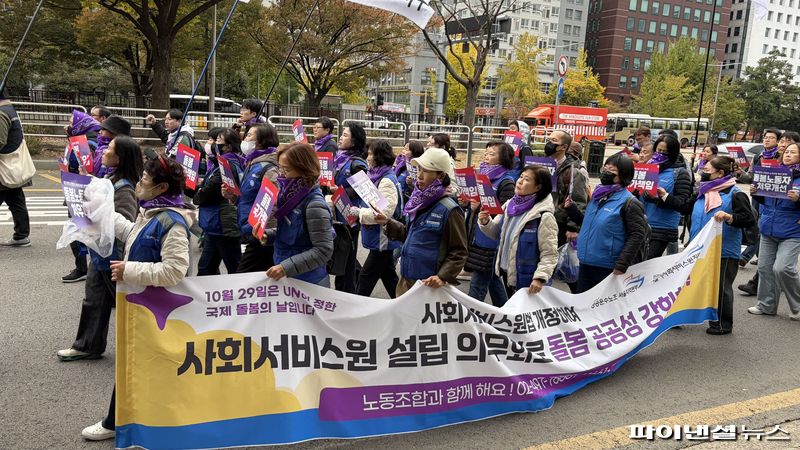
After the rally, participants marched to the headquarters of the People Power Party and the Democratic Party of Korea, repeatedly chanting, “National Assembly, increase the budget for improving care workers’ working conditions!”
Earlier that day, at 10 a.m., labor and civil society groups including the Federation of Korean Trade Unions, KCTU, People’s Solidarity for Participatory Democracy and the Korean Women Workers Association also held a joint press conference in front of the fountain at Cheong Wa Dae in Jongno-gu, Seoul, calling for care to be made more public.
In their joint statement, the participating organizations criticized the excessive reliance on for-profit and private markets for care despite ultra-low birth rates and rapid population aging, saying, “As long as the low-wage system that fails to recognize workers’ experience is left unaddressed, ‘high-quality care’ is nothing but fiction.”
They called on the government to enshrine the right to care in the Constitution and enact a Framework Act on Care; protect care users’ right to self-determination; protect workers’ labor rights and recognize the value of their work; expand paid sick leave and sickness benefits; and guarantee the right to form diverse family structures.
[email protected] Seong-hyun Park Reporter