Gimpo, Goyang and Hanam call for prerequisites after government announces new housing sites; Guri welcomes the plan
- Input
- 2026-10-29 15:05:00
- Updated
- 2026-10-29 15:05:00
【Financial News, Gimpo, Goyang, Hanam and Guri — Kim Kyung-soo】 Local governments have responded differently to the government’s announcement of new public housing sites in the Seoul metropolitan area. Gimpo, Goyang and Hanam set out prerequisites to address worsening traffic and secure self-sufficiency, calling for effective measures. Guri City, by contrast, welcomed the announcement and said it expected it to provide an opportunity for the Sano-dong area to emerge as a new growth hub.
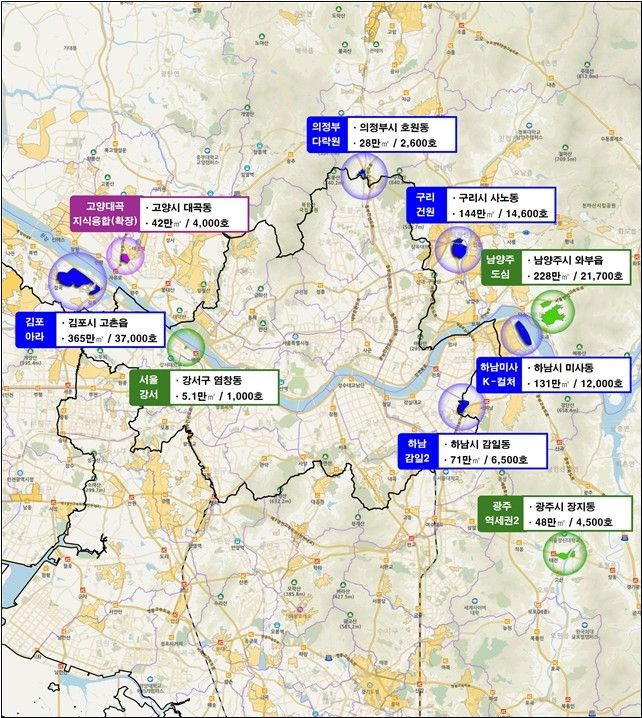
The new public housing sites in the Seoul metropolitan area announced by the Ministry of Land, Infrastructure and Transport on the 29th comprise six districts and a total of 76,700 housing units. The planned supply by area is 37,000 units in Gimpo Ara (Gochon-eup, Gimpo), 14,600 in Guri Geonwon (Sano-dong, Guri), 12,000 in Hanam Misa K-Culture (Misa-dong), 6,500 in Hanam Gamil 2 (Gamil-dong), 4,000 in the expansion of the Goyang Daegok Knowledge Convergence District (Daegok-dong, Goyang Special City), and 2,600 in Uijeongbu Darakwon (Howon-dong, Uijeongbu).
Although local governments have differing positions, they share the challenge of prioritizing the expansion of urban infrastructure, including transport networks and jobs.
In Gimpo, concerns have been raised that large-scale housing construction could worsen traffic congestion. Critics say the burden could grow further if additional land is developed while the Gimpo Hangang New Town and Gimpo Hangang 2 Compact City projects are under way.
Congestion on the Gimpo Goldline during commuting hours currently reaches about 170% of capacity. With construction on the extension of Seoul Subway Line 5 not scheduled to begin until 2031, calls are growing for effective metropolitan transport measures to be put in place before housing is supplied.
Gimpo Mayor Lee Gi-hyeong expressed regret over the government’s announcement of the candidate site for the Gimpo Ara public housing district, saying metropolitan transport measures and plans to strengthen self-sufficiency should come first. He urged the government to “put in place practical measures to ease Gimpo residents’ transportation difficulties, including extensions of Lines 5 and 9, a new Seogwanggeup station, construction of Hyangsan Bridge, and full undergrounding of the Gyeyang-Ganghwa Expressway.”
Goyang City said it agreed with the aim of the government’s policy to stabilize the housing market in the Seoul metropolitan area, but stressed that the city must move beyond being a “bedroom community” focused solely on housing supply. Its position is that, after years of supplying housing, it should expand its industrial and employment base and become a self-sufficient city where homes and jobs coexist.
The city pointed out that, in past large-scale land development projects, promises to secure land for self-sufficiency were repeatedly followed by reductions in the allocated land or changes to its use, citing rising construction costs, changing project conditions and financial constraints. Goyang City therefore called for the self-sufficiency functions in the Daegok district expansion project to be finalized at the planning stage and effectively guaranteed throughout the project.
Hanam City likewise says it should proactively expand self-sufficiency functions and metropolitan transport networks alongside the development of new housing sites. In a statement issued that day, Hanam Mayor Hyunjae Lee expressed sympathy for residents who would lose their homes as a result of the housing supply plan and emphasized the need to build a new town equipped with jobs and transport infrastructure. He said the city should address its inadequate employment base, which has been constrained by overlapping regulations, and create a “work-home-leisure” city where jobs, homes and leisure come together.
To that end, Hanam City asked the government to support the successful development of the K-Culture complex, build a new station on Subway Line 3 and open it before residents move in, include an extension of the Wirye–Sinsa Line to Gamil, and improve the grade separation at the Seo Hanam IC. It also said measures should be put in place to help original residents resettle and secure their livelihoods, and to narrow the gap between the new town and the old city center.
Guri City, by contrast, welcomed the announcement of the government’s new public housing site, the “Guri Geonwon District.” It expects the announcement to be an important turning point that will help the Sano-dong area emerge as a new growth hub.
The Guri Geonwon District project will supply 14,600 housing units across approximately 1,437,882 square meters in the Sano-dong area. Guri City expects the announcement to give long-stalled local development projects fresh momentum and accelerate the area’s development.
Guri Mayor Shin Dong-hwa said, “The Guri Geonwon District is a project that must take into account not only housing supply but also the future structure and direction of development of the city.” He added, “We will ensure the relocation of the Guri Agricultural and Marine Products Wholesale Market, which MOLIT announced as a proposal, proceeds without a hitch, develop the Sano-dong area into a distribution hub for the northeastern Seoul metropolitan area, and dramatically improve transport infrastructure, including by building Sano Station.”
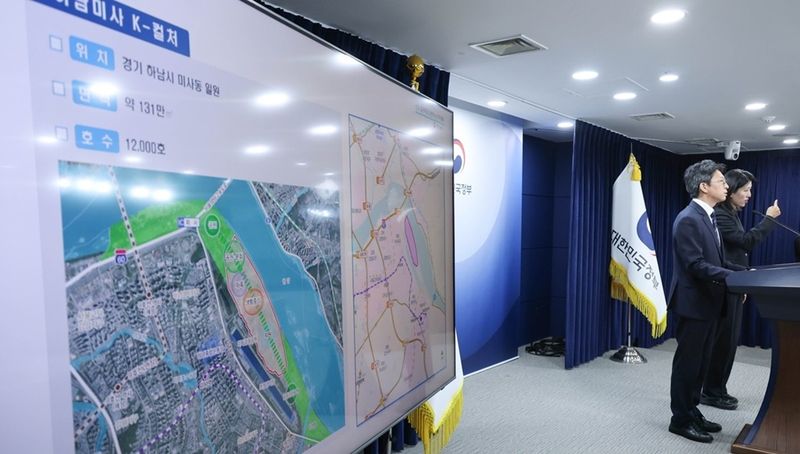
Meanwhile, the Ministry of Land, Infrastructure and Transport held its regular housing supply briefing that day at the Government Complex Seoul in Jongno-gu, Seoul, and announced six additional candidate sites for new housing developments, totaling 76,700 units. This is a follow-up to the plan in the previously announced Aug. 13 measures to supply 100,000 housing units at new sites.
[email protected] Kim Kyung-soo Reporter