Seoul sets next year’s budget at ₩55.7445 trillion, prioritizing investment in youth AI and housing supply
- Input
- 2026-10-29 13:05:10
- Updated
- 2026-10-29 13:05:10
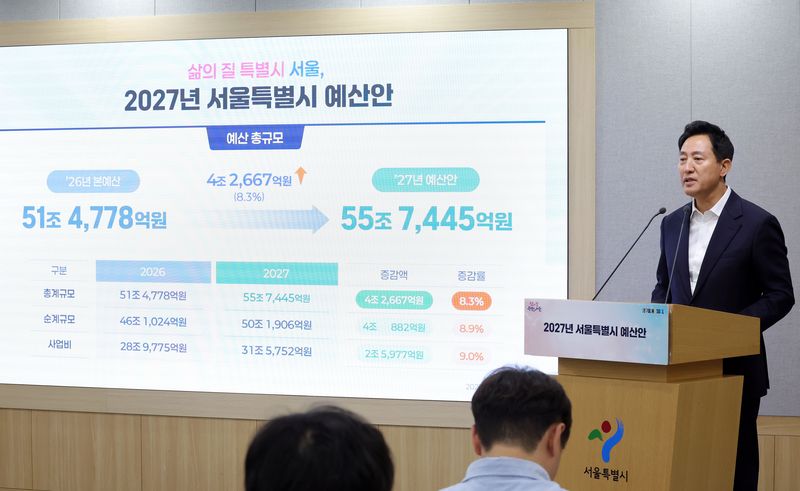
Seoul said on the 29th that it had announced its 2027 budget proposal and would submit it to the Seoul Metropolitan Council on the 30th.
Next year’s budget is ₩4.2667 trillion higher than this year’s original budget of ₩51.4778 trillion. The net budget, excluding double-counted amounts from transfers between accounts, is ₩50.1906 trillion, up 8.9%. Policy program spending, excluding support for education offices and autonomous districts as well as administrative operating expenses, totals ₩31.5752 trillion, a 9.0% increase from this year.
Seoul said that its share of costs for national subsidy programs had risen by ₩1.17 trillion from this year as the government expanded programs such as marriage and child-rearing support, but that it had curbed debt growth through efficient allocation of resources. The city plans to keep its debt balance at the end of next year at ₩11.569 trillion, close to this year’s forecast of ₩11.5695 trillion.
The budget’s fiscal approach is to increase overall spending and policy program funding without adding to the debt. However, with mandatory spending on national subsidy programs rising, securing stable funding for the city’s own policy programs remains a challenge.
The most prominent new program is the “Youth AI Growth Voucher,” which will target 500,000 young people. Seoul will invest ₩26.6 billion to provide generative AI access vouchers and tailored education suited to different skill levels. The aim is to provide support early so that differences in AI skills do not lead to gaps in employment and income.
Seoul has allocated ₩22.3 billion to “Seoul Young Careers,” which connects young people’s career exploration with employment. It will invest ₩46 billion in the Seoul Youth Job Academy to train 4,500 AI professionals needed in industry.
The city will also step up support for future growth industries. It will invest ₩16.4 billion in the Yangjae AI Innovation District and ₩48.4 billion in developing the Hongneung bio-medical cluster. Seoul has allocated ₩35.1 billion to the Seoul Creative Industry Hub, which links content creation and experiences with commercialization, and plans to open it in the second half of next year.
To promote housing stability, Seoul will combine public rental housing supply with support for private redevelopment projects. The city plans to invest a total of ₩1.1228 trillion to supply 27,200 public rental homes: 20,736 purchased units, 3,100 leased units and 3,364 newly built units.
Seoul will newly supply 500 Seoul-style Sprout Studio Apartments for university students and acquire 3,027 new Safe Homes for young people and newlyweds. It has allocated ₩10.8 billion to Rapid Integrated Planning 2.0 and ₩12.3 billion to Moa Town and Moa Housing to support the swift progress of private redevelopment projects.
The number of people eligible for youth rent assistance will rise by 9,000, from 23,000 this year to 32,000 next year. The related budget is ₩126.2 billion. Seoul will also invest ₩75.8 billion in interest support for rental-deposit loans for newlywed couples and young people who do not own homes.
The focus is on easing immediate housing costs, including rent and loan interest, alongside expanding housing supply. However, public housing projects and private redevelopment projects are at different stages, so the timing of when budget spending translates into more homes available for occupancy may vary.
Seoul will also expand its “Companion with the Vulnerable” policy, which supports vulnerable groups and small business owners. Next year’s budget for the policy will be ₩17.6892 trillion, up ₩2.0533 trillion (13.1%) from this year.
The city will increase the budget for livelihood, medical and education benefits to ₩4.8054 trillion in line with the rise in the standard median income and other factors. It will invest ₩780.6 billion in public jobs for middle-aged people, older adults, people with disabilities and low-income groups.
Seoul will also introduce a “Seoul-style Sandwich Generation Pension” to help cover income gaps for 10,000 middle-aged people approaching retirement. It will expand Ittda Place, which aims to address loneliness and social isolation, to six locations, and increase the number of Seoul Mind Convenience Stores from 25 to 31.
To support small business owners, Seoul will provide ₩3 trillion in loans through its small and medium-sized business development fund and increase issuance of Seoul-wide Love Gift Certificates to ₩200 billion.
Funding has also been allocated to the “24-hour Vibrant Economy,” a key policy of Seoul’s ninth popularly elected administration. The city will invest ₩10.5 billion to add 10 Seoul Moonlight Night Market sites to boost nighttime spending in neighborhood commercial districts, increasing the total from six to 16.
Seoul will expand nighttime activities at Hangang Park. It will increase the number of tents available for its summer Hangang night-camping program from 200 to 300 per day and create nighttime recreational sports spaces at Ichon and Gwangnaru Hangang Parks. The city will spend ₩10 billion to improve nighttime scenery along an approximately 4-kilometer stretch covering Jamwon Hangang Park and the areas around Hannam, Dumo and Dongho bridges.
Seoul will invest ₩5.6 billion in making the DDP 365 Light Show a permanent fixture. It has allocated ₩10.7 billion for year-round seasonal festivals, ₩53.3 billion to develop Nodeul Global Art Island and ₩22.2 billion to build the Second Sejong Center for the Performing Arts.
Investment in public health and urban safety will continue. Seoul will invest ₩58.9 billion in Wrist Doctor 9988, expanding its health management services beyond their existing focus on walking to include management of metabolic syndrome, dementia and smoking cessation.
Seoul will invest ₩236.2 billion in deep underground stormwater drainage tunnels at Gangnam Station, Gwanghwamun and Dorimcheon, as well as the construction or expansion of nine stormwater pumping stations. It has also allocated ₩410.9 billion to repair 113 kilometers of aging water pipes and 151 kilometers of sewer pipes.
The city will also invest in expanding its urban rail and road networks. It has allocated ₩138.3 billion to five urban rail projects: the Ui-Sinseol extension, the Dongbuk Line, the Gangbuk Crossing Line, the Seonam Line and the Seobu Line. Seoul will invest ₩132.1 billion in building the Gukhoe-daero underpass and creating a park above it, and ₩72 billion in an underpass for the Changdong-Sanggye section of the Dongbu Expressway.
Seoul has allocated ₩747.8 billion to public transportation fare support through the Climate Companion Pass. It also plans to continue city-specific benefits, including expanding the age range eligible for the youth discount from 34 to 39.
This budget proposal puts investment in young people’s future skills and housing stability front and center while also expanding existing policies in areas such as welfare, transportation and urban safety. Whether the first budget of the ninth popularly elected administration delivers results that residents can feel will depend on future deliberations by the Seoul Metropolitan Council and how each program is carried out.
Seoul Mayor Oh Se-hoon said, “Despite the increase in inflexible expenditures such as mandatory spending and the reverse discrimination in central government fiscal support, we have kept the debt from growing and expanded investment in what residents need in their daily lives. We will provide young people with opportunities to advance, residents deeply concerned about housing with greater stability, and those in need with a robust safety net.”
[email protected] Lee Seol-yeong Reporter