Death penalty sought again for Yoon on appeal over 'insurrection ringleader' charge... Special counsel: "No reason to hesitate to impose it"
- Input
- 2026-10-29 13:33:45
- Updated
- 2026-10-29 13:33:45
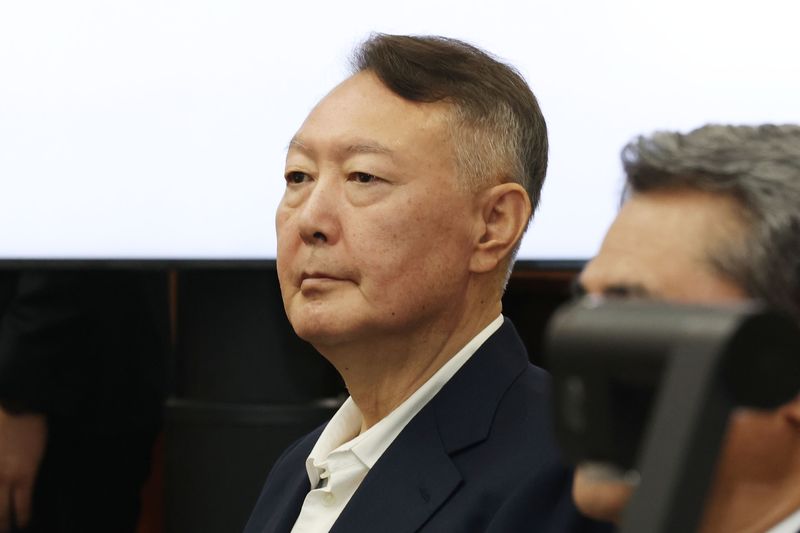
[Financial News] In connection with the December 3 Martial Law Incident, the special counsel team sought the death penalty—the maximum sentence under the law—on appeal for former President Yoon Suk Yeol, who was sentenced to life imprisonment in the first trial on charges including leading an insurrection. It also asked the court to overturn the lower court's ruling and impose heavy sentences on the military and police commanders indicted alongside him.
The special counsel team investigating the insurrection (Special Prosecutor Cho Eun-seok) sought the death penalty on the 29th at the final hearing in the appeal of charges including leading an insurrection against former President Yoon, held before Seoul High Court Criminal Division 12-1, comprising High Court Judges Lee Seung-chul, Jo Jin-gu and Kim Mina.
In its closing argument that day, the special counsel said, "The grounds on which the lower court chose life imprisonment do not fit the facts of the crime," adding, "The crime of leading an insurrection is one for which responsibility cannot be fully imposed without the death penalty."
The statutory penalties for the charge of leading an insurrection are limited to three: death, life imprisonment and life confinement. The first-instance court chose life imprisonment, citing factors including that the plan did not appear to have been drawn up with great care in advance; that martial law ended quickly and the military and police restrained their use of force; that a relatively small number of troops were deployed; that Yoon had a long career as a public official and no criminal record; and that he was 65, an advanced age.
The special counsel argued that the lower court's ruling was legally unsound and reduced the sentence by rejecting most of the evidence. It said the court treated the review of the requirements for declaring martial law as "an area of presidential discretion" and arbitrarily added "use of force" as a separate requirement, creating a rationale under which even unconstitutional and unlawful martial law might not constitute a crime. Noting that the list of evidence excluded by the first-instance court alone ran to 17 pages, it asked the appeals court to assess the circumstantial evidence as a whole and admit it.
The special counsel also rebutted the first-instance court's sentencing reasons point by point. It noted, "The martial law declaration had been prepared over eight months, and there were specific follow-up plans, including establishing an extra-constitutional legislative body and arresting opposition figures after neutralizing the National Assembly." It also stressed, "The use of force was restrained and martial law ended in a short time thanks to the restraint shown by military and police personnel on the ground, the public's resistance, and the National Assembly's swift passage of a resolution demanding its lifting—not because that was what the defendant wanted."
It stressed in particular, "The strongest reason to oppose the death penalty is the possibility of a miscarriage of justice, however unlikely, but there is no room for that in this case," adding, "There is no reason to hesitate to impose the death penalty."
The special counsel also sought heavy sentences for key military and police officials accused of being accomplices. It sought life imprisonment for former Defense Minister Kim Yong-hyun, who led the declaration of martial law and drafted the proclamation. It sought 30 years in prison for former Defense Intelligence Command chief Roh Sang-won, who is accused of discussing martial law and drawing military personnel into it, and 20 years for former Korean National Police Agency Commissioner General Jo Ji-ho, who ordered the National Assembly to be placed under full control.
It sought 15 years in prison for former Seoul Metropolitan Police Agency chief Kim Bong-sik, who restricted access to the National Assembly, and 12 years for former National Assembly Guard chief Mok Hyun-tae, who is accused of aiding and participating in the storming of the National Assembly.
The special counsel also sought prison sentences for defendants acquitted in the first trial. It asked the court to sentence each to 10 years in prison: defendant Kim Yong-gun, a retired Army colonel accused of conspiring to form the Second Investigation Unit and handing over a list of military police personnel, and former National Office of Investigation investigation planning and coordination chief Seung Young Yoon, who is accused of briefing officials in person on support for the DCC arrest team and obtaining approval.
Yoon's legal team criticized the special counsel, saying, "Even in its sentencing recommendation, the special counsel stitched together phrases from the 'Roh Sang-won notebook' to write a fantasy novel and once again revived its claim of a self-coup aimed at a long-term hold on power." It added, "What the special counsel said in its sentencing recommendation made it clear that this was a politically motivated prosecution."
Yoon's side plans to make its closing statement, using CCTV footage from the National Election Commission and other locations that it submitted during the proceedings to emphasize that "there was no riot."
[email protected] Chang-hun Lee Reporter