Listed mid-sized companies’ revenue up 9.2%...debt-to-equity ratio also rises 2.2 percentage points
- Input
- 2026-10-29 14:49:17
- Updated
- 2026-10-29 14:49:17
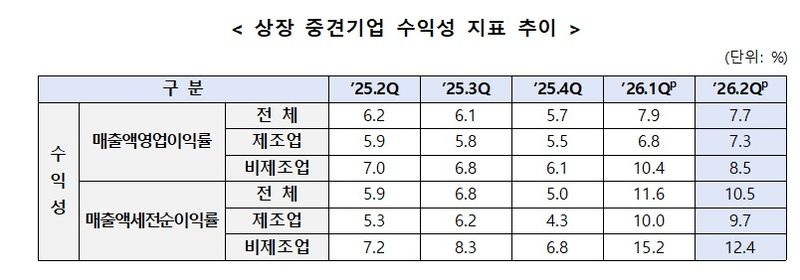
According to the ‘2026 Q2 Management Analysis of Listed Mid-sized Enterprises’ released by the Korea Federation of Mid-sized Enterprises on the 29th, the revenue growth rate of listed mid-sized companies was 9.2%, up 8.0 percentage points from the same period a year earlier. The total asset growth rate jumped 4.3 percentage points to 7.7%.
Revenue growth accelerated particularly sharply in the non-manufacturing sector. The revenue growth rate rose 10.5 percentage points from the same period a year earlier to 10.3%. The total asset growth rate also climbed 2.8 percentage points to 5.0%.
The manufacturing sector’s revenue growth rate jumped 6.9 percentage points to 8.7%. Its total asset growth rate rose 5.0 percentage points to 9.1%. The increase in current assets contributed to the rise, with quick assets and inventories growing by ₩16.0786 trillion and ₩5.8258 trillion, respectively.
The operating profit margin on revenue for all listed mid-sized companies rose 1.5 percentage points from the same period a year earlier to 7.7%. This was due to the cost-of-sales ratio falling from 78.4% to 77.1% and the selling, general and administrative expense ratio also declining, from 15.4% to 15.2%.
The operating profit margin rose by 1.5 percentage points to 8.5% in the non-manufacturing sector and by 1.4 percentage points to 7.3% in manufacturing. An increase in non-operating income, including foreign currency translation gains, lifted the overall pretax net profit margin on revenue by 4.6 percentage points to 10.5%. The margin rose by 5.2 percentage points to 12.4% in the non-manufacturing sector and by 4.4 percentage points to 9.7% in manufacturing.
Financial stability, however, weakened somewhat. The debt-to-equity ratio rose as current liabilities, including borrowings for investment and business operations, increased, despite growth in equity, including retained earnings.
The overall debt-to-equity ratio rose 2.2 percentage points from the same period a year earlier to 68.3%. It increased by 3.3 percentage points to 70.2% in manufacturing and by 0.1 percentage point to 64.6% in the non-manufacturing sector.
Reliance on borrowings remained at the same level as in the same period a year earlier, at 15.8%. It rose 0.6 percentage point to 17.4% in manufacturing, while falling 1.4 percentage points to 12.5% in the non-manufacturing sector.
Kim Hyun-chul, full-time vice chairman of the Korea Federation of Mid-sized Enterprises, said, “It is very encouraging that listed mid-sized companies maintained solid growth in the second quarter, following the first quarter, despite ongoing instability in the Middle East and supply chain instability. We will do our utmost to create a legal, institutional and policy environment that supports smooth financing and proactive investment, based on close communication with the government and the National Assembly, so that mid-sized companies can sustain a steady trend of improved performance.”
[email protected] Kim Hyun-chul Reporter