Rate of income-generating assets at four-year private universities falls below 100% again after a year
- Input
- 2026-10-29 12:00:00
- Updated
- 2026-10-29 12:00:00
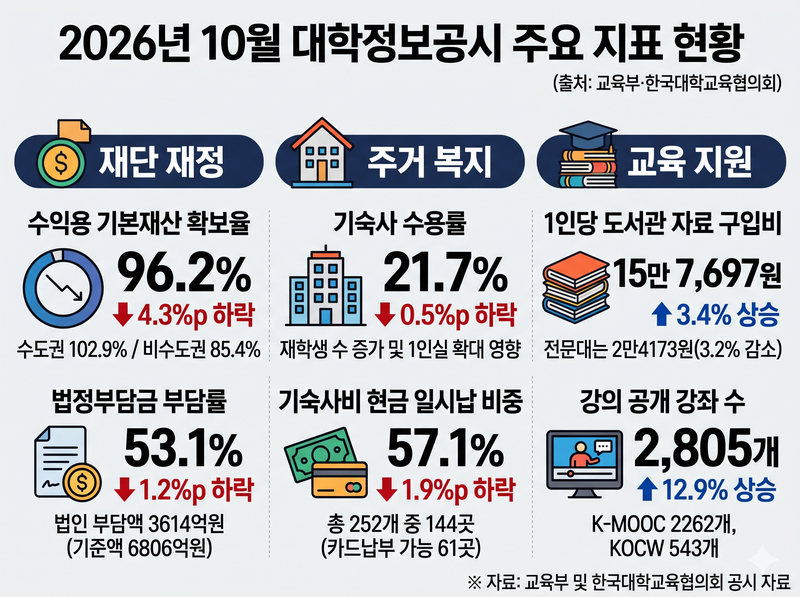
[Financial News] The rate at which foundations of four-year private universities secure the “basic property for income generation” they are required to hold to support school operations fell below 100% again after a year. Although the foundations’ assets increased, the benchmark amount—calculated based on tuition revenue and other factors—rose more sharply. The rate in the Seoul metropolitan area barely exceeded the benchmark, at 102.9%, while non-metropolitan universities recorded just 85.4%.
Payment options for dormitory fees, which directly affect student life, also remain limited. A survey found that six out of every 10 dormitories at four-year universities still do not accept card payments or installment payments, and allow students to pay their fees only in a single lump sum, such as by bank transfer.
According to an analysis of the October 2026 University Information Disclosure data released on the 29th by the Ministry of Education and the Korean Council for University Education, the rate at which foundations at 154 private four-year universities nationwide secured basic property for income generation this year was 96.2%, down 4.3 percentage points from 100.5% the previous year. The value of assets held by the foundations rose from 11.6 trillion won to 11.8 trillion won, but the required benchmark amount increased more sharply. The rate at universities in the Seoul metropolitan area was 102.9%, down 4.9 percentage points from 107.8% the previous year, while the rate at non-metropolitan universities was 85.4%, down 3.5 percentage points from 88.9%.
For fiscal 2025, the rate at which private university foundations covered their legally required contributions also fell 1.2 percentage points from the previous year, to 53.1%. Of the 680.6 billion won required for statutory contributions for faculty and staff, including contributions to the Teachers' Pension and health insurance premiums, the foundations paid 361.4 billion won, leaving them 319.2 billion won short of the required amount.
The dormitory occupancy rate at four-year universities this year fell 0.5 percentage points from the previous year, to 21.7%. The number of available beds increased from 342,117 to 344,730, but the number of enrolled students rose by more, from 1,543,351 to 1,591,070. The Ministry of Education also said that student preferences had led universities to increase the number of single rooms and reduce the number of multi-person rooms with four or more beds.
Dormitory fee payment options are gradually becoming more varied. Of the 252 dormitories at four-year universities, 61, or 24.2%, accept card payments, while 92, or 36.5%, allow cash payments in installments. Those figures were up by 8 and 13 dormitories, respectively, from the previous year. However, 144 dormitories, or 57.1%, accept payment only in a single lump sum, such as by bank transfer.
Meanwhile, in 2025, per-student spending on library materials rose 3.4% to 157,697 won at four-year universities, while it fell 3.2% to 24,173 won at junior colleges. Four-year universities disclosed 2,805 lecture courses, up 12.9% from the previous year. Completion rates for violence-prevention education rose from the previous year by 1.7 percentage points for faculty and staff, to 82.9%, and by 1.9 percentage points for enrolled students, to 60.2%.
[email protected] Kim Man-gi Reporter