“Swift Response to Digital Bank Runs” ... FSC Pushes to Revise Financial Firm Resolution System
- Input
- 2026-10-29 12:00:00
- Updated
- 2026-10-29 12:00:00
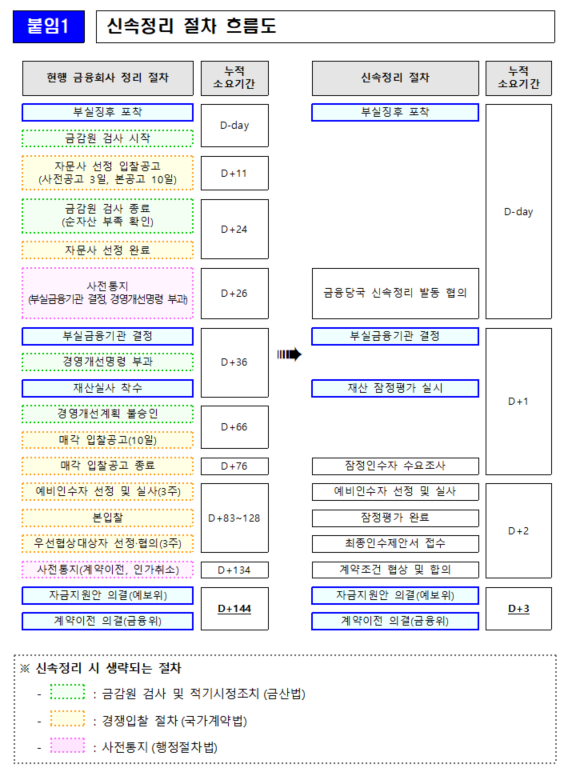
Drawing on the U.S. financial authorities’ response to the Silicon Valley Bank bank run, a system has been devised to compensate stakeholders for losses after the fact. The Financial Services Commission plans to consult with relevant ministries in the fourth quarter and pursue an amendment to the Act on the Structural Improvement of the Financial Industry as government legislation.
On the 29th, the Financial Services Commission said it would pursue the introduction of a “rapid resolution system for financial firms” to respond swiftly and proactively to the spread of financial distress. Last July, the FSC reported plans to introduce the system in a briefing on its work to the president. If adopted, the system would significantly simplify the resolution process for financial firms: procedures for resolving troubled or at-risk firms that currently take 144 days would be cut to 3–4 days. Various procedures involving the Financial Supervisory Service would be omitted.
The United States, the United Kingdom and other countries have introduced or overhauled rapid resolution systems for financial firms in response to the need to quickly contain systemic risks highlighted by events such as the Global Financial Crisis (GFC) and the Silicon Valley Bank (SVB) crisis. They established a legal basis for waiving procedures when necessary in the public interest during a crisis, and operate systems that enable them to stabilize financial markets in a short time through various resolution methods. In the 2023 SVB crisis in the United States, a bank run saw about 30% of deposits withdrawn in a short period. The U.S. and U.K. authorities completed rapid resolution procedures in four and three days, respectively, quickly calming market anxiety.
Under the Systemic Risk Exception (SRE), the FDIC can transfer assets and liabilities without a bidding process or due diligence. The United Kingdom and the EU have adopted procedural exemptions for rapid resolutions, including waiving bidding procedures, conducting preliminary due diligence and giving share transfers priority effect, as well as post-resolution loss compensation (NCWOL). The rapid resolution system also helped stabilize markets in the 2023 Credit Suisse (CS) crisis in Switzerland.
Under the current system for resolving financial firms in South Korea, however, the Act on the Structural Improvement of the Financial Industry and the Depositor Protection Act require supervisory authorities to take prompt corrective action and impose resolution measures in stages when a firm becomes insolvent. Due to the Financial Supervisory Service’s due diligence and the need to comply with various procedures, about 150 days elapse between detecting distress and deciding on a transfer of contracts. The FSC and the Korea Deposit Insurance Corporation believe these lengthy procedures drive up resolution costs. They also judged that the procedures could fuel market anxiety, citing a past savings bank crisis in which the scale of financial distress grew to about 1.2 times its previous level after a resolution decision was made.
The FSC is pursuing a system that would enable rapid resolution through early intervention before distress spreads and waivers of various legal procedures. The system would apply to banks eligible for support from the deposit insurance fund (excluding Nonghyup and Suhyup), insurers (excluding reinsurers), securities firms, savings banks and financial holding companies.
The rapid resolution system would be activated by a resolution of the Financial Services Commission in exceptional circumstances involving an insolvent or at-risk financial institution where there are concerns about systemic risk. There must be an urgent need, with a determination that existing measures such as prompt corrective action alone would not be sufficient to prevent systemic risk. The relevant agencies—including the FSC, the Ministry of Finance and Economy, the Financial Supervisory Service, the Korea Deposit Insurance Corporation and the Bank of Korea—would be consulted. The optimal resolution method could be selected from among various measures under the Act on the Structural Improvement of the Financial Industry, including suspending executives from their duties, appointing an administrator, suspending business, transferring contracts, arranging a third-party acquisition, cancelling or consolidating shares, and revoking licenses or approvals.
To ensure speed, various procedures would be waived, including bidding procedures under the National Contract Act, prior notice under the Administrative Procedures Act, and shareholder meeting and creditor protection requirements under the Commercial Act and the Act on the Structural Improvement of the Financial Industry. The Korea Deposit Insurance Corporation would conduct preliminary due diligence within 1–2 days, followed by a final post-resolution review. Merger review under the Monopoly Regulation and Fair Trade Act would also be waived, and the early termination and settlement of qualified financial transactions could be stayed for up to two business days.
To protect stakeholders, losses resulting from rapid resolution would be compensated afterward by the Deposit Insurance Fund, ensuring they are no greater than losses in liquidation or bankruptcy. After the resolution is completed, an external specialist institution would conduct a settlement review to calculate the losses, and a process would be established to compensate the difference. The FSC would also report resolution costs and the status of subsequent sales, among other matters, to the National Assembly’s Political Affairs Committee within six months of the date of the disposition.
[email protected] Park Mun-su Reporter