Jaw clicks every time you yawn... “How can you tell when a jaw sound is dangerous?” [Health Talk]
- Input
- 2026-10-29 11:12:08
- Updated
- 2026-10-29 11:12:08
[Financial News] Should a clicking sound in your jaw every time you yawn be treated? Specialists say it is fine to monitor if there is only a sound and no pain, but advise seeking medical care if the sound suddenly changes or if pain and limited mouth opening occur together.
Clicking is common... Degenerative changes can occur without pain
A common symptom of temporomandibular joint disorders is a clicking sound in front of the ear when opening or closing the mouth. Joint sounds are common, so if there is only a sound without pain or impaired function, treatment is not always necessary. A clicking sound does not necessarily lead to pain or limited mouth opening, either. Conversely, some people suddenly have difficulty opening their mouths without any sound.
Some patients experience limited mouth opening because of abnormal movement of the articular disc. They may have pain in front of the ear, at the temples or in the cheeks when moving the jaw or chewing, sometimes along with headaches or discomfort in the neck and shoulders.
Degenerative changes in the temporomandibular joint can progress without pain, so caution is warranted. Choi Eun-hye, a professor of oral medicine at Kyung Hee University Dental Hospital at Gangdong, said, “If the pattern of joint sounds suddenly changes, or if pain, changes in how widely the mouth opens, asymmetrical jaw movement, changes in the bite or discomfort when chewing occur together, it is advisable to seek medical care for an accurate diagnosis.”
The temporomandibular joint is where the lower jaw meets the skull, just in front of the ear. The articular disc and surrounding muscles move together to allow the mouth to open and food to be chewed. Because the joint is used very frequently in everyday activities such as speaking, chewing and swallowing, habits such as teeth grinding and clenching place additional strain on it.
Temporomandibular joint disorders are difficult to explain with a single cause. Biological factors such as trauma or systemic joint disease, behavioral factors such as clenching and teeth grinding, and sleep and stress all play a role. High stress can lead to more clenching or jaw tension and may also affect sleep. People with chronic temporomandibular joint pain may also experience anxiety or depression, sleep disorders, headaches, and neck or shoulder pain.
Diagnosis is based on a detailed medical history, questionnaires and a clinical examination. The clinician checks how widely the mouth opens, jaw movement, joint sounds, pain and tenderness in the surrounding muscles. If needed, panoramic X-rays or CT scans are used to assess the bones, while MRI is used to examine the articular disc and surrounding soft tissue. During the consultation, the clinician assesses not only the temporomandibular joint and chewing muscles but also sleep, stress, other pain and the impact on daily life to develop a treatment plan.
Treatment begins with the most conservative methods. Depending on the symptoms and diagnosis, options include lifestyle changes, exercise or physical therapy, medication and splint therapy. Medication can help control pain and inflammation, and adjunctive treatments such as botulinum toxin injections may be considered for some patients with muscular pain. If symptoms persist despite conservative treatment, joint lavage or other procedures may be considered; surgery is rarely necessary.
Avoid hard foods, resting your chin on your hand and chewing gum for a long time
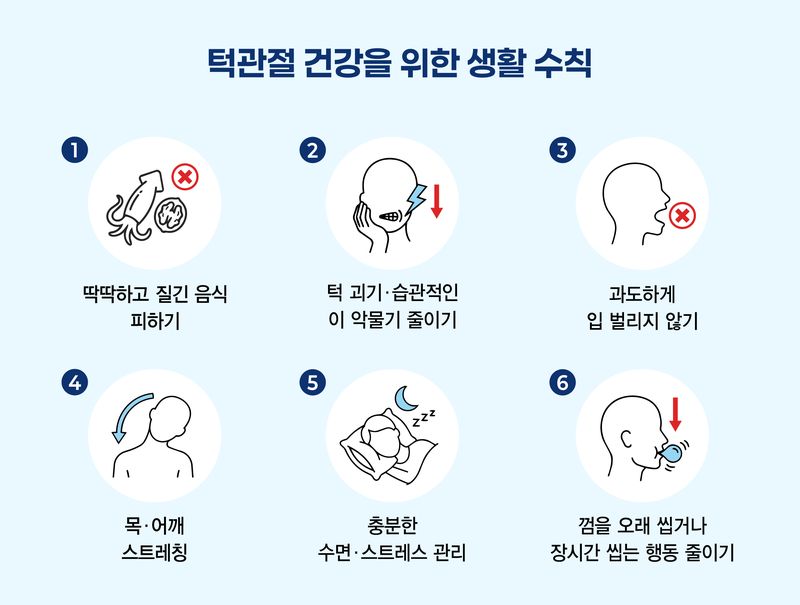
To protect the temporomandibular joint, avoid hard and chewy foods and reduce habits such as resting your chin on your hand or clenching your teeth. It is also best not to open your mouth excessively wide or chew gum for a long time. Stretching the neck and shoulders, getting enough sleep and managing stress can also help.
Professor Choi emphasized, “Even if the temporomandibular joint makes a sound, it can be monitored if there is no pain or impaired function. But if it is accompanied by pain or limited mouth opening, it is important to get an accurate diagnosis and appropriate treatment.”
[email protected] Jung Myung-jin, medical correspondent Reporter