President Lee: ‘Some policies for multicultural families must not become excessive privileges or lead to reverse discrimination against Korean families’
- Input
- 2026-10-29 10:44:48
- Updated
- 2026-10-29 10:44:48
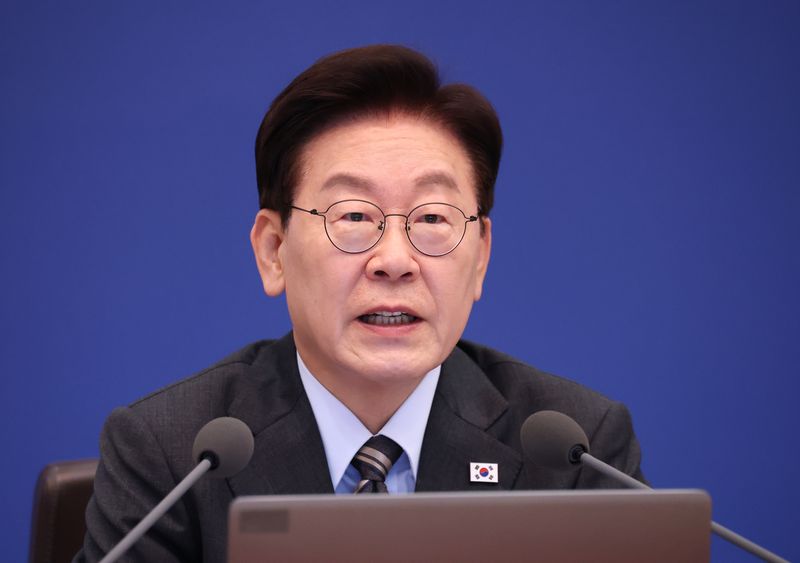
[Financial News] Lee Jae Myung said on the 29th, regarding policies supporting multicultural families, ‘Some policies must not go beyond their original purpose and become excessive, amounting to privileges or leading to reverse discrimination against Korean families.’ The point was that support to prevent discrimination against multicultural families should continue, while ensuring that policies do not lead to excessive benefits or reverse discrimination.
In a post on X (formerly Twitter) that day, President Lee said, ‘Ensuring that multicultural families are not discriminated against compared with Korean families is a necessary policy and should of course continue,’ while emphasizing this point.
President Lee explained, ‘The essence of an issue does not change depending on who points it out, nor should it. Excesses in a particular policy undermine trust in policy in general, so if there is a problem, it is right to correct it promptly, whoever raises it.’
He also stressed the principles governing support for socially vulnerable people. President Lee said, ‘The goal of support for socially vulnerable people is to make up for what falls short of the general average and restore equality, so it is essential to ensure that it does not become a privilege or unfair preferential treatment.’
He added, ‘Correcting excesses in some policies should not be mistaken for measures that foster general discrimination against or hatred of multicultural families.’
The remarks came amid questions about fairness in a system giving mothers from multicultural families preferential access to postpartum care centers. Earlier, on the 28th, President Lee shared a post on the FM Korea online community about preferential access to postpartum care centers for mothers from multicultural families, and said he would consider, among other things, whether the system should be abolished. Some labor and civic groups raised concerns that this could intensify discrimination and exclusion.
Cheong Wa Dae also stressed that the aim was not to eliminate support for multicultural families altogether. In a press notice, Kang Yoo-jung, Cheong Wa Dae’s senior presidential spokesperson, explained, ‘The proposal is not to end support for multicultural families, but to raise the fairness and rationality of priority access to postpartum care centers and improve the support system so that all families giving birth can find it acceptable.’
Im Ho-geun, Cheong Wa Dae’s secretary for population policy, also explained the reasoning behind efforts to improve the criteria for postpartum care center support. The aim is to review the relevant criteria with local governments so that mothers with greater support needs receive priority access, while ensuring that multicultural families receive all the support they need.
President Lee’s remarks are understood as recognizing the need to support multicultural families while underscoring that policies must be fair.
[email protected] Choi Jong-geun, Seong Seok-woo Reporter