Boosts Korean Search Performance... Kakao Corp. Unveils Two AI Models
- Input
- 2026-10-29 10:54:00
- Updated
- 2026-10-29 10:54:00
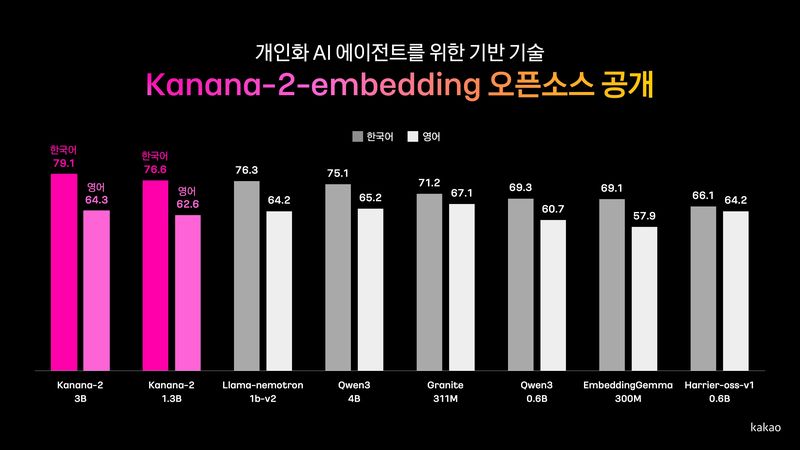
Industry sources said on the 29th that Kakao Corp. had introduced two embedding models, Kanana-2-Embedding, on the developer platform Hugging Face. The newly released models are Kanana-2-3B-Embedding, with 3 billion parameters, and Kanana-2-1.3B-Embedding, with 1.3 billion parameters. Following the release of four Kanana small language models (SLMs) last July, the company has expanded its technology based on its own language models.
Embedding is a technology that converts the meaning of text into numerical representations to find related information. Instead of searching for information that matches the exact words entered, it finds what is needed based on the semantic similarity between a question and the information. For example, when users look for a restaurant they mentioned in a past conversation, they can retrieve relevant information using semantically similar expressions such as “a quiet place” or “a restaurant good for conversation,” even if they cannot remember its exact name. It is a foundational technology that allows AI agents to use users’ past conversations and context to provide personalized responses.
According to Kakao Corp., in evaluations against publicly available embedding models of similar size, including Llama-Nemotron-Embed-1B-v2 and Qwen3-Embedding-4B, the two models had the strongest Korean-language performance, while their English-language performance was comparable. Their inference efficiency was also higher than that of Qwen3-Embedding. The company said it had improved search performance over its previous Kanana embedding models and confirmed efficiency gains of several dozen times or more in terms of memory usage and inference speed.
Kakao Corp. developed the 3-billion-parameter model by training its in-house small language model, Kanana-2-SLM, to apply its language-understanding capabilities to information retrieval. It then built the 1.3-billion-parameter model using knowledge distillation, a technique that transfers knowledge learned by a larger model to a smaller one.
The models also use the MRL technique, which adjusts the number of values used in an embedding vector. This allows developers to choose the vector size according to the needs of their service, including search accuracy, storage space and processing speed.
The two models are released under the Kanana Open License, which allows commercial use subject to its terms as well as research and development. Researchers and companies in Korea and abroad can evaluate the models themselves and use them to develop semantic search tools or personalized AI agents.
Kakao Corp. plans to continue research into embedding training and knowledge distillation based on larger language models and to develop models that improve both search performance and efficiency in practical use.
Noh Byeong-seok, performance lead for Kakao Corp.’s Unified Foundation Model, said, “For AI agents to provide users with the help they need, it is important not only to be able to answer questions but also to accurately find the necessary information among scattered information.” He added, “With this release, we will help researchers and developers use embedding technology with strengths in Korean across a range of services, and continue research to improve both search performance and efficiency.”
[email protected] Choi Hye-rim Reporter