Israeli election leaves no party with a majority; both sides determined to form the next government
- Input
- 2026-10-29 12:51:10
- Updated
- 2026-10-29 12:51:10
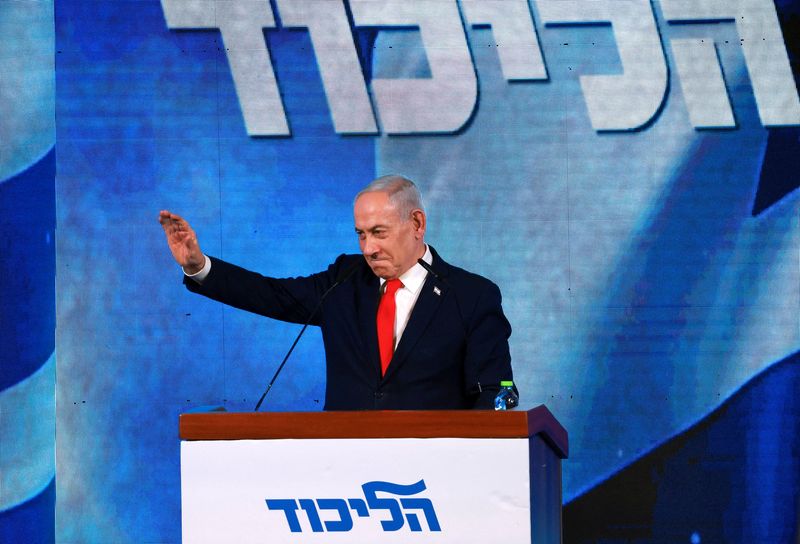
[Financial News] In Israel’s election held on the 27th (local time), the right-wing bloc led by Prime Minister Benjamin Netanyahu held a narrow lead but fell short of a majority. Netanyahu and the opposition are both seeking ways to form the next government, with Arab parties in Israel emerging as a pivotal factor holding the balance of power, AFP reported on the 28th.
This was the first election since the surprise attack by the Palestinian militant group Hamas on October 7, 2023, an attack that set the stage for Israel’s war in the Gaza Strip and surrounding areas.
Netanyahu, Israel’s longest-serving prime minister, who is allied with far-right and ultra-Orthodox Jewish parties, and former military chief of staff Gadi Eisenkot, who leads the opposition alliance, both expressed their determination to form the next government.
However, exit polls suggest that neither bloc is likely to secure the 61 seats needed for a majority in the 120-seat parliament. Netanyahu’s bloc is expected to win 53 seats, while the opposition led by Eisenkot is projected to take 48.
The final results may change, but the Arab parties in Israel are the group that has made the most notable gains, with their seat count expected to rise to 19.
President Herzog, who is responsible for deciding whom to assign the task of forming a government, stressed that everything possible must be done to avoid another election and urged each party to have an “open mind.”
Yousef Jabareen, leader of the left-leaning Arab party alliance Joint List, said the Israeli people had chosen a new leader, adding, “If you want to offer a substantive and genuine alternative to Netanyahu’s ‘blood-stained’ government, you will have to talk to us.” He added, “The question is whether racism, exclusion and supremacism will continue, or whether we will build a genuine Jewish-Arab partnership.”
But he later told AFP in an interview that he was willing to cooperate with an opposition-led government to oust Netanyahu, but had no intention of joining a coalition government directly.
Foreign media outlets report that Eisenkot might be able to sustain a minority government with temporary support from Arab lawmakers, but few observers expect such an arrangement to last long.
Arab voters, descendants of Palestinians who remained after Israel was established and who make up about 20% of the total population, turned out in unprecedented numbers in this election, angered by the Netanyahu government’s vision of an “ultranationalist Jewish state” for Israel and the Palestinian territories.
During the campaign, Netanyahu repeatedly stoked fears that Arabs might take power to rally his supporters. His party, Likud, accused the Arab party alliance of “stealing” the election. Likud claimed they had used “corruption, intimidation, violence, the spread of false information, and banned software” to boost turnout. It presented no concrete evidence but said it would submit evidence to the authorities.
Eisenkot and most of his close allies have refused to join forces with Arab lawmakers. But Yair Golan, leader of one of Israel’s major left-wing parties and a member of Eisenkot’s bloc, became the first to call for such an alliance.
Golan said on social media, “We must no longer tolerate Netanyahu’s racist divisiveness, which pits Jewish votes against Arab votes.”
With neither bloc securing a clear majority, negotiations to form a coalition government could take weeks, and another election may be held if the talks fail. “Perhaps everyone except the Arab parties lost this election. But it is unclear how the Arab parties can make use of this enormous success,” said Gideon Rahat, a political scientist at the Hebrew University of Jerusalem.
With more than 90% of the votes counted, the Central Elections Committee (CEC) said the count of regular ballots was not yet complete, while counting of “double-envelope” ballots began late. These include absentee ballots, many cast by Israel Defense Forces (IDF) soldiers, as well as ballots cast by prisoners, patients, medical workers and staff at diplomatic missions abroad.
[email protected] Yoon Jae-joon Reporter